

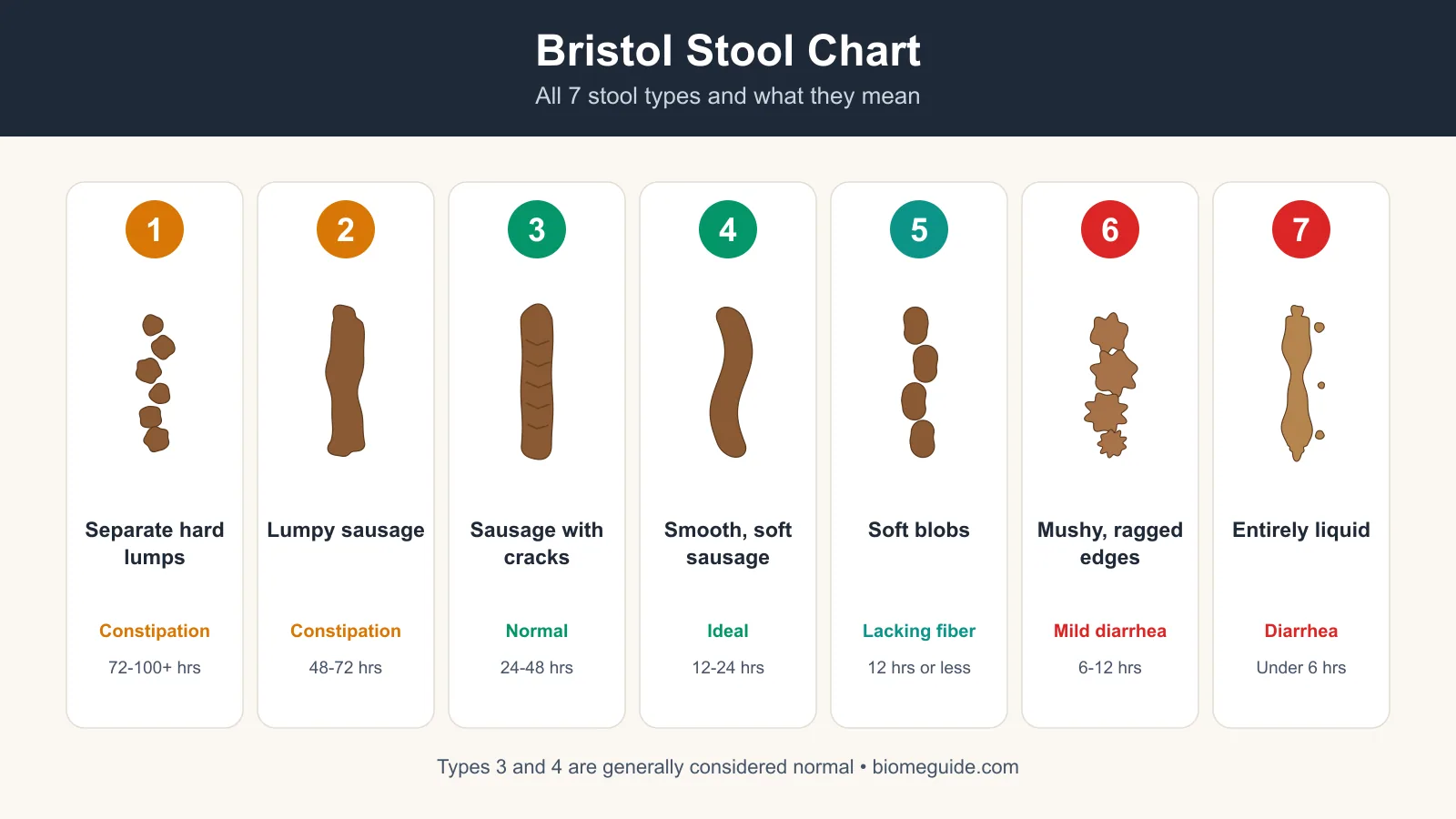
The Bristol Stool Chart is a medical tool that sorts stool — poop — into seven types by shape and consistency. Types 1 and 2 mean constipation, Types 3 and 4 are normal, Type 5 is borderline, and Types 6 and 7 mean diarrhea. Your type mostly reflects how long stool spent in your colon, which is why it is used as a practical stand-in for gut transit time.[1]
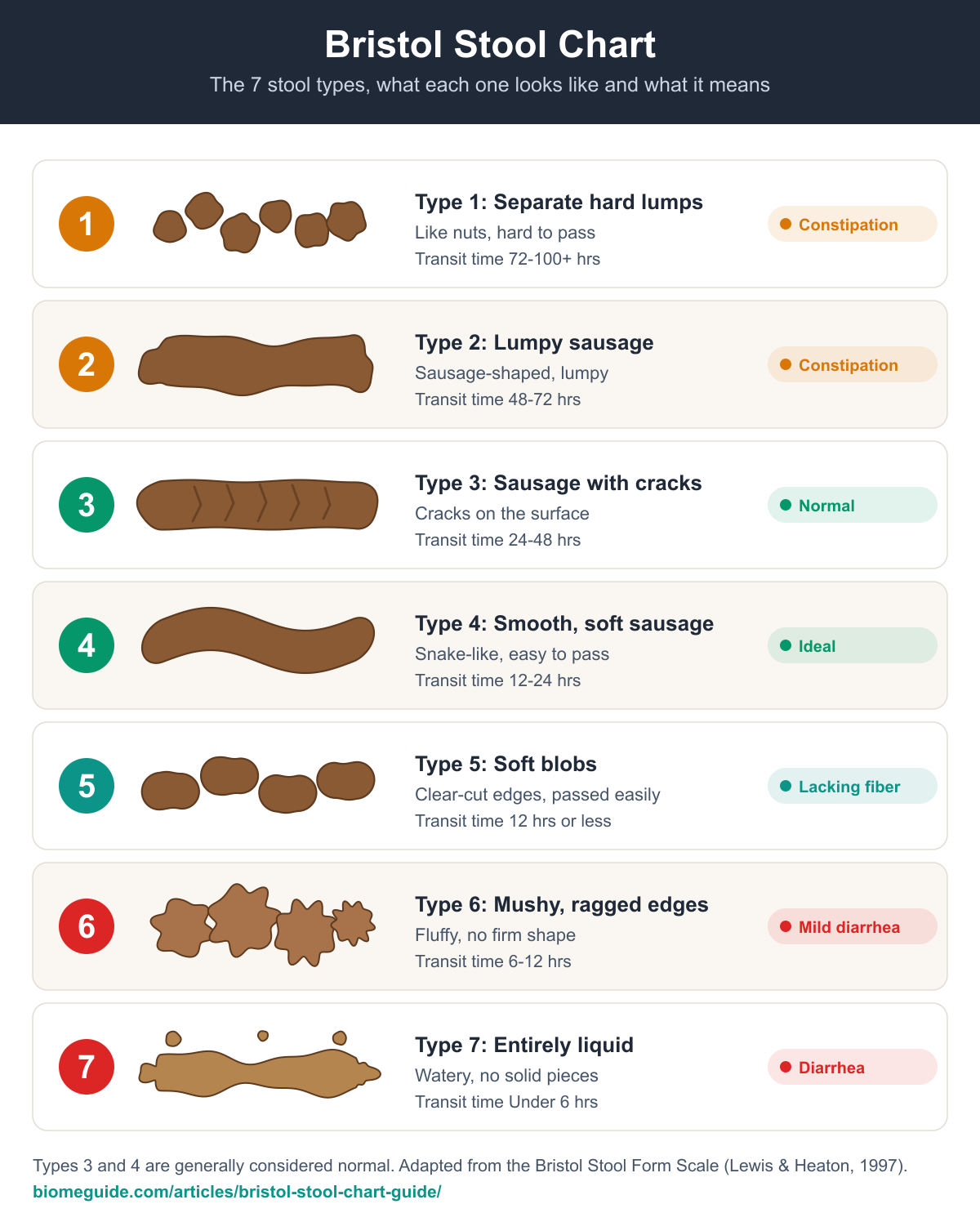
Bristol Stool Chart: all 7 types at a glance
Find your type in the table below, then jump to the full section for causes and what to do about it.
| Type | What it looks like | What it means | Typical transit | First thing to try |
|---|---|---|---|---|
| Type 1 | Separate hard lumps, like nuts | Severe constipation | 72–100+ hrs | Fluid first, then fiber — slowly |
| Type 2 | Sausage-shaped but lumpy | Constipation | 48–72 hrs | More fiber and daily movement |
| Type 3 | Sausage with surface cracks | Normal | 24–48 hrs | Keep doing what you're doing |
| Type 4 | Smooth, soft sausage or snake | Ideal | 12–24 hrs | Nothing — this is the target |
| Type 5 | Soft blobs with clear-cut edges | Borderline; often low fiber | ~12 hrs | Add bulking soluble fiber |
| Type 6 | Fluffy, mushy, ragged edges | Mild diarrhea | 6–12 hrs | Find the trigger; soluble fiber |
| Type 7 | Entirely liquid, no solid pieces | Diarrhea | Under 6 hrs | Rehydrate; check if it persists |
If you are here because of a color rather than a shape, skip to what stool color means — color is not part of the Bristol scale.
Medical Disclaimer: This article is for informational purposes only and does not constitute medical advice. While the Bristol Stool Chart is a useful reference tool, it is not a substitute for medical evaluation. Changes in bowel habits, blood in stool, unexplained weight loss, or persistent digestive symptoms should be discussed with a qualified healthcare provider.
What is the Bristol Stool Chart?
The Bristol Stool Chart — properly the Bristol Stool Form Scale (BSFS), and widely searched as the Bristol stool scale or the Bristol poop chart — is a seven-point visual scale that classifies stool by form and consistency alone. It was developed at the University of Bristol and published in 1997 by Dr Stephen Lewis and Dr Ken Heaton, who compared stool form against measured whole-gut transit time and found the two tracked closely.[1]
That is the whole idea behind it. Stool form is mostly a readout of how long the stool sat in the colon. The longer it stays, the more water the colon reabsorbs and the harder and more fragmented it becomes. The faster it moves, the less water is removed and the looser it arrives. The chart turns a vague, hard-to-discuss symptom into a single number a clinician can act on.
It is now used worldwide in gastroenterology clinics, in nursing and care records, in drug trials as an outcome measure, and as the basis for defining IBS subtypes.
What is normal on the Bristol Stool Chart?
Types 3 and 4 are the normal range, and Type 4 is generally described as ideal. In practice most clinicians treat Types 3 to 5 as acceptable, provided stool is comfortable to pass and your own pattern is stable.
Three things define "normal" together, and no single one of them is enough:
- Form — mostly Types 3–5, with occasional excursions either side
- Frequency — anywhere from three times a day to three times a week
- Effort — passed without straining, urgency, or a feeling of incomplete emptying
The last point is the one people most often miss. A daily Type 2 that requires straining is not "regular"; an every-other-day Type 4 that takes ten seconds is closer to normal. Frequency alone is a poor guide.
Consistency over time also matters more than any single day. Stool form moves around with meals, travel, sleep, hydration, hormones and stress. A week of records is far more informative than one observation — which is why clinicians ask for a stool diary rather than a description.
Type 1: separate hard lumps, like nuts
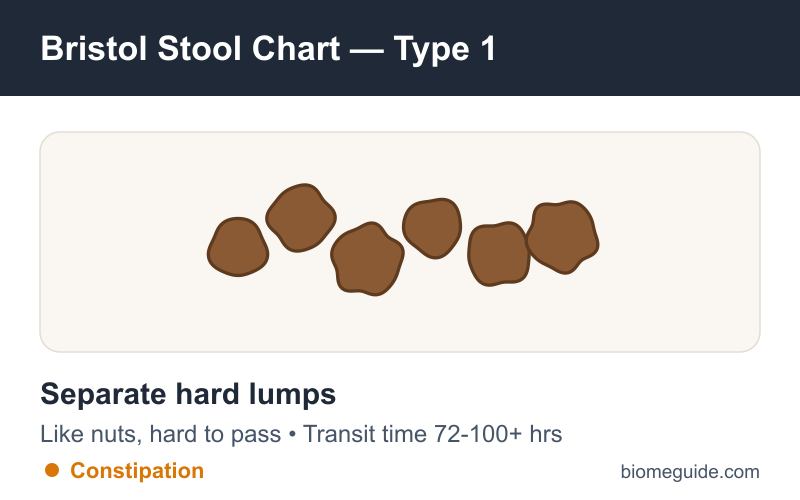
What it looks like: Small, hard, separate pellets that are difficult and often painful to pass. They may come out one at a time.
What it means: Severe constipation with a very slow transit time — often 72 to 100+ hours. The stool has spent so long in the colon that most of its water has been reabsorbed and the mass has broken into fragments.
Common causes: Very low fiber intake, dehydration, a sedentary routine, repeatedly ignoring the urge to go, pregnancy, hypothyroidism, and medications — opioids in particular, but also iron supplements, some antacids, anticholinergics and certain antidepressants. Slow-transit constipation and pelvic floor dysfunction are less common but real causes.
How to fix it: Address fluid before fiber. Adding bulk to a dehydrated colon can make Type 1 worse rather than better. Once fluid intake is adequate, increase fiber gradually — a sudden jump usually produces gas and cramping and gets abandoned. Gel-forming soluble fibers such as psyllium husk hold water in the stool and are generally better tolerated here than coarse bran. Daily walking helps motility, and reviewing any constipating medication with your prescriber is often the single highest-yield step. Certain probiotic strains have modest evidence for improving stool frequency and consistency in functional constipation.[2]
When to get it checked: Type 1 that does not respond to dietary change over a few weeks, or that is new, painful, or accompanied by blood, weight loss or vomiting. See the full constipation overview and the probiotics for constipation evidence review.
Type 2: sausage-shaped but lumpy
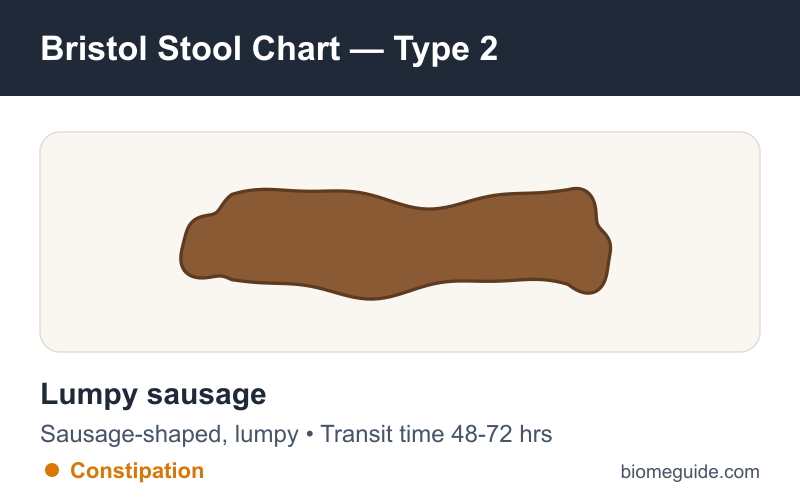
What it looks like: A single large, firm mass with a visibly lumpy surface — Type 1 pellets compacted together rather than separated.
What it means: Constipation, less severe than Type 1 but still slower than ideal, typically 48 to 72 hours. This is the common "a bit blocked up" presentation, and the type commonly associated with straining and hemorrhoids.
Common causes: Insufficient fiber, inadequate hydration, low physical activity, suppressing the urge to defecate, irregular meal timing, and travel. It is also the dominant stool form in IBS with constipation (IBS-C).
How to fix it: The same levers as Type 1, applied earlier. Build total fiber gradually toward 25–35 g a day from varied plant sources rather than a single supplement, drink enough for that fiber to gel, and move daily. Do not ignore the urge — repeatedly suppressing it desensitizes the rectum's stretch receptors over time and makes the pattern self-reinforcing. A structured approach is set out in the gut restoration protocol.
When to get it checked: Persistent Type 2 with abdominal pain, bloating that does not settle, or any bleeding on passing stool.
Type 3: sausage-shaped with surface cracks
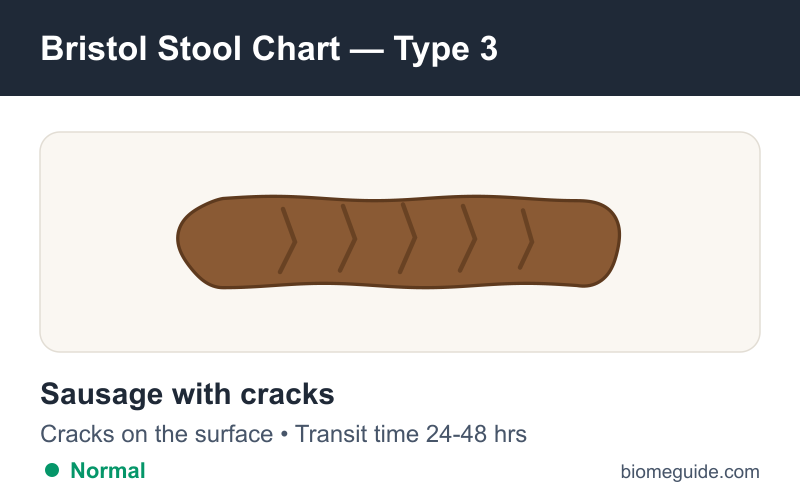
What it looks like: A formed, sausage-shaped stool with visible cracks along the surface. Holds together and passes without effort.
What it means: Normal. A transit time of roughly 24 to 48 hours with adequate fiber and fluid. The surface cracks simply indicate slightly firmer stool than Type 4 — they are not a problem.
Common causes: This is what a typical mixed diet with reasonable fiber and hydration produces. Nothing needs explaining.
How to fix it: Nothing to fix. If you would prefer the slightly softer Type 4, a modest increase in fluid or in soluble fiber usually gets you there.
When to get it checked: Type 3 on its own is not a concern. Pain, blood or mucus alongside a normal-looking stool still warrants evaluation — form is only one signal.
Type 4: smooth, soft sausage or snake
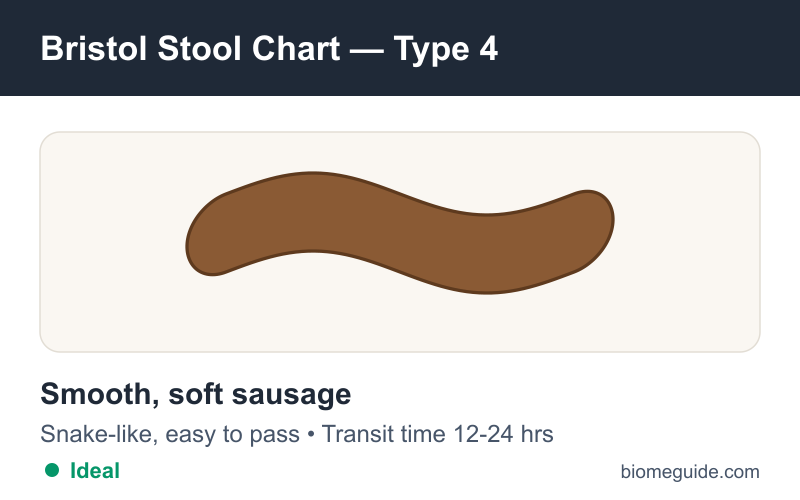
What it looks like: Smooth, soft and elongated, like a snake. Holds its shape, passes in one piece, requires no straining and leaves little residue.
What it means: Ideal. A colonic transit time of roughly 12 to 24 hours with balanced water content — the result of enough fiber, enough fluid, regular movement and a stable routine acting together. Type 4 is the usual target in symptom diaries and in clinical trials of bowel therapies.
Common causes: Type 4 is not caused by any one thing. It is what happens when four inputs are simultaneously adequate:
- Fiber — roughly 25–35 g daily from varied plant sources. Variety matters as much as quantity: different fibers feed different bacteria, and the by-products of that fermentation are part of what keeps the colonic environment working properly.[3]
- Fluid — enough that fiber can form a gel rather than a plug. Fiber without water reliably produces Type 1 or 2.
- Movement — physical activity stimulates colonic motility directly.
- Rhythm — consistent meal times, and not suppressing the urge to go.
How to get to Type 4, from either direction:
- Coming from Types 1–2: fix fluid first, then add gel-forming soluble fiber gradually over two to three weeks. Review constipating medications with your prescriber.
- Coming from Types 5–6: add soluble fiber to absorb excess water and slow transit, and work on identifying dietary triggers. Soluble fiber can help normalize stool form in both directions, which is what makes it one of the more broadly useful single changes on this page.[3]
- Either way: expect one to three weeks, not days. Bowel habit lags dietary change, which is why short experiments so often look like failures.
When to get it checked: Type 4 with persistent pain, bleeding, urgency or weight loss still needs evaluation. A normal stool form does not rule out disease.
Type 5: soft blobs with clear-cut edges
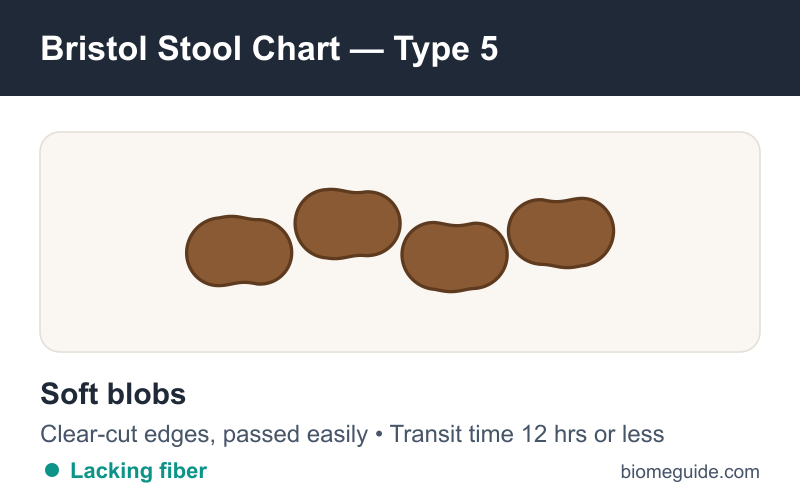
What it looks like: Soft, separate pieces that still hold a defined shape with clean edges. Passed easily, usually without urgency.
What it means: Transit slightly faster than ideal — around 12 hours or less — so the stool left the colon before it fully consolidated. Type 5 sits on the border between normal and loose. On its own it is not diarrhea, and an occasional Type 5 is unremarkable. Persistent Type 5, however, is often an early signal that something in the diet or routine is off.
Common causes:
- Not enough fiber to add bulk — commonly the explanation. Without sufficient fiber the stool has less to bind it into a single mass.
- Caffeine and alcohol, both of which accelerate colonic transit
- Large or high-fat meals, which trigger a stronger gastrocolic reflex
- Stress and poor sleep, acting on motility through the gut-brain axis
- Recent antibiotics or a recent gut infection, while the microbial community re-establishes
- Mild intolerances — lactose, fructose, or sugar alcohols (sorbitol, mannitol, xylitol) in "sugar-free" products
- Mixed-type IBS, where Type 5 alternates with firmer stools
How to fix it: Add bulk rather than removing food. Increase soluble, gel-forming fiber — psyllium is the best-studied option — which absorbs excess water and consolidates soft blobs into a formed stool.[3] Then look for the accelerator: drop caffeine for a week and see what changes, then alcohol, then sugar alcohols. If Type 5 followed a course of antibiotics or a stomach bug, it commonly settles over a few weeks as the microbiome recovers; probiotics for regularity covers what the evidence supports during that window.
When to get it checked: Type 5 persisting beyond two to three weeks despite more fiber, or accompanied by urgency, night-time bowel movements, weight loss, blood, or a family history of bowel disease. Looseness that consistently follows dairy points toward lactose intolerance; after gluten-containing foods, toward celiac disease.
Type 6: fluffy, mushy pieces with ragged edges
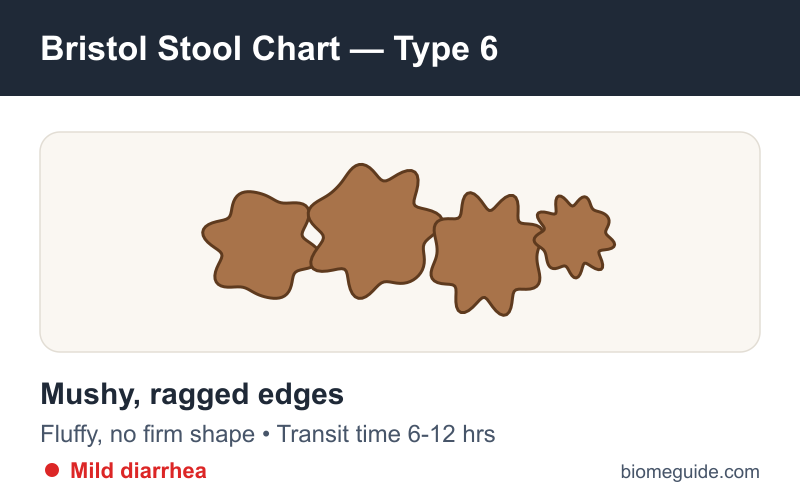
What it looks like: Mushy, fluffy pieces with ragged, indistinct edges and no firm shape. Usually accompanied by urgency.
What it means: Mild diarrhea. Transit has accelerated to roughly 6 to 12 hours and the colon has not had time to absorb water normally. Unlike Type 5, Type 6 is classed as abnormal, and if it persists it is worth investigating rather than simply managing with fiber.
The difference from Type 5 is the edges. Type 5 pieces are soft but discrete; Type 6 pieces have lost their boundaries. Type 6 also usually brings urgency, which Type 5 does not.
Common causes:
- Gut infections — viral, bacterial or parasitic, including traveler's diarrhea
- Food intolerances — lactose, fructose, or broader FODMAP sensitivity
- Sugar alcohols and artificial sweeteners in sugar-free gum, sweets and drinks
- Medications — antibiotics, metformin, magnesium-containing supplements, some antidepressants and NSAIDs
- Excess caffeine or alcohol
- IBS with diarrhea (IBS-D) and flares of inflammatory bowel disease
- Bile acid malabsorption, an under-recognized and specifically treatable cause of persistent Type 6–7 stools
- Stress, which shortens transit through the gut-brain axis
How to fix it: First, remove the obvious accelerators for a week — caffeine, alcohol, sugar alcohols, very high-fat meals. Second, add soluble fiber, which absorbs water and firms loose stool.[3] Third, keep a food-and-stool diary; Type 6 is far easier to solve with two weeks of written records than from memory. If it began with antibiotics or an infection, the evidence for specific probiotic strains in shortening diarrhea is summarized in probiotics for diarrhea — Saccharomyces boulardii is the most studied. Persistent Type 6 alongside bloating may point toward SIBO; the SIBO and IMO protocol covers assessment.
When to get it checked: More than two weeks of Type 6, or any Type 6 with blood, fever, night-time stools that wake you, unexplained weight loss, or onset after travel or hospital antibiotics.
Type 7: entirely liquid, no solid pieces
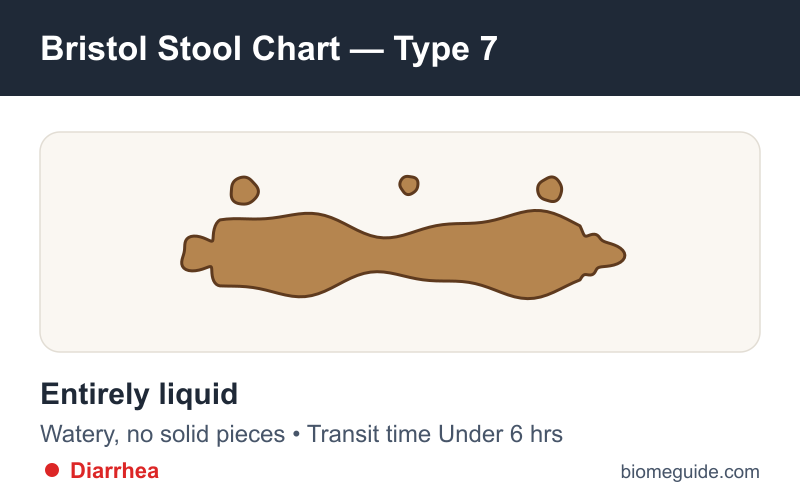
What it looks like: Watery, with no solid pieces at all.
What it means: Diarrhea. Transit under about six hours, with essentially no water absorption in the colon. Acute Type 7 is most often infectious or food-related and resolves within a few days. Chronic Type 7 is not something to manage at home.
Common causes: Gastroenteritis and food poisoning; C. difficile infection after antibiotics; IBS-D; inflammatory bowel disease; celiac disease; bile acid malabsorption; and osmotic causes such as large doses of magnesium or sugar alcohols.
How to fix it: Rehydration is the priority — plain water alone does not replace the sodium and potassium lost, so oral rehydration solutions are preferable during an acute episode. Reintroduce bland, low-fat food as tolerated. Do not start high-dose fiber supplementation mid-episode; wait until stools begin to form. Prolonged diarrhea also disrupts the microbial community itself, flushing out resident bacteria and altering the colonic environment.[4] See the full diarrhea overview.
When to get it checked: Seek care for Type 7 lasting more than 48 hours in an adult — sooner in children, older adults, or anyone immunocompromised — or at any point with blood, black stools, high fever, severe abdominal pain, signs of dehydration, or recent antibiotic use.
Is there a Type 8 on the Bristol Stool Chart?
No. The Bristol Stool Form Scale has exactly seven types. There is no Type 8, and no Type 0. Type 7 — entirely liquid — is the loosest form the scale describes, and Type 1 is the hardest.
People search for a "Type 8" for a reason, though, and it is usually one of these:
- A color change — black, pale, yellow, green or red stool. The Bristol scale ignores color entirely. See what stool color means.
- Mucus, blood or undigested food in the stool. Also outside the scale, and worth reporting to a clinician directly rather than trying to fit onto a form chart.
- Stool that is very narrow or ribbon-like. Calibre is a separate observation from form, and a persistent, new change in stool calibre should be assessed.
- Confusion with a different scale. Pediatric and modified adult scales exist, and some care settings use their own charts — but the Bristol scale itself stops at 7.
If what you are seeing does not fit on the chart, that is useful information in itself. Describe it in words rather than forcing a number.
What stool color means
Color is not part of the Bristol Stool Chart, but it is the other half of what people are actually looking at — and unlike form, a few colors are genuine red flags. Normal stool is brown because bile pigments are chemically modified as they pass through the colon.
| Color | Common benign explanations | When it matters |
|---|---|---|
| Brown | Normal | — |
| Green | Fast transit, leafy greens, food coloring, iron supplements | Persistent green with looseness is worth mentioning |
| Yellow, greasy, floats | A very high-fat meal | Persistent — possible fat malabsorption (celiac, pancreatic) |
| Pale, clay or white | Barium after imaging; some antacids | Assess promptly — may mean bile is not reaching the intestine |
| Black, tarry, sticky | Iron supplements, bismuth, licorice, blueberries | Assess promptly — may indicate upper-GI bleeding |
| Red or blood-streaked | Beetroot, tomato, red food coloring; hemorrhoids or a fissure | Assess — do not assume hemorrhoids without evaluation |
The practical rule: brown, green and yellow are usually about transit and diet. Pale, black and red are about whether blood and bile are where they should be — and those three deserve a clinician's opinion rather than a chart. Record color separately from your Bristol type; the two answer different questions.
Using the Bristol Stool Chart to track IBS
The Bristol scale is not merely useful in IBS — it is how IBS is divided into subtypes. Under the Rome IV criteria, subtyping is based on the proportion of abnormal bowel movements, assessed on days without medication:[5]
| Subtype | Bristol pattern | Usual direction of treatment |
|---|---|---|
| IBS-C (constipation-predominant) | Mostly Types 1–2 | Soluble fiber, osmotic agents, prescribed secretagogues |
| IBS-D (diarrhea-predominant) | Mostly Types 6–7 | Trigger removal, soluble fiber, antidiarrhoeals |
| IBS-M (mixed) | Substantial amounts of both | Treat the dominant symptom in each phase |
| IBS-U (unclassified) | Meets IBS criteria but fits none of the above | Individualised |
Two points are easy to get wrong. First, only abnormal stools count toward the proportions — Types 3, 4 and 5 are excluded from the calculation. Second, a subtype describes a period of time, not a day: people move between subtypes, and IBS-M is common precisely because of that.
How to keep a useful record: log the Bristol type of every bowel movement for two to four weeks alongside abdominal pain (0–10), bloating, urgency, and what you ate. Then look at the proportions, not individual days. That record is what lets a gastroenterologist choose a direction, and it is far more useful than a description from memory at an appointment. Dietary and probiotic strategies by subtype are covered in the IBS protocol and in best probiotic strains for IBS.[6]
How clinicians chart and score stool form
In clinical practice the Bristol type is recorded as a single ordinal number from 1 to 7 for each bowel movement — not averaged, and not treated as a score with arithmetic meaning. A "Bristol 6" is a description, not a measure of severity.
Where it is used:
- Stool diaries. One to two weeks of daily entries: date, time, Bristol type, effort, and any pain or blood. This is the standard request before a gastroenterology appointment.
- Transit assessment. The original validation compared stool form against measured whole-gut transit time, which is why the scale works as a cheap surrogate for a formal transit study.[1]
- Rome IV subtyping. The proportions of Types 1–2 and 6–7 among abnormal stools drive the IBS subtype.[5]
- Trial endpoints. Stool consistency by Bristol type is a standard outcome measure in constipation and diarrhea trials, including probiotic studies.[2]
- Nursing and care records. Widely used in inpatient and long-term care charting to track bowel function without ambiguous descriptions.
If you are asked to "chart your Bristol scores," what is being requested is that daily log — one number per bowel movement across one to two weeks — not a single average.
What your stool type says about your microbiome
A landmark study published in Gut found that stool consistency, measured with the Bristol Stool Chart, was one of the strongest covariates of gut microbiome composition — more strongly associated than body mass index, age, or most other measured variables.[4]
Key findings:
- Higher microbiome richness — more bacterial species — was associated with Types 3 and 4, the normal range
- Lower diversity was observed at both extremes, in very hard and in very loose stools
- Transit time changes bacterial growth rates. Slow transit gives bacteria more time to ferment, but also lets certain species dominate; very fast transit flushes bacteria out before populations establish
A large population-level analysis independently confirmed stool consistency as a leading factor explaining microbiome variation between individuals.[7]
The practical implication: normalizing stool form is not only about comfort. It is one of the few levers on this page that is associated with a more diverse microbial community — and it is measurable at home, which is more than can be said for most microbiome interventions. If you want objective data alongside a stool diary, see the microbiome testing guide.
Limitations of the Bristol Stool Scale
The chart is genuinely useful, but it is a narrow instrument and it is often over-read.
- It measures form only. Frequency, volume, urgency, pain, blood, mucus and color are all clinically important, and none of them appear on the scale.
- Agreement is imperfect. Even experienced gastroenterology clinicians do not always assign the same type to the same stool, and agreement drops further when the seven types are collapsed into the broader constipation and diarrhea categories used in the Rome criteria. In the study that tested this, disagreement clustered at the boundaries — Type 2 versus Type 3, and Type 5 versus Type 6.[8]
- It was validated in adults. It performs less reliably in infants and young children, whose normal stool form differs substantially by age and feeding.
- A single reading means little. Form varies day to day with diet, travel, hydration, sleep and hormonal cycles. Proportions over a week or more carry the information; one observation does not.
- It cannot diagnose anything. Type 1 does not mean you have a motility disorder, and Type 7 does not mean you have inflammatory bowel disease. The chart describes a symptom; it does not identify a cause.
- It lags behind what you changed. The gap between a dietary change and a change in stool form is typically one to three weeks.
Treat it as a shared vocabulary and a tracking tool, not a diagnostic test.
Printable Bristol Stool Chart
The full seven-type chart above is a high-resolution image (1200 × 1496 px) that can be opened, saved and printed at A4 or Letter size — for a bathroom door, a clinic room, a care record, or the front of a symptom diary. It shows each type's illustration, description, typical transit time and category.
If you are printing it to track symptoms rather than just to identify a type, add these columns beside it and fill in one row per bowel movement:
| Date | Time | Bristol type (1–7) | Notes (pain, urgency, blood, food) |
|---|---|---|---|
Two weeks of that record is worth more at an appointment than any description from memory, and it is exactly the format a gastroenterologist will ask for.
How to improve your stool quality
If you tend toward Types 1–2 (constipation)
Increase fiber gradually. Aim for 25–35 g daily from diverse sources, added over two to three weeks rather than overnight. Particularly useful for constipation:
- Psyllium husk — forms a gel and improves stool water content
- Prunes and prune juice — contain sorbitol, a natural osmotic laxative
- Ground flaxseed
- Legumes and whole grains
More options are covered in the prebiotic foods guide and the prebiotic fiber reference.
Hydrate adequately. Fiber needs water to work; without it, more fiber makes Type 1 worse.
Move regularly. Physical activity stimulates colonic motility. Daily walking is enough to make a measurable difference for many people.
Consider probiotics. A meta-analysis found that certain probiotics — particularly Bifidobacterium lactis strains — modestly improved stool frequency and consistency in adults with functional constipation.[2] Which strains have trial data is covered in probiotics for constipation.
Don't ignore the urge. Repeatedly suppressing it desensitizes the rectum's stretch receptors and reinforces the pattern.
If you tend toward Types 5–7 (loose stools)
Identify triggers. The usual list: lactose, fructose, caffeine, alcohol, sugar alcohols (sorbitol, mannitol, xylitol) and high-fat meals.
Keep a food-and-stool diary. Two weeks of records solves more of these than any supplement.
Add soluble fiber. Soluble fiber normalizes stool in both directions — bulking loose stools and softening hard ones.[3]
Evaluate for intolerances. If looseness persists, consider lactose intolerance, celiac disease or fructose malabsorption; persistent bloating alongside loose stools may point toward SIBO.
Manage stress. The gut-brain connection means stress and anxiety directly alter gut motility and can shorten transit.
Try probiotics selectively. Some strains, particularly Saccharomyces boulardii, have evidence for reducing diarrhea duration in specific contexts — see probiotics for diarrhea.
For everyone: holding Types 3–4
- Diverse fiber intake — 25–35 g daily from multiple plant sources[3]
- Adequate hydration — enough that fiber gels rather than plugs
- Regular physical activity — at least 150 minutes of moderate exercise weekly
- Stress management — the gut-brain axis meaningfully influences bowel function
- Consistent meal timing — regular eating patterns support regular bowel patterns
- Fermented foods — yogurt, kefir, kimchi and sauerkraut support microbial diversity
For structured plans, explore the digestive health goals hub, the gut restoration protocol, and signs of poor gut health.
When to see a doctor
Most variation in stool form is diet, hydration, stress, or a temporary illness. These features are different, and warrant evaluation rather than home management:
- Blood in stool — bright red, or dark and tarry
- Persistent change in bowel habit lasting more than 2–3 weeks without an obvious dietary cause
- Unexplained weight loss alongside bowel changes
- Chronic Type 1 or Type 7 that does not respond to dietary adjustment
- Severe abdominal pain with bowel changes
- Consistently narrow, pencil-thin stools — as a new change
- Night-time bowel movements that wake you from sleep
- New bowel habit changes after age 45–50 — the age at which colorectal screening is recommended
- Mucus or pus in stool
- Pale, clay-colored, or black tarry stool — see what stool color means
These can indicate anything from IBS to inflammatory bowel disease, celiac disease, infection, or — uncommonly — colorectal cancer. Most turn out to be benign. Early evaluation is still what makes the difference in the cases that are not.[6]
The bottom line
The Bristol Stool Chart is a simple, validated shorthand for something otherwise hard to describe. Types 3 and 4 are the target, and getting there runs through the same four inputs every time: enough fiber from varied sources, enough fluid to make that fiber work, daily movement, and a stable routine. Type 5 usually means not enough bulk. Types 6 and 7 mean something is accelerating transit, and deserve a trigger hunt rather than more fiber alone.
Two caveats are worth keeping. The chart describes form only — color, blood, mucus and pain are separate signals and matter at least as much. And a single reading tells you very little: it is the pattern across a week or two that carries the information. Persistent deviations, particularly with pain, blood, weight loss, or any new change after age 45–50, deserve a clinician's assessment rather than another dietary experiment.
Frequently Asked Questions
What is normal on the Bristol Stool Chart?
Types 3 and 4 are the normal range on the Bristol Stool Chart, and Type 4 — a smooth, soft sausage — is usually described as ideal. Many clinicians treat Types 3 to 5 as acceptable if stool is comfortable to pass and your pattern is stable. Normal frequency ranges from three times a day to three times a week. What matters most is consistency over time: a stable pattern within Types 3–5 is more reassuring than hitting Type 4 on any single day.
What does Type 5 stool mean and what causes it?
Type 5 is soft blobs with clear-cut edges that pass easily. It sits at the border between normal and loose, and usually reflects slightly faster transit than ideal — the stool left the colon before it fully consolidated. The most common cause is simply not enough fiber to add bulk and structure. Other contributors include high caffeine or alcohol intake, large or high-fat meals, stress, recent antibiotics, and mild food intolerances. Occasional Type 5 is not a concern. Persistent Type 5 alongside urgency, cramping or weight loss is worth discussing with a healthcare provider.
What does Type 6 stool mean?
Type 6 is fluffy, mushy stool with ragged edges and no firm shape. It indicates accelerated transit with incomplete water absorption — mild diarrhea. Common causes include gut infections, food intolerances such as lactose or fructose, artificial sweeteners like sorbitol, excessive caffeine or alcohol, stress, medication side effects, and flares of IBS-D or inflammatory bowel disease. A day or two of Type 6 after a rich meal or a stressful week is common. Type 6 lasting more than two weeks, or occurring with blood, fever, night-time stools or weight loss, needs medical evaluation.
What causes Type 4 stool, and how do I get to Type 4?
Type 4 stool reflects a colonic transit time of roughly 12 to 24 hours with balanced water content — the result of adequate fiber, adequate fluid, regular movement and a stable routine. To move toward Type 4, most people benefit from raising total fiber gradually toward 25–35 grams a day from varied plant sources, drinking enough that fiber can form a gel rather than a plug, walking daily, and eating and going to the toilet at consistent times. Soluble fibers such as psyllium are useful in both directions because they hold water in the stool, firming loose stools and softening hard ones. Changes usually take one to three weeks, not days.
What is the difference between Type 5 and Type 6?
Type 5 pieces still have clear-cut edges and hold their shape — they are soft but discrete. Type 6 pieces have ragged, indistinct edges and no firm shape at all, and typically come with more urgency. Type 5 is generally treated as borderline normal and often responds to more fiber. Type 6 is classed as mild diarrhea and points more toward accelerated transit from an infection, an intolerance, a medication, or an IBS or inflammatory bowel flare.
Is there a Type 8 on the Bristol Stool Chart?
No. The Bristol Stool Form Scale has exactly seven types, from Type 1 to Type 7, and there is no Type 8 or Type 0. Type 7 — entirely liquid with no solid pieces — is the loosest form on the scale. If you are searching for a Type 8 because your stool seems to fall outside the scale, what you are probably describing is a color or content change rather than a form change: mucus, blood, undigested food, or very pale or black stool. Those features are not captured by the Bristol scale at all and should be described to a healthcare provider directly.
What does stool color mean?
Normal stool is brown, from bile pigments processed by gut bacteria. Green can follow fast transit, leafy greens or iron supplements. Yellow, greasy, foul-smelling stool that floats can suggest fat malabsorption, as in celiac disease or pancreatic conditions. Pale, clay-colored or white stool can indicate that bile is not reaching the intestine and should be assessed promptly. Black, tarry stool may indicate bleeding higher in the digestive tract, though iron supplements and bismuth medicines also darken stool. Red streaks or blood can come from hemorrhoids or a fissure, but also from more serious causes. Color is not part of the Bristol scale, so record it separately.
What are the limitations of the Bristol Stool Scale?
The scale describes stool form only — it says nothing about frequency, volume, urgency, color, blood, mucus or pain, all of which matter clinically. Agreement between clinicians on the exact type is imperfect, and reliability drops further when types are collapsed into broader categories such as the Rome constipation and diarrhea groupings. It was developed and validated mainly in adults, so it is a weaker tool in infants and young children. A single reading is also a poor guide: stool form varies day to day, so a week of records is far more informative than one observation.
How do you use the Bristol Stool Chart to track IBS?
The Bristol scale is how IBS is subtyped. Under the Rome IV criteria, subtypes are defined by the proportion of abnormal bowel movements: IBS-C is predominantly Types 1–2, IBS-D is predominantly Types 6–7, and IBS-M involves substantial amounts of both. Only abnormal stools are counted, and the assessment is made on days without medication. Practically, log the Bristol type of every bowel movement for two to four weeks alongside pain, bloating and food, then look at the proportions rather than individual days. That record is what a gastroenterologist needs to choose a treatment direction.
Is there a printable Bristol Stool Chart?
Yes. The full seven-type chart on this page is a high-resolution image you can open, save and print for a bathroom door, a clinic room or a symptom diary. It shows each type's illustration, description, typical transit time and category. If you are printing it to track symptoms, add columns beside it for date, time and Bristol type, and record every bowel movement for at least two weeks — proportions over time are far more useful to a clinician than single readings.
How do clinicians record Bristol Stool scores?
Clinicians usually record the Bristol type as a single number from 1 to 7 for each bowel movement, often in a stool diary kept over one to two weeks. The scale is treated as an ordinal descriptor rather than a score to be averaged, and it is used as a practical surrogate for whole-gut transit time, which was what the original validation study measured. In research and in IBS care, the individual readings are then summarized as the proportion of stools falling in the 1–2 and 6–7 bands, which is what drives Rome IV subtyping.
When do stool changes suggest colorectal cancer?
Most changes in stool form are dietary and temporary, and the Bristol scale cannot diagnose anything. However, certain patterns warrant prompt evaluation because bowel cancer is one of the possible causes: a persistent change in bowel habit lasting more than two to three weeks without an obvious dietary explanation, visible blood in the stool, stools that become consistently narrow, unexplained weight loss, persistent abdominal pain, iron-deficiency anemia, or any new change in bowel habit after roughly age 45–50. These features have many benign explanations, but they should be assessed by a healthcare provider rather than monitored at home.
How do you spell Bristol Stool Chart?
The correct spelling is 'Bristol Stool Chart,' named after the University of Bristol in England where the scale was developed in 1997. It is very commonly misspelled — frequent variants include birstol, bistol, bistrol, bristal, bridtol, and briatol stool chart, and it is sometimes confused with a 'Boston stool chart.' The tool is also correctly known as the Bristol Stool Form Scale (BSFS) or simply the Bristol Stool Scale.
What is the Bristol Stool Chart?
The Bristol Stool Chart (also called the Bristol Stool Form Scale) is a medical diagnostic tool developed in 1997 at the University of Bristol by Dr. Ken Heaton and Dr. Stephen Lewis. It classifies human stool into seven types based on shape and consistency, ranging from Type 1 (hard, separate lumps) to Type 7 (entirely liquid). Types 3 and 4 are generally considered ideal, indicating healthy transit time and adequate hydration and fiber intake.
What is the ideal poop type?
Types 3 and 4 on the Bristol Stool Chart are generally considered ideal. Type 3 is sausage-shaped with cracks on the surface, and Type 4 is smooth, soft, and sausage- or snake-like. These types indicate a healthy balance of fiber, hydration, and transit time — typically 12–48 hours. They should be easy to pass without straining.
How often should you poop?
Normal bowel frequency ranges from three times per day to three times per week. Most gastroenterologists consider anything within this range as normal, provided the stool is comfortable to pass and falls within Types 3–5 on the Bristol Stool Chart. Significant changes from your personal baseline — either increased or decreased frequency — may warrant medical attention, especially if accompanied by other symptoms.
What does Type 1 stool mean?
Type 1 stool (hard, separate lumps like nuts) indicates severe constipation, often with a transit time of 72–100+ hours. This type suggests insufficient fiber and fluid intake, reduced gut motility, or both. It can be painful to pass and may indicate a need for dietary changes, increased hydration, or medical evaluation if persistent.
When should you see a doctor about your stool?
See a healthcare provider if you experience: persistent change in bowel habits lasting more than 2–3 weeks, blood in your stool (red or black/tarry), unexplained weight loss, persistent Type 1 or Type 7 stools, severe abdominal pain with bowel changes, stool that is consistently very narrow (pencil-thin), or new symptoms after age 45–50. These can be signs of conditions requiring medical evaluation, including inflammatory bowel disease, celiac disease, infections, or in rare cases, colorectal cancer.
References
- Lewis SJ, Heaton KW. Stool form scale as a useful guide to intestinal transit time. Scandinavian Journal of Gastroenterology. 1997;32(9):920-924. doi:10.3109/00365529709011203 ↩
- Dimidi E, Christodoulides S, Fragkos KC, et al.. The effect of probiotics on functional constipation in adults: a systematic review and meta-analysis. American Journal of Clinical Nutrition. 2014;100(4):1075-1084. doi:10.3945/ajcn.114.089151 ↩
- Makki K, Deehan EC, Walter J, Bäckhed F. The Impact of Dietary Fiber on Gut Microbiota in Host Health and Disease. Cell Host & Microbe. 2018;23(6):705-715. doi:10.1016/j.chom.2018.05.012 ↩
- Vandeputte D, Falony G, Vieira-Silva S, et al.. Stool consistency is strongly associated with gut microbiota richness and composition, enterotypes and bacterial growth rates. Gut. 2016;65(1):57-62. doi:10.1136/gutjnl-2015-309618 ↩
- Lacy BE, Mearin F, Chang L, et al.. Bowel Disorders. Gastroenterology. 2016;150(6):1393-1407. doi:10.1053/j.gastro.2016.02.031 ↩
- Ford AC, Moayyedi P, Lacy BE, et al.. American College of Gastroenterology monograph on the management of irritable bowel syndrome and chronic idiopathic constipation. American Journal of Gastroenterology. 2014;109(S1):S2-S26. doi:10.1038/ajg.2014.187 ↩
- Falony G, Joossens M, Vieira-Silva S, et al.. Population-level analysis of gut microbiome variation. Science. 2016;352(6285):560-564. doi:10.1126/science.aad3503 ↩
- Chumpitazi BP, Self MM, Czyzewski DI, et al.. Bristol Stool Form Scale reliability and agreement decreases when determining Rome III stool form designations. Neurogastroenterology & Motility. 2016;28(3):443-448. doi:10.1111/nmo.12738 ↩