

Actinomyces israelii is a Gram-positive, non-acid-fast, branching filamentous bacterium that lives as a commensal in the human mouth, gastrointestinal tract, and female genital tract — and, when it breaches a mucosal barrier, is the organism most often isolated in actinomycosis. It is responsible for roughly 70% of orocervicofacial actinomycosis cases, together with the closely related A. gerencseriae.[1]
Quick Reference
| Property | Actinomyces israelii |
|---|---|
| Gram stain | Gram-positive, branching filamentous rod; non-spore-forming, non-motile |
| Oxygen requirement | Anaerobic (anaerobic to microaerophilic); must be processed and incubated anaerobically |
| Acid-fast | No — not acid-fast on routine or modified acid-fast stain (contrast: Nocardia is partially acid-fast) |
| Catalase | Negative (A. viscosus is the notable catalase-positive exception in the genus) |
| Indole | Negative |
| Colony morphology | "Molar tooth" colony on agar; clumps in broth; growth in 5-20 days |
| Hallmark findings | Sulfur granules in pus; chronic draining sinus tracts |
| Causes | Actinomycosis — cervicofacial ("lumpy jaw"), abdominopelvic, thoracic, CNS |
| First-line therapy | Penicillin G or amoxicillin, high dose, IV then oral for 6-12 months |
| No activity | Metronidazole, aminoglycosides, oxacillin, cloxacillin, cephalexin |
Etymology: Why Is It Called Actinomyces israelii?
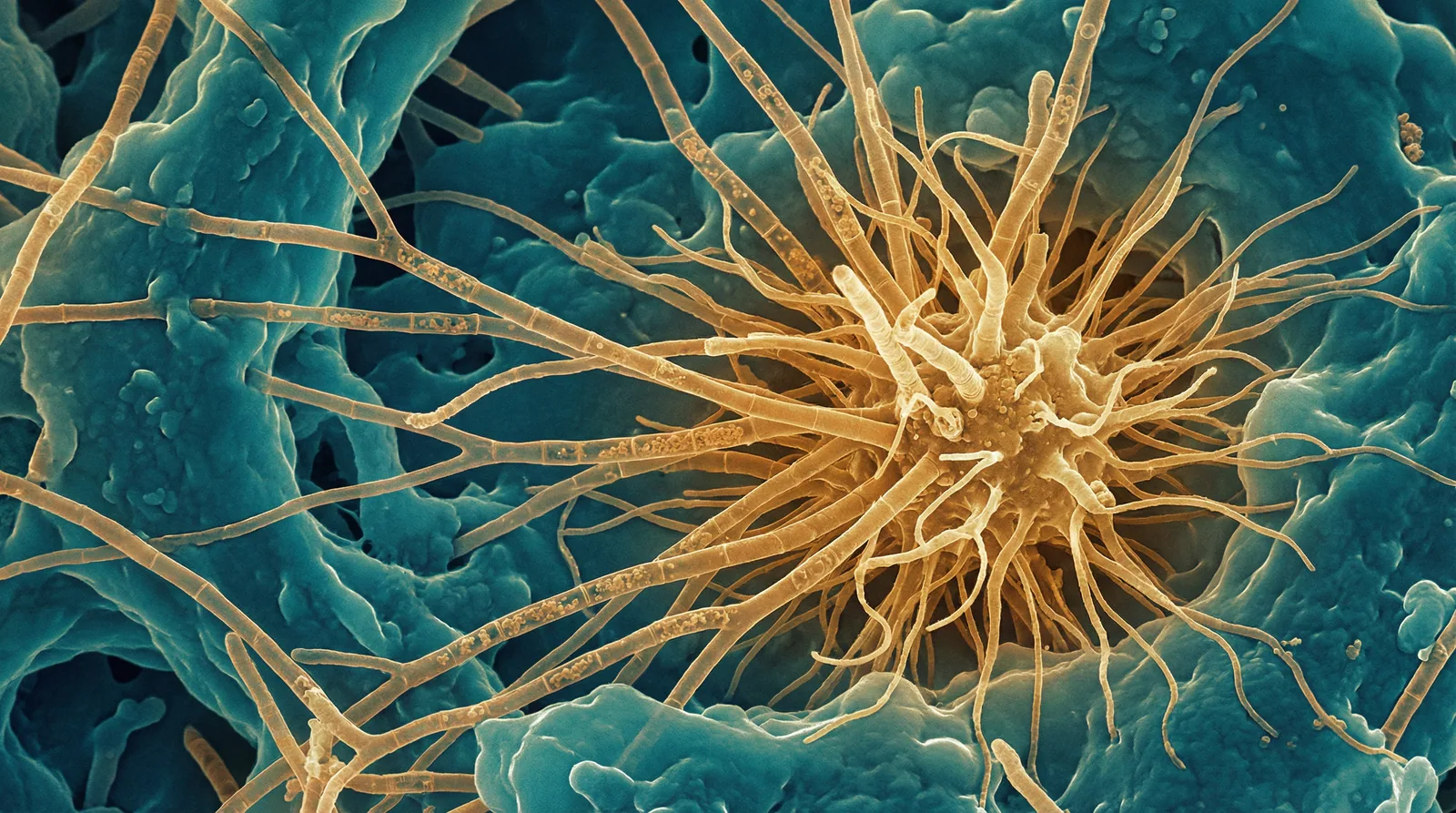
The genus name is built from the Greek aktis ("ray") and mykes ("fungus"), describing the way the filaments radiate outward from the center of a granule. Nineteenth-century pathologists took the branching, mycelium-like growth at face value and called the organism the "ray fungus" — a misnomer that survived for decades before it was established that Actinomyces is a true bacterium, not a fungus.
The species epithet honors James Israel (1848-1926), the German surgeon who described the organism in human tissue in 1878. The formal nomenclatural citation is Actinomyces israelii (Kruse 1896) Lachner-Sandoval 1898.[2] The genus sits in the phylum Actinobacteria, order Actinomycetales, alongside Corynebacterium, Mycobacterium, Nocardia, and Propionibacterium — which is why Nocardia is the recurring differential.[1]
Gram Stain and Morphology
On Gram stain, A. israelii appears as a Gram-positive, non-spore-forming rod that branches into thin filaments, frequently at acute angles, forming a tangled mat rather than discrete cells. All Actinomyces species except A. meyeri (small, non-branching) show this branching filamentous form.[1]
Key morphological points for identification:
- It is not a fungus. The filaments are far narrower than fungal hyphae. "Fungal-like" describes the growth pattern, not the organism.
- Gram stain of pus is usually more sensitive than culture, especially when the patient has already received antibiotics — which is common, because actinomycosis is typically diagnosed late.[1]
- At the granule periphery, Gram staining shows Gram-positive filamentous branching bacteria radiating from the edge of the granule. That combination is strongly suggestive of actinomycosis.[1]
- On H&E, sulfur granules appear as basophilic masses with eosinophilic terminal clubs. Silver stains (GMS) highlight the filaments within the granule.[1]
- Colony morphology: A. israelii forms a characteristic "molar tooth" colony on agar — heaped, white, and irregularly nodular — and grows as discrete clumps in broth. A. odontolyticus, by contrast, forms rust-brown or red colonies.[1]
Culture and Laboratory Identification
Recovering A. israelii is difficult, and a negative culture does not exclude the diagnosis. Cultures remain sterile in more than 50% of actinomycosis cases.[1]
Why cultures fail:[1]
- Prior antibiotic therapy (the most common reason)
- Inhibition of Actinomyces growth by faster-growing co-pathogens in polymicrobial specimens
- Failure to maintain anaerobic conditions during transport
- Incubation stopped before slow-growing colonies appear
Specimen and culture conditions:[1]
| Variable | Requirement |
|---|---|
| Specimen | Surgical tissue biopsy or pus — swabs should be avoided |
| Transport | Rapid transport and/or anaerobic transport medium |
| Atmosphere | Anaerobic incubation at 37 °C |
| Media | Chocolate blood agar; brain-heart infusion broth; Brucella blood agar with hemin and vitamin K1 |
| Selective media | Phenylethyl alcohol or mupirocin-metronidazole blood agar, to suppress overgrowth |
| Incubation | Growth appears from ~5 days and may take 15-20 days; hold at least 10 days before reporting negative |
Because chronic osteomyelitis specimens grow especially poorly, cultures from bone are incubated for two weeks, and stopping antibiotics for at least 14 days before surgical sampling substantially improves recovery.[1]
Molecular and proteomic identification. 16S rRNA gene sequencing is the current reference method for species-level identification, having replaced phenotypic biochemical panels that frequently misidentified Actinomyces at both species and genus level. 16S rDNA restriction analysis (ARDRA) and species-specific PCR are practical alternatives. MALDI-TOF mass spectrometry identifies Actinomyces reliably at the genus level, but species-level assignment remains uncertain and depends on the instrument and database.[1][3]
Clinicians should tell the laboratory that actinomycosis is suspected — otherwise the prolonged, anaerobic, appropriate-media protocol will not be run.[1]
Sulfur Granules
Sulfur granules are the classic macroscopic finding in actinomycosis, and the name is misleading: they contain no sulfur. The term describes only their yellow color.[1]
- Size: roughly 0.1-1 mm in diameter — visible to the naked eye in thick yellow exudate.
- Structure: an internal tangle of mycelial filaments surrounded by a rosette of peripheral clubs, stabilized by a protein-polysaccharide complex thought to inhibit phagocytosis and contribute to persistence.
- Yield: histopathology discloses one to three sulfur granules in about 75% of cases.
- Not specific: similar granules occur in nocardiosis, botryomycosis, and chronic cervicofacial fungal infection, so a granule alone does not confirm the diagnosis. Gram staining of the granule periphery is what raises specificity.[1]
Actinomyces vs. Nocardia: Key Differences
Both genera are Gram-positive, branching, filamentous organisms that cause chronic suppurative disease with granules, and they are the classic paired differential. Two tests separate them quickly: oxygen requirement and the modified acid-fast stain.
| Feature | Actinomyces israelii | Nocardia spp. |
|---|---|---|
| Oxygen | Anaerobic to microaerophilic | Obligate aerobe |
| Modified acid-fast | Negative (not acid-fast) | Partially acid-fast (mycolic acids) |
| Catalase | Negative | Positive |
| Habitat | Human commensal flora (mouth, gut, genital tract) | Environmental — soil, dust, water, decaying vegetation |
| Typical host | Often immunocompetent | Predominantly immunosuppressed |
| Usual route | Endogenous, after mucosal breach | Inhalation, or traumatic skin inoculation |
| Common sites | Cervicofacial, abdominopelvic, thoracic | Pulmonary (most common), cutaneous, CNS dissemination |
| First-line therapy | Penicillin G / amoxicillin | Trimethoprim-sulfamethoxazole |
Sources: Actinomyces characteristics[4][1]; Nocardia characteristics[5]
Where the Infection Turns Up
Actinomycosis is a chronic, indolent infection whose defining behavior is that it spreads contiguously across tissue planes rather than through lymphatics, forms a cold, firm mass, and frequently mimics malignancy or tuberculosis.[1] Which tissue is involved depends on which mucosal barrier A. israelii crossed.
| Form | Approximate share | Barrier crossed | Hallmark |
|---|---|---|---|
| Cervicofacial ("lumpy jaw") | ~60% | Oral mucosa, usually a dental focus | Indurated mandibular mass with draining sinus tracts; mandible ~50%, cheek ~15%, chin ~15%; bone involved in ~10% |
| Abdominopelvic / genitourinary | 20-32% | Gut mucosa; intrauterine device | Ileocecal predilection; pelvic mass that may raise CA-125 |
| Thoracic | 15-30% | Aspiration into the airway | Cavitation together with a chest-wall sinus tract |
| CNS | 2-4% | Hematogenous or contiguous spread | Brain abscess, typically polymicrobial |
Reported shares vary between case series; cervicofacial disease accounts for roughly 60% of infections.[4][1][6] The full symptom picture by site is covered on the actinomycosis condition page.
Pathogenesis: How a Commensal Becomes a Pathogen
Actinomycosis is an endogenous infection. A. israelii causes no disease while it remains on the mucosal surface; disease begins when that barrier is broken.[1]
Predisposing factors: dental caries, gingivitis and poor oral hygiene, dental extraction or other mucosal trauma, surgery, foreign bodies (IUDs, implants), irradiated or devitalized tissue, diabetes, alcohol use, malnutrition, and immunosuppression.[1]
Mechanism:
- Organisms reach deeper tissue through a mucosal breach.
- Co-isolated "companion microbes" — Eikenella corrodens, Aggregatibacter actinomycetemcomitans, Haemophilus species, fusobacteria — appear to lower oxygen tension and impair local host defenses, which is why actinomycosis is characteristically polymicrobial.[1]
- Dense masses of interlinked branching filaments form, encased in a protein-polysaccharide matrix that resists phagocytic clearance.
- Chronic granulomatous and suppurative inflammation produces abscesses containing sulfur granules.
- Infection extends contiguously through fascial planes, generating the sinus tracts and fistulae that define the disease.
Because Actinomyces is a normal inhabitant of mucosa, isolating it from a mucosal sample is of little diagnostic significance on its own, in the absence of sulfur granules or a compatible clinical syndrome.[1]
Antibiotic Susceptibility
Drug resistance is not the obstacle in actinomycosis: Actinomyces species are highly susceptible to beta-lactams and do not produce beta-lactamases. The obstacle is penetration into abscesses and fibrotic tissue, which is why doses are high and courses run for months — intravenous penicillin G or amoxicillin for 2-6 weeks, then oral penicillin V or amoxicillin for 6-12 months, usually alongside surgical drainage or debridement.[1] With prolonged therapy, the reported prognosis is generally excellent.[4]
| Susceptibility | Agents |
|---|---|
| Active | Penicillin G, penicillin V, amoxicillin; ceftriaxone (though A. europaeus and A. graevenitzii are resistant to it) |
| Alternatives in penicillin allergy | Clindamycin, macrolides (erythromycin, clarithromycin, azithromycin), doxycycline — weaker in vitro but better bone penetration |
| No useful activity | Metronidazole, aminoglycosides, oxacillin, cloxacillin, cephalexin; fluoroquinolone activity is considered poor |
Source: Actinomyces susceptibility data[1]
Full regimens, dosing, and the role of surgery are covered on the actinomycosis condition page.
This section summarizes published review data, not a treatment recommendation. Antibiotic selection, dosing, and duration are individualized decisions for a treating clinician.
Where A. israelii Lives in the Healthy Body
Outside of infection, A. israelii is an ordinary member of several human microbial communities.[7][3]
- Oral cavity — supragingival and subgingival dental plaque, gingival crevices, periodontal pockets, tonsillar crypts, carious teeth, and the tongue surface (a contributor to oral malodor). Practical oral-microbiome context is covered in the oral and dental health protocol.
- Gastrointestinal tract — part of the alimentary tract microbiota, with an ileocecal predilection when it does invade.
- Female genital tract — a normal inhabitant, with colonization strongly promoted by intrauterine device use.[6]
Biofilm ecology. A. israelii is an early colonizer of tooth surfaces and a coaggregation hub in dental plaque: type 2 fimbriae recognize receptor polysaccharides on Streptococcus oralis and S. gordonii, Fusobacterium nucleatum bridges early and late colonizers, and Veillonella and Campylobacter gracilis are significant partners in root caries.[8]
IUD-associated colonization. In vitro, A. israelii forms spider-like colonies and porous biofilm on copper IUD surfaces, attaching via extracellular polymer production.[9] Actinomyces-like organisms are reported on cervical cytology in a minority of IUD users, and risk rises with duration of use; replacing the device every five years is the standard preventive recommendation in the actinomycosis literature.[4] Colonization is not infection: asymptomatic women with Actinomyces-like organisms on cytology who replace their device on schedule are not treated with antibiotics.[1][6]
Related Actinomyces Species
A. israelii is one of more than 30 described Actinomyces species, and the genus is easy to conflate.[1][3]
| Species | Principal association |
|---|---|
| A. israelii | The species most often isolated in invasive actinomycosis; ~70% of orocervicofacial cases with A. gerencseriae |
| A. gerencseriae | Formerly A. israelii serotype 2; cervicofacial disease |
| A. naeslundii | Oral commensal and plaque former; occasionally cervicofacial disease |
| A. oris | Split from A. naeslundii in a 2009 taxonomic revision; dental plaque and root caries |
| A. odontolyticus | Rust-brown to red colonies; oral commensal |
| A. meyeri | Small, non-branching; notable propensity for dissemination |
| A. viscosus | Catalase-positive exception in the genus; plaque and pulmonary disease |
Older literature that predates the 2009 split often groups A. naeslundii and A. oris together as "A. naeslundii genospecies," which is worth keeping in mind when comparing studies across decades.