

Bacillus subtilis is a Gram-positive, spore-forming, aerobic/facultative anaerobic bacterium with a centuries-long history of safe use in fermented foods including natto (Japan), kimchi and cheonggukjang (Korea), and miso. As a spore-based probiotic, it offers exceptional advantages over vegetative probiotics: survival of gastric acid and bile salts, shelf stability for 12+ months without refrigeration, and germination within 3 hours in the human small intestine[1]. B. subtilis holds both FDA GRAS and EFSA QPS status.
Spore-Forming Characteristics
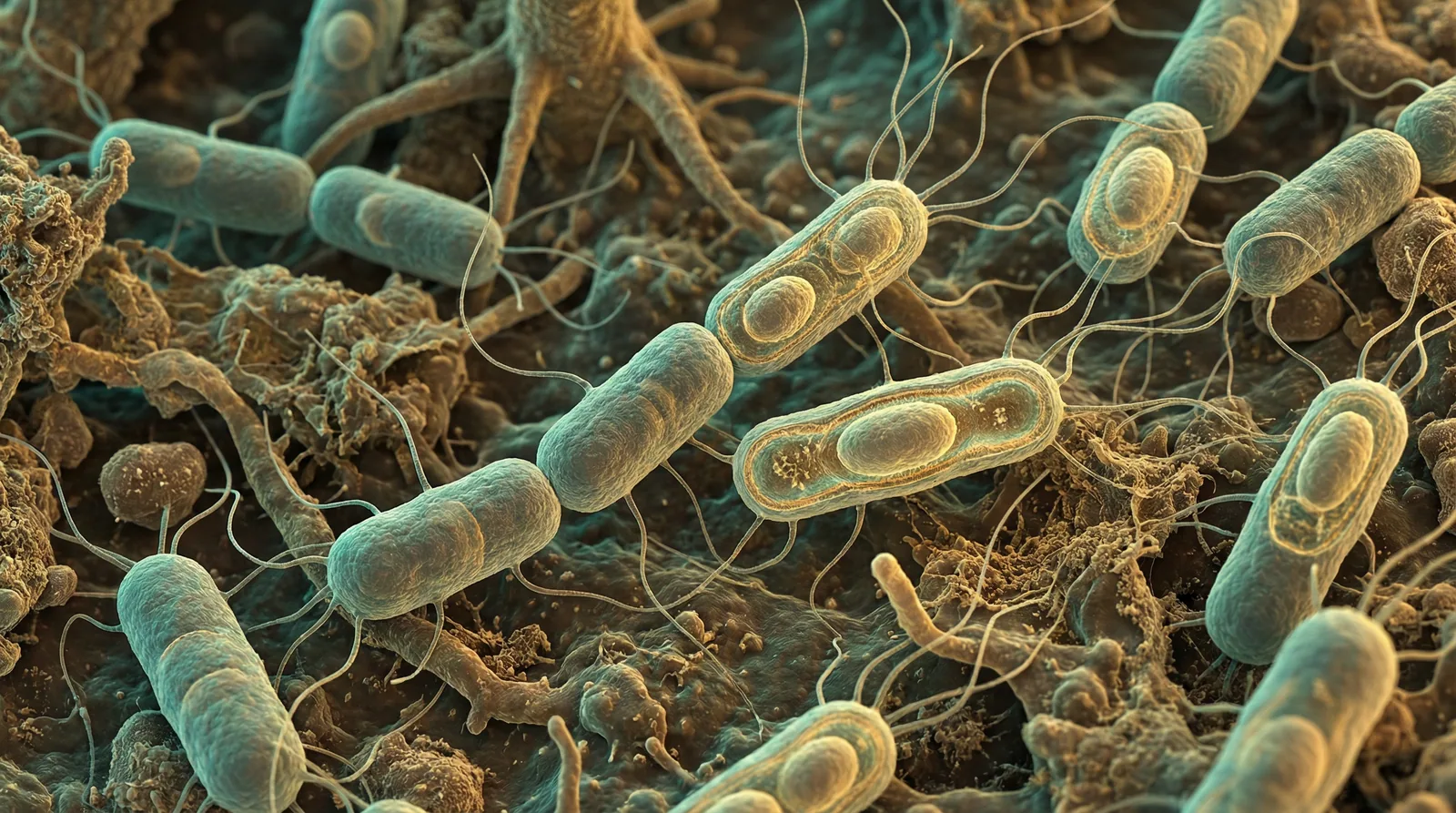
Germination Mechanisms
Spore germination is triggered by nutrient germinants (L-alanine, L-valine, L-asparagine) binding to germinant receptors (GRs) in the inner membrane. The process involves:
- Commitment phase: GerD protein required for GR clustering (germinosome formation)
- Release of monovalent cations: H⁺, K⁺, Na⁺ expelled
- CaDPA release: Via SpoVA protein channels (DPA comprises ~10% of spore dry weight)
- Cortex hydrolysis: Cortex-lytic enzymes CwlJ and SleB degrade peptidoglycan
- Core expansion: Water content increases from 25-50% to ~80%, volume increases 1.5-2 fold[2]
Human Intestinal Germination
A landmark human study of DE111 (5×10⁹ CFU) demonstrated:
- 100% of participants showed both spores and vegetative cells during 8-hour monitoring
- Germination observed as early as 3 hours post-ingestion
- Peak spore concentration at 6h: 9.7×10⁷ CFU/g effluent
- Peak vegetative cells at 7h: 7.3×10⁷ CFU/g
- Total spores recovered: 3.0×10⁹ CFU over 8 hours[1]
Exceptional Shelf Stability
B. subtilis spores exhibit extraordinary stability:
- Less than 2 log reductions under all storage conditions over 12 months (25°C, 4°C, -18°C)
- Survives baking temperatures (0.5-1.2 log reduction)
- Initial concentrations of 10.86-11.54 log₁₀ CFU/g maintained above therapeutic threshold (10⁶ CFU/g)[3]
Antimicrobial Compound Production
B. subtilis produces 66 different antibiotics, devoting 4-5% of its genome to antimicrobial synthesis[4]. Key compounds include:
Cyclic Lipopeptides (CLPs)
| Compound | Mechanism | Efficacy |
|---|---|---|
| Surfactins | Disrupt lipid bilayers, form ion-conducting pores | 50-400 μg/mL inhibitory concentration |
| Iturins | Antifungal, antiviral | 2 μg/mL effective against Staphylococcus |
| Fengycins | Induce fungal apoptosis via mitochondria | <50 μg/mL for apoptosis |
| Bacillomycin D | Anti-Staphylococcal | 2.0-2.5 log viral reduction (SARS-CoV-2) |
CLPs prevent biofilm adhesion through surface tension reduction and trigger plant induced systemic resistance (ISR)[5].
Clinical Evidence: Gastrointestinal Health
Gastrointestinal Symptoms (BS50 Strain)
A randomized, double-blind, placebo-controlled trial of 76 healthy adults receiving BS50 (2×10⁹ CFU/day for 6 weeks) showed:
- Composite symptom improvement: 47.4% vs 22.2% placebo (P=0.024)
- Odds ratio: 3.2 (95% CI: 1.1-8.7)
- Burping improvement: 44.7% vs 22.2% placebo (P=0.041)
- Bloating improvement: 31.6% vs 13.9% placebo[6]
Antibiotic-Associated Diarrhea in Children (HU58 Strain)
A trial of 68 children (ages 1-12) with AAD receiving HU58 (2×10⁹ CFU/day for 7 days) demonstrated:
- Normal stool by day 3: 93.5% (probiotic) vs 22.6% (placebo), P<0.001
- Abdominal pain reduction day 3: -7.4 vs -1.9, P<0.001
Clinical Evidence: Metabolic Effects
Cholesterol Reduction (DE111 Strain)
A 4-week trial of DE111 (10⁹ CFU daily) showed:
- Total cholesterol reduction: -8 mg/dL (P=0.04)
- Non-HDL-C reduction: -11 mg/dL (P=0.01)
- Compliance: 96%[7]
Weight Loss and Diabetes Control (DG101 Strain)
A 12-week trial of DG101 (10⁸ CFU/day) showed:
- Men weight loss: 3.25 kg/month vs 2.14 kg/month placebo (51.59% more efficient)
- Women weight loss: 2.49 kg/month vs 1.74 kg/month placebo (43.10% more efficient)
- Men insulin reduction: 58.40% vs 17.08% placebo
- Women insulin reduction: 50.00% vs 24.20% placebo[8]
Immunomodulatory Effects
Secretory IgA Stimulation (CU1 Strain)
A study in elderly subjects receiving CU1 (2×10⁹ spores daily) showed:
- Fecal SIgA at 10 days: 2062.6 μg/mL vs 1249.5 μg/mL placebo (P=0.0038)
- Salivary SIgA: 940.4 μg/mL vs 650.1 μg/mL placebo (P=0.0219)
- Serum IFN-γ increase: 6.9 to 9.7 pg/mL (P=0.009)
- Respiratory infection frequency: 0.6 vs 1.1 placebo (P=0.0323)[9]
Extracellular Vesicles
B. subtilis extracellular vesicles (EVs) up-regulate pro-inflammatory cytokines (IL-1β, IL-8), antimicrobial peptides (hepcidin, cathelicidin 2), induce B cell differentiation, and increase MHC II expression on IgM⁺ B cells[10].
Safety Profile
Regulatory Status
| Authority | Status | Year | Key Qualification |
|---|---|---|---|
| EFSA | QPS (Qualified Presumption of Safety) | 2008 | Absence of toxigenic activity |
| FDA | GRAS (Generally Recognized as Safe) | Multiple notices | Strain-specific evaluation |
Safety Data
The MB40 strain showed:
- Rat NOAEL: 2000 mg/kg bw/day (3.7×10¹¹ CFU/kg bw/day)
- Calculated ADI: 260 billion CFU/day for 70 kg adult
- Human tolerance: 10×10⁹ CFU/day well-tolerated over 28 days
- Antibiotic susceptibility: Susceptible to 18 of 21 antibiotics tested[11]
Skin Health Applications
A trial of 373 patients with mild-to-moderate acne using cream containing 1% B. subtilis bacteriocins for 60 days showed:
- S. aureus reduction: 38% decrease (P<0.001)
- Inflammatory lesions: 59% decrease (P<0.001)
- Non-inflammatory lesions: 58% decrease (P<0.001)
- Patient satisfaction: 95.4% rated good or excellent[12]
Commercial Strains
| Strain | Manufacturer | Key Benefits |
|---|---|---|
| DE111 | ADM | Cholesterol reduction, germination in small intestine within 3h |
| HU58 | Novonesis/Microbiome Labs | AAD treatment, hepatic encephalopathy |
| BS50 | - | GI symptom reduction (burping, bloating) |
| CU1 | - | Immune stimulation, respiratory infection prevention |
| DG101 | - | Weight loss, insulin reduction |
| MB40 | - | Extensively safety tested |