

What Is Akkermansia muciniphila?
Akkermansia muciniphila is one of the gut bacteria that live in the mucus layer lining the intestine, where it feeds on mucin — the glycoprotein that mucus is made of. It makes up roughly 1–4% of gut bacteria in healthy adults, and lower abundance has been associated with obesity, type 2 diabetes and impaired gut barrier function.[1]
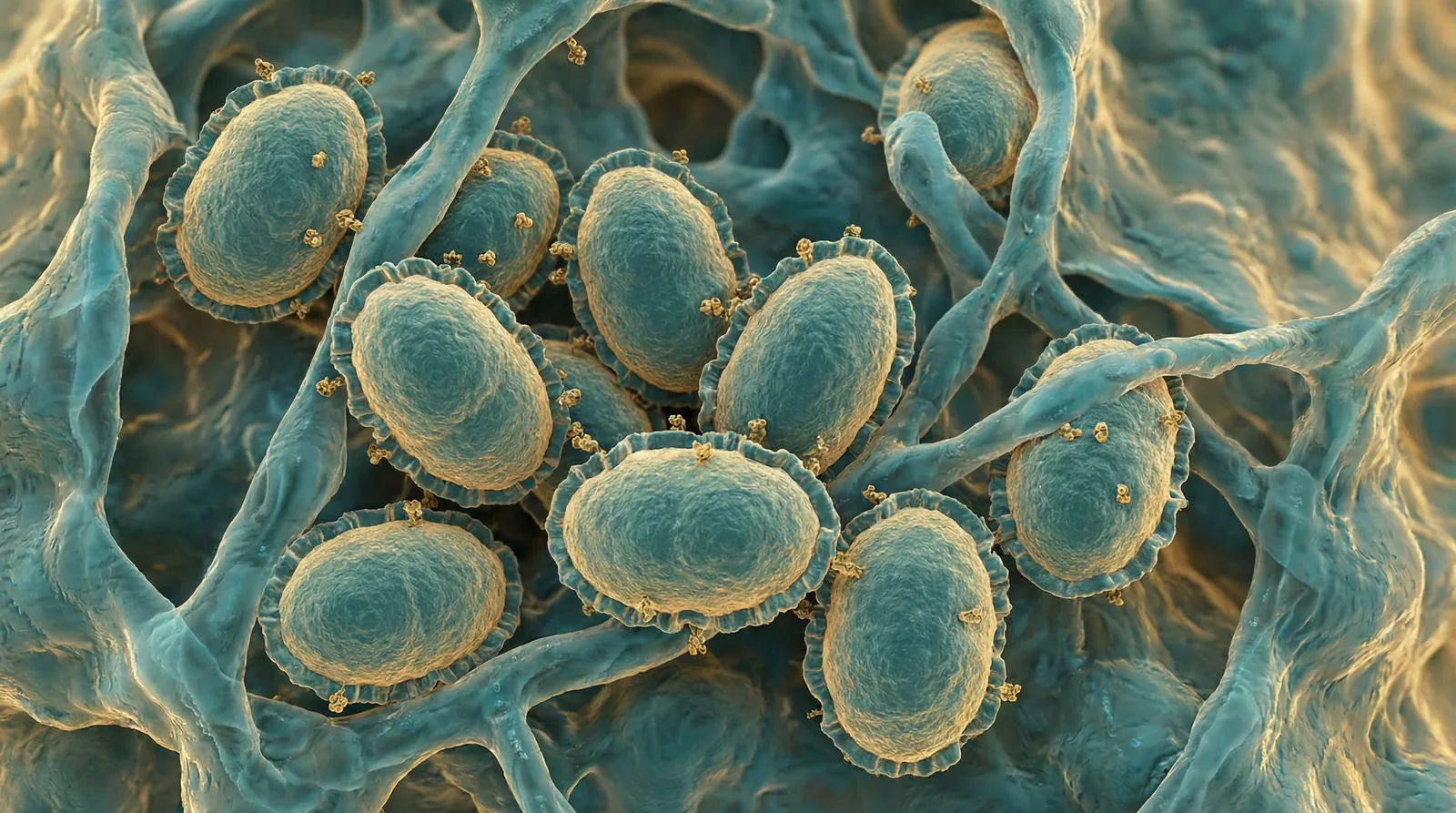
Unlike the Lactobacillus and Bifidobacterium species in most probiotic supplements, A. muciniphila is not a food organism. It is a native resident of the human gut acquired in early life, and it is the only member of the phylum Verrucomicrobiota consistently detected in mammalian intestinal samples.[1] That combination — abundant, mucus-dwelling, and consistently correlated with metabolic health — is why it became one of the first next-generation probiotics to be tested in humans.[2]
What does Akkermansia do for the body?
- Maintains the mucus layer. It degrades mucin using glycosyl hydrolases, proteases, sulfatases and sialidases, and that turnover appears to prompt the host to secrete fresh mucus.[3]
- Feeds other bacteria. Mucin fermentation releases acetate and propionate, which cross-feed butyrate-producing species.
- Signals to the gut lining. Its surface protein Amuc_1100 activates TLR2, tightening junctions between intestinal cells.[4]
- Influences metabolic hormones. The secreted P9 protein stimulates GLP-1 release from intestinal L-cells.[3]
Did You Mean Acromancia, Akermansia, or Achromasia?
The correct spelling is Akkermansia muciniphila — two k's, one r — commonly abbreviated A. muciniphila. It is pronounced ah-ker-MAN-see-ah mew-sin-IH-fih-lah.
Because the name is unfamiliar, it is one of the most frequently misspelled organisms in gut health. Variants that all refer to this same bacterium include acromancia, acromania, akermansia, achromasia, acermancia, ackermansia, acramancia, acromansia, akkarmensia and addermansia.
The genus honours the Dutch microbiologist Antoon Akkermans, and the species name muciniphila means "mucin-loving" — a direct reference to how the organism feeds on the intestinal mucus layer.[5]
Akkermansia muciniphila Taxonomy and Characteristics
| Property | Value |
|---|---|
| Domain | Bacteria |
| Phylum | Verrucomicrobiota (formerly Verrucomicrobia)[6] |
| Class | Verrucomicrobiae |
| Order | Verrucomicrobiales |
| Family | Akkermansiaceae |
| Genus | Akkermansia |
| Species | Akkermansia muciniphila |
| Type strain | MucT (ATCC BAA-835 / DSM 22959 / CIP 107961) |
| Gram stain | Gram-negative |
| Morphology | Oval (ovoid), non-motile, non-spore-forming |
| Oxygen requirement | Strict anaerobe |
| Growth substrate | Mucin as sole carbon and nitrogen source |
| First isolated | 2004, Derrien et al., Wageningen University, Netherlands |
| Typical abundance | 1–4% of gut bacteria in healthy adults |
A. muciniphila is the sole representative of the Verrucomicrobiota phylum consistently found in mammalian gastrointestinal samples; the phylum was formally renamed from Verrucomicrobia when prokaryotic phylum names were validly published in 2021.[6] Within it, the genus sits in the family Akkermansiaceae.
Its Gram-negative status means it carries an outer membrane containing lipopolysaccharides (LPS), though research suggests the specific phospholipid composition of its membrane may promote anti-inflammatory rather than pro-inflammatory immune responses.[7] This distinguishes A. muciniphila from many other Gram-negative bacteria whose LPS typically triggers inflammation.
Its genome encodes an unusual set of mucolytic enzymes — glycosyl hydrolases, proteases, sulfatases and sialidases — that allow it to use mucin as a source of carbon, nitrogen and energy, which is also why it grows only under strictly anaerobic conditions and evaded isolation until 2004.[5]
What Low Akkermansia Means on a Stool Test
Akkermansia muciniphila appears on most comprehensive stool panels, usually in a "commensal" or "normal flora" section. If you are reading a result, the first thing worth knowing is that the number depends heavily on which test produced it.
| Test | Provider | How Akkermansia is typically reported |
|---|---|---|
| GI-MAP / GI-MAP + Zonulin | Diagnostic Solutions Laboratory | qPCR, absolute value in organisms per gram of stool, against a lab-specific range |
| GI Effects Comprehensive Profile | Genova Diagnostics | PCR, reported among commensal bacteria with a lab reference interval |
| GI360 | Doctor's Data | PCR-based panel; also contributes to a composite dysbiosis index |
| Consumer sequencing kits (Thorne, Tiny Health, Ombre and similar) | Various | 16S rRNA or shotgun sequencing, reported as relative abundance (%) |
What a low or "not detected" result means
A low or "not detected" result means the assay found Akkermansia below that laboratory's reporting threshold on that sample. Low abundance has been associated in observational research with obesity, type 2 diabetes, and inflammatory bowel disease, and a 2025 randomized trial (n=58) found no overall difference between supplement and placebo, but reported reductions in body weight, fat mass and HbA1c in the subgroup that began with low Akkermansia.[8] That is a subgroup result from a single trial, not an established treatment threshold.
What a low result does not mean
- It is not a diagnosis. No condition is defined by an Akkermansia value.
- It does not have symptoms of its own. Low Akkermansia is a laboratory marker, not a syndrome.
- It is not necessarily stable. Abundance varies with recent diet, medication, bowel transit and the sampling site within a single stool.
- It is not comparable across labs. A relative abundance percentage from a sequencing kit and an organisms-per-gram figure from qPCR are different measurements and cannot be converted into one another.
What high Akkermansia means
Higher-than-expected Akkermansia is frequently unremarkable. It has been reported after fasting and calorie restriction, and metformin use is associated with higher abundance.[9] Because the organism earns its living by consuming mucin, unusually heavy abundance has also been reported in settings where the mucus layer is under strain. Populations in which raised abundance has been described, and where supplementation therefore warrants caution, include:
- Active inflammatory bowel disease (IBD)
- Colitis-associated colorectal cancer
- Parkinson's disease and multiple sclerosis
- PCOS or endometriosis, given the associated IBD risk
Why there is no validated cut-off
This is the part most lab-interpretation pages leave out: reference ranges for Akkermansia are lab-specific and statistically derived, not clinically validated. They describe how a given laboratory's own sample population distributes, not a threshold at which health changes. There is currently no consensus cut-off that defines "deficient" Akkermansia, and no published intervention target expressed in organisms per gram. Treat a result as one input alongside symptoms and clinical history, and interpret it with the clinician who ordered it. For how these panels differ more broadly, see our guide to microbiome testing.
Is Akkermansia a Probiotic or a Prebiotic?
Neither by default. Akkermansia muciniphila is a native gut bacterium — a normal resident of your intestinal mucus layer, not something you consume. It only meets the definition of a probiotic when it is cultured, pasteurized and supplied as a supplement, which is exactly how it has been tested in human trials.[2]
It is never a prebiotic. Prebiotics are the substrates that feed bacteria — compounds such as galacto-oligosaccharides, inulin, pectin and dietary polyphenols. Akkermansia is on the receiving end of that relationship, and it also produces its own substrate indirectly by stimulating host mucus secretion. If the distinction is unfamiliar, our prebiotics vs probiotics guide covers it in full.
Akkermansia Benefits
Research suggests that A. muciniphila may offer a range of health benefits, particularly for individuals with metabolic and digestive concerns:
- Metabolic health: Clinical trials indicate improvements in insulin sensitivity, cholesterol levels, and body composition in overweight and obese individuals.[2]
- Gut lining integrity: Studies suggest that A. muciniphila strengthens the intestinal barrier by upregulating tight junction proteins and stimulating mucus production, which may help reduce intestinal permeability ("leaky gut").[10]
- Immune regulation: The bacterium's unique phospholipids appear to promote balanced immune responses rather than excessive inflammation.[7]
- Weight management: Preclinical and early clinical evidence indicates associations between higher A. muciniphila abundance and healthier body weight.[8]
- Cardiovascular markers: Some research suggests improvements in total cholesterol and other cardiometabolic risk factors.[2]
For a broader look at how the gut microbiome supports digestive health, see our digestive health goals page, or the metabolic health protocol for a structured approach.
Akkermansia Foods and Sources
No food contains Akkermansia muciniphila. It is not present in yogurt, kefir, sauerkraut, kimchi or any other fermented food, and it is not something you acquire from your diet — it is already a resident of your gut mucus layer.[5] What diet can do is change how well the population you already have is fed.
The foods most often studied for this effect are polyphenol-rich, and the honest summary is that the rodent evidence is considerably stronger than the human evidence:
| Food | Active compound | What the research shows | Study type |
|---|---|---|---|
| Cranberry | Proanthocyanidins | Cranberry extract prevented diet-induced obesity and insulin resistance alongside a marked increase in Akkermansia[11] | Mouse |
| Concord grape | Grape polyphenols | Polyphenol extract promoted A. muciniphila growth and attenuated high-fat-diet metabolic syndrome[12] | Mouse |
| Green tea | Catechins (EGCG) | Green tea extract relieved high-fat-diet metabolic abnormalities and significantly increased Akkermansia[13] | Mouse |
| Chili pepper | Capsaicin | Capsaicin's anti-obesity effect tracked with higher Akkermansia and increased Muc2 (mucin) expression[14] | Mouse |
| Pomegranate | Ellagitannins → urolithins | Akkermansia was 33–47× higher in people who produce urolithin A than in non-producers — an association with producer status, not evidence that the extract raised Akkermansia[15] | Human, n=20 |
Fiber and prebiotics
A 2024 meta-analysis of six microbiome studies (821 stool samples, 451 participants) tested the assumption that prebiotic fibers and polyphenols reliably raise Akkermansia in humans. Galacto-oligosaccharides (GOS) increased its relative abundance in healthy participants; inulin and polyphenols did not do so consistently.[16] This is the clearest human-level evidence currently available, and it is a useful corrective to food lists that present rodent polyphenol data as established human effects.
More generally, a fiber-rich, plant-forward diet supports overall microbiome diversity and mucus-layer health, which is the environment A. muciniphila depends on. Our prebiotic foods guide and gut restoration protocol cover this in practical terms.
Lifestyle and medication factors
- Metformin: The diabetes drug is associated with higher Akkermansia abundance. In diet-induced obese mice, that increase appeared to contribute to the drug’s effect on glucose homeostasis; the mechanism has not been established in humans.[9]
- High-fat diets: Associated with reduced A. muciniphila abundance in both animal and human studies.[10]
- Fasting and caloric restriction: Frequently reported to raise Akkermansia, though largely in short-term and animal studies; durability in humans is unclear.
People managing type 2 diabetes or working on weight management may find these strategies particularly relevant given the association between A. muciniphila and metabolic health.
Clinical Evidence
Human Clinical Trials
A landmark 2019 proof-of-concept study demonstrated that supplementation with pasteurized A. muciniphila in overweight and obese insulin-resistant volunteers resulted in significant metabolic improvements:[2]
- Insulin sensitivity: +28.62% improvement
- Insulinemia: -34.08% reduction
- Total cholesterol: -8.68% reduction
- Body weight: -2.27 kg decrease
- Fat mass: -1.37 kg decrease
Importantly, a 2025 phase 2 randomized controlled trial revealed that supplementation efficacy depends critically on baseline intestinal A. muciniphila levels. Participants with low baseline levels showed significant reductions in body weight, BMI, total fat mass, visceral fat mass, and HbA1c, while those with high baseline levels showed no significant clinical improvements.[8]
Mechanisms of Action
Gut Barrier Enhancement
A. muciniphila strengthens intestinal barrier function through multiple mechanisms:[10]
- Mucus layer restoration: Restored intestinal mucus layer thickness that becomes significantly thinned during obesity
- Tight junction upregulation: Increases expression of tight junction proteins (ZO-1, occludin, claudin-3)
- Goblet cell stimulation: Enhances goblet cell count and mucus secretion via NLRP6 inflammasome and autophagy pathways
Metabolic Regulation
The bacterium improves metabolic health through several pathways:[3]
- GLP-1 secretion: Secretes P9 protein that directly stimulates GLP-1 release from intestinal L-cells
- SCFA production: Produces acetate and propionate from mucin fermentation
- Endocannabinoid modulation: Activates PPAR receptors and downregulates CB1 receptors
- Thermogenesis: Promotes thermogenic activation of brown adipose tissue
Immune Modulation
A 2022 study in Nature identified that a specific phospholipid (diacyl phosphatidylethanolamine) in the A. muciniphila cell membrane mediates homeostatic immune responses through non-canonical TLR2-TLR1 signaling, helping to reset cellular activation thresholds and suppress inflammatory responses.[7]
Key Bioactive Components
Proteins
- Amuc_1100: A 30 kDa outer membrane pili-like protein that remains stable after pasteurization, strongly activates TLR2, and improves gut barrier function while inducing anti-inflammatory IL-10 production[4]
- P9 protein: A secreted protein that binds to ICAM-1/ICAM-2 receptors and stimulates GLP-1 secretion for improved glucose homeostasis
Metabolites
- Short-chain fatty acids (SCFAs): Primarily acetate and propionate that support other beneficial bacteria and provide energy for colonocytes
- Extracellular vesicles (AmEVs): Membrane-derived vesicles that activate AMPK signaling and upregulate tight junction proteins
Ecological Role
A. muciniphila plays a crucial role in the gut ecosystem through cross-feeding relationships. By degrading mucin into acetate and propionate, it provides substrates for butyrate-producing bacteria like Clostridia species. This mucin degradation also prompts the host to produce more mucus, maintaining healthy mucus layer dynamics.[3]
Akkermansia Supplements
A. muciniphila is available as a next-generation probiotic supplement, though its commercial availability is more limited than traditional probiotics like Lactobacillus rhamnosus. Key considerations when evaluating Akkermansia supplements include:
- Pasteurized vs. live: The landmark clinical trials used pasteurized (heat-treated) preparations, which may actually be more effective than live bacteria for some metabolic endpoints.[2]
- Regulatory status: A. muciniphila has been recognized by EFSA as a novel food ingredient deemed safe for human consumption.[17]
- Strain verification: Look for products specifying the MucT type strain (ATCC BAA-835), as this is the strain with clinical trial data.
- Quality testing: As with any supplement, third-party testing for potency and purity is advisable.
Who has benefited most in trials
- Individuals with low baseline A. muciniphila levels[8]
- Overweight or obese individuals with metabolic syndrome
- Type 2 diabetes patients with insulin resistance
- Individuals with compromised gut barrier function
Doses used in research
- Typical dose: 1×10¹⁰ colony forming units (CFU) per day
- Treatment duration: Typically 12 weeks in clinical trials
- Preferred form: Pasteurized bacteria often preferred due to stability and safety profile
These figures describe what trials administered, not a recommendation. For how Akkermansia products compare with other options, see our review of microbiome supplements.
Akkermansia Safety and Side Effects
Comprehensive toxicological evaluation has established the safety of pasteurized A. muciniphila:[17]
- NOAEL: Established at 1500 mg/kg body weight/day (highest dose tested)
- Genotoxicity: In vitro tests (Ames and micronucleus) were negative
- Human tolerance: Daily supplementation well tolerated with adverse event rates comparable to placebo
- Regulatory status: Recognized by European Food Safety Authority (EFSA) as 'novel food' safe for human administration
Reported side effects are limited. Mild gastrointestinal symptoms such as transient bloating or changes in bowel habits have been described, generally at rates comparable to placebo.[17] Research remains early, and long-term safety data beyond 12 weeks of supplementation is limited.
Who should not take Akkermansia
Caution is advised, and medical supervision recommended, for people with:
- Active inflammatory bowel disease
- Colitis-associated colorectal cancer
- Conditions already associated with high A. muciniphila abundance, including Parkinson's disease and multiple sclerosis
- PCOS or endometriosis, given the associated IBD risk
Individual responses vary. This page is a research summary and is not medical advice — it is not a substitute for professional medical evaluation. Consult a healthcare professional before starting any new supplement, particularly if you have an inflammatory bowel condition, are pregnant, or take prescription medication.