

Ruminococcus bromii is a Gram-positive, strictly anaerobic, non-motile bacterium belonging to the Firmicutes phylum, specifically within the Oscillospiraceae family (formerly Ruminococcaceae). It is the dominant primary degrader of resistant starch (RS) in the human colon, possessing a unique amylosome complex that enables superior colonization and degradation of particulate starches compared to all other amylolytic bacteria.[1] This species is present in 90% of healthy adults and is recognized as a keystone species whose presence determines whether dietary resistant starch can be efficiently fermented.
The Amylosome: A Unique Enzymatic Complex
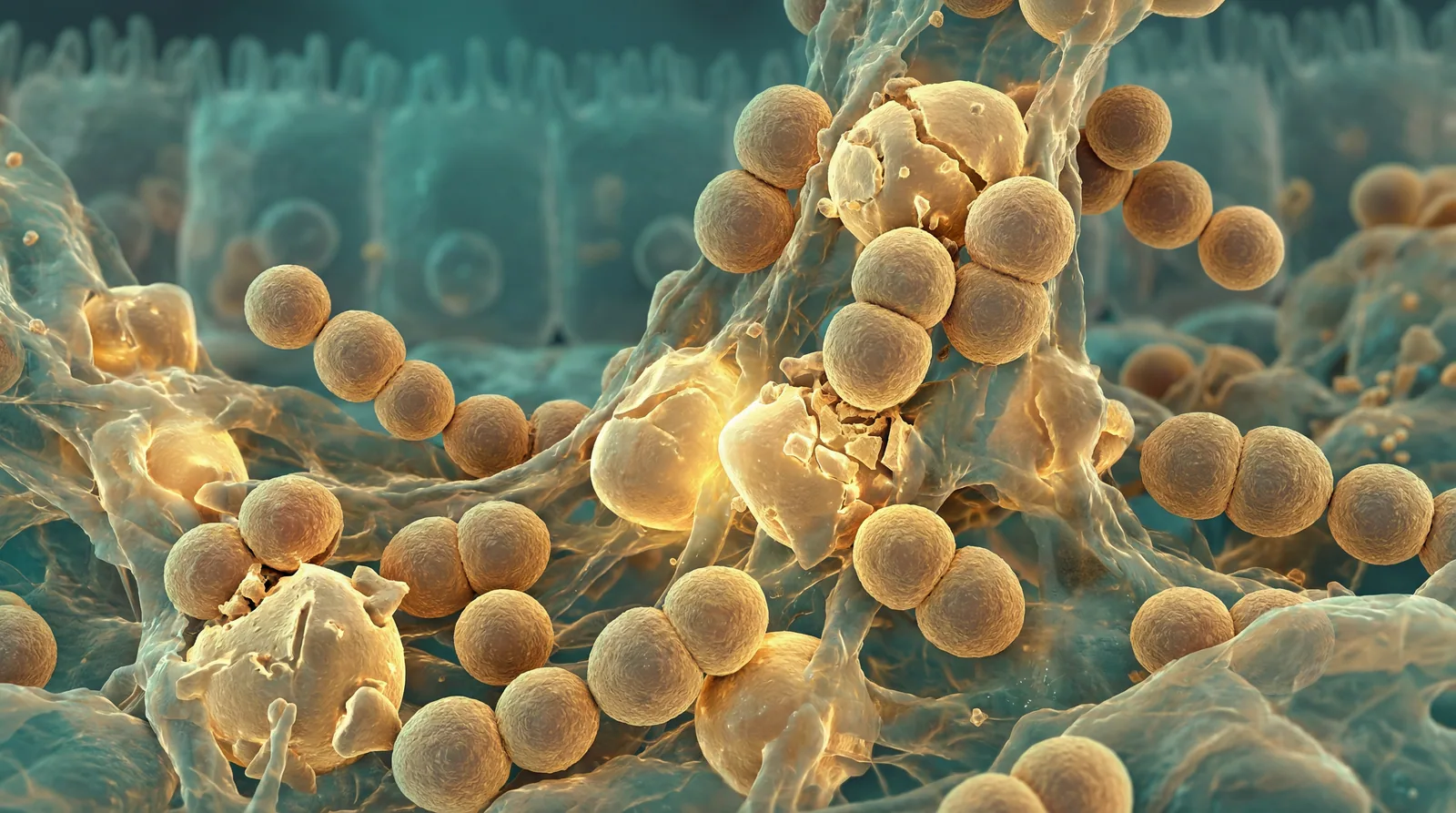
R. bromii possesses a specialized extracellular multienzyme complex called the amylosome, analogous to cellulosomes in cellulolytic bacteria. This complex is organized through a cohesin-dockerin protein interaction system:
- Present in 85-90% of cells regardless of carbon source
- Genome encodes 26 dockerin-containing proteins and 4 cohesin-carrying scaffoldin proteins (Sca1-4)
- Four scaffoldins organize multiple amylases into cell-surface or starch-bound complexes
- Amy4 is unique in carrying both cohesin and dockerin modules, enabling autoaggregation and enzyme recruitment[2]
Recent structural studies reveal that enzymatic composition is dynamically regulated based on substrate. On RS, Amy4 and Amy16 together comprise 60% of the amylosome, with Amy4 increasing 3-fold to 45% abundance vs fructose. Synergistic degradation increased RS breakdown products by >40% compared to individual enzyme activities.[3]
Key Amylosome Enzymes
| Enzyme | Function | Specificity |
|---|---|---|
| Amy4 | α-1,4-amylase + scaffoldin adapter | Bifunctional; enables enzyme aggregation |
| Amy9 | α-1,4-amylase | Hydrolyzes α-1,4 glycosidic bonds |
| Amy16 | α-1,4-amylase | Critical for synergistic degradation with Amy4 |
| Amy10 | Pullulanase | Cleaves α-1,6 branch points |
| Amy12 | Pullulanase | Cleaves α-1,6 branch points |
| Sas20 | Starch-binding protein | Two domains (Kd = 0.61-1.5 μM for maltoheptaose) |
Key Characteristics
R. bromii is designated a "keystone species" because its presence determines whether resistant starch is fermented or passes through undigested:
- In individuals with low or undetectable R. bromii (<1%), >60% of RS3 remained unfermented
- Supplementing R. bromii to fecal bacteria lacking it greatly enhanced RS3 fermentation in vitro
- On high RS diet, abundance increases from 3.8% to up to 17% of total bacteria[4]
Sporulation capability: Contains 73 genes for sporulation and germination including Spo0A and sigma factors. Spores survive 80°C for 20 minutes and atmospheric oxygen exposure, facilitating transmission between hosts.[5]
Cross-Feeding Networks and Ecosystem Role
R. bromii acts as a primary degrader releasing substrates that support secondary fermenters and butyrate producers through extensive cross-feeding networks:
Released Metabolites and Cross-Feeding Partners
In monoculture, R. bromii produces formate, ethanol, and acetate in approximately equal molar proportions (11.3 mM acetate, 18.7 mM ethanol, 10.7 mM formate).[6] Crucially, it does NOT produce butyrate directly, but supports butyrate production through substrate provision:
- Releases glucose as a major byproduct, creating visible glucose 'halos' on solid media that support Bacteroides thetaiotaomicron growth[7]
- Releases malto-oligosaccharides (maltose, maltotriose, maltotetraose) supporting R. gnavus and Bifidobacterium species[8]
- Formate is cross-fed to acetogens like Blautia hydrogenotrophica, which convert it to acetate via Wood-Ljungdahl pathway—in co-culture, formate drops to ~2.2 mM while acetate increases to 23.1 mM
Butyrate Production Network
R. bromii is strongly positively correlated with major butyrate producers through cross-feeding:
- Eubacterium rectale
- Roseburia faecis
- Faecalibacterium prausnitzii
Interestingly, it is negatively associated with Clostridiaceae and C. difficile.[9] In fecal inoculum lacking B. adolescentis, R. bromii dominated and achieved highest butyrate production. Its presence is a prerequisite for certain interactions rather than simply an abundance-based driver.
Health Implications
Atopic Dermatitis Prevention
A key study found that lower R. bromii abundance is significantly associated with atopic dermatitis development in infants:
- At 360 days: High R. bromii: 11.1-12.5% had AD vs Low R. bromii: 44.4-52.5% had AD
- Higher R. bromii levels correlated with higher fecal butyrate (Spearman's rho 0.3-0.49)
- Correlation was independent of major butyrate producers E. rectale or F. prausnitzii[10]
Cardiovascular Health
In an obese population study, the CVD risk group showed significantly lower Ruminococcus abundance (0.95% vs 2.97%, P=0.0002). Higher R. bromii was positively associated with protein, MUFA, vitamin A, and vitamin D intake.[11]
Liver Health
Oral administration of R. bromii alleviates liver fibrosis and inflammation in mouse models. The mechanism involves acetate activating the PI3K/AKT pathway in hepatic stellate cells, reducing ECM accumulation. R. bromii also restores intestinal barrier function by upregulating Occludin and Claudin-1 and restoring goblet cells.[12]
Constipation Relief
The genus Ruminococcus is notably depleted in constipated patients. R. bromii was the most effective among four tested species (R. bromii, R. torques, R. obeum, R. gnavus). Its pullulanase-mediated RS degradation increases SCFA production and increases Akkermansia and Bifidobacterium levels. Clinical trials confirmed RS effectiveness is dependent on R. bromii presence.[13]
Inflammatory Bowel Disease
R. bromii is significantly depleted in subjects with IBD,[14] likely due to reduced butyrate availability for colonocyte nutrition and anti-inflammatory effects.
Other Associations
- Chronic kidney disease: Reduced inflammation
- Cancer immunotherapy: Enhanced response to immune checkpoint inhibitors
- Depressive disorders: Reduced risk via gut-brain axis and SCFA-mediated effects
Metabolic Activities
R. bromii's metabolic activities center around the degradation of complex carbohydrates, particularly resistant starch:
Amylolytic Activity: R. bromii possesses a specialized amylolytic system that enables it to efficiently break down various types of resistant starch. This system includes amylases and other enzymes that can attack the α-1,4 and α-1,6 linkages in starch molecules.
Fermentation of Starch Degradation Products: After breaking down starch into simpler sugars, R. bromii ferments these products to generate energy. The primary fermentation products include acetate, formate, and hydrogen, but not butyrate.
Cross-Feeding Interactions: R. bromii engages in cross-feeding relationships with other gut bacteria. It releases partially degraded starch products and fermentation intermediates that can be utilized by other species, including butyrate producers such as Eubacterium rectale and Faecalibacterium prausnitzii.
Hydrogen Production: As part of its fermentation process, R. bromii produces hydrogen gas, which can be utilized by hydrogenotrophic microorganisms in the gut, such as methanogens and sulfate-reducing bacteria.
Colonization of Starch Particles: R. bromii has an exceptional ability to colonize and degrade starch particles, forming biofilm-like structures on the surface of starch granules, which enhances its degradative efficiency.
Clinical Relevance and Therapeutic Potential
Dietary Response and Personalized Nutrition
A landmark study of dietary interventions with fermentable fibers found:
- Resistant maize starch (RMS) increased R. bromii 2.5-fold
- 76% of individuals with baseline R. bromii responded to resistant potato starch (RPS) with higher butyrate
- Only 36% without R. bromii responded to RPS
- Individuals with increased R. bromii: 9.1 mmol/kg average butyrate increase[15]
This suggests R. bromii status could guide personalized nutrition recommendations for resistant starch supplementation.
Biomarker Potential
| Application | Clinical Significance |
|---|---|
| RS fermentation capacity | Predicts response to resistant starch dietary interventions |
| Metabolic health status | Low abundance associated with obesity, T2D, CVD risk |
| Inflammatory conditions | Depletion indicates inflammatory dysbiosis in IBD |
| Atopic dermatitis risk | Predictive in infant populations |
Next-Generation Probiotic Candidate
R. bromii is identified as a promising next-generation probiotic due to:
- Keystone species with ecosystem-wide effects
- Enhances SCFA production via cross-feeding
- Supports beneficial microbial community structure
- Safe human commensal with long co-evolution history[14]
Challenges for therapeutic development include:
- Strict anaerobe requiring specialized cultivation
- Slow growth and autolysis in culture
- Requires RS co-administration for maximal effect
- Inter-strain variability in efficacy
Interaction with Other Microorganisms
R. bromii engages in complex interactions with other members of the gut microbiome:
Cross-Feeding with Butyrate Producers: R. bromii breaks down resistant starch into products that can be utilized by butyrate-producing bacteria such as Eubacterium rectale, Faecalibacterium prausnitzii, and Anaerostipes hadrus. This cross-feeding relationship enhances butyrate production in the gut.
Synergistic Interactions: In co-culture experiments, R. bromii has been shown to stimulate the growth and metabolic activities of other amylolytic bacteria, including Bacteroides thetaiotaomicron, Eubacterium rectale, and Bifidobacterium adolescentis, even in conditions that do not support R. bromii's own growth.
Competition for Substrates: R. bromii competes with other amylolytic bacteria for access to resistant starch. However, its superior degradative capabilities often give it a competitive advantage in this ecological niche.
Interactions with Akkermansia muciniphila: Some studies have noted correlations between the abundance of R. bromii and Akkermansia muciniphila, a mucin-degrading bacterium associated with gut health. Both species have been found to be reduced in children with atopic dermatitis.
Influence on Overall Microbial Community Structure: As a keystone species, R. bromii's activities can influence the overall structure and function of the gut microbial community, particularly in individuals consuming diets rich in resistant starch.
The unique role of R. bromii as a keystone species in resistant starch degradation highlights the importance of specific bacterial functions, rather than just overall diversity, in maintaining gut health. Its interactions with other gut bacteria exemplify the complex web of relationships that underpin the functioning of the gut microbiome and its impact on human health.
Can You Buy It as a Supplement?
Readers who encounter this organism in a microbiome test result often ask whether it can be purchased as a probiotic. For most gut commensals the answer is currently no, for reasons ranging from oxygen sensitivity to regulatory status. See which next-generation probiotics are actually available for this organism's current commercial status and what to do instead.