

Bifidobacterium adolescentis is the dominant adult-type bifidobacterium in the human gut microbiome, found in 60-80% of healthy adults[1]. Unlike infant-associated bifidobacteria, B. adolescentis specializes in plant-derived carbohydrates and exhibits remarkable genetic diversity that underlies its exceptional metabolic versatility, including resistant starch degradation, folate production, and GABA synthesis.
Characteristics and Prevalence
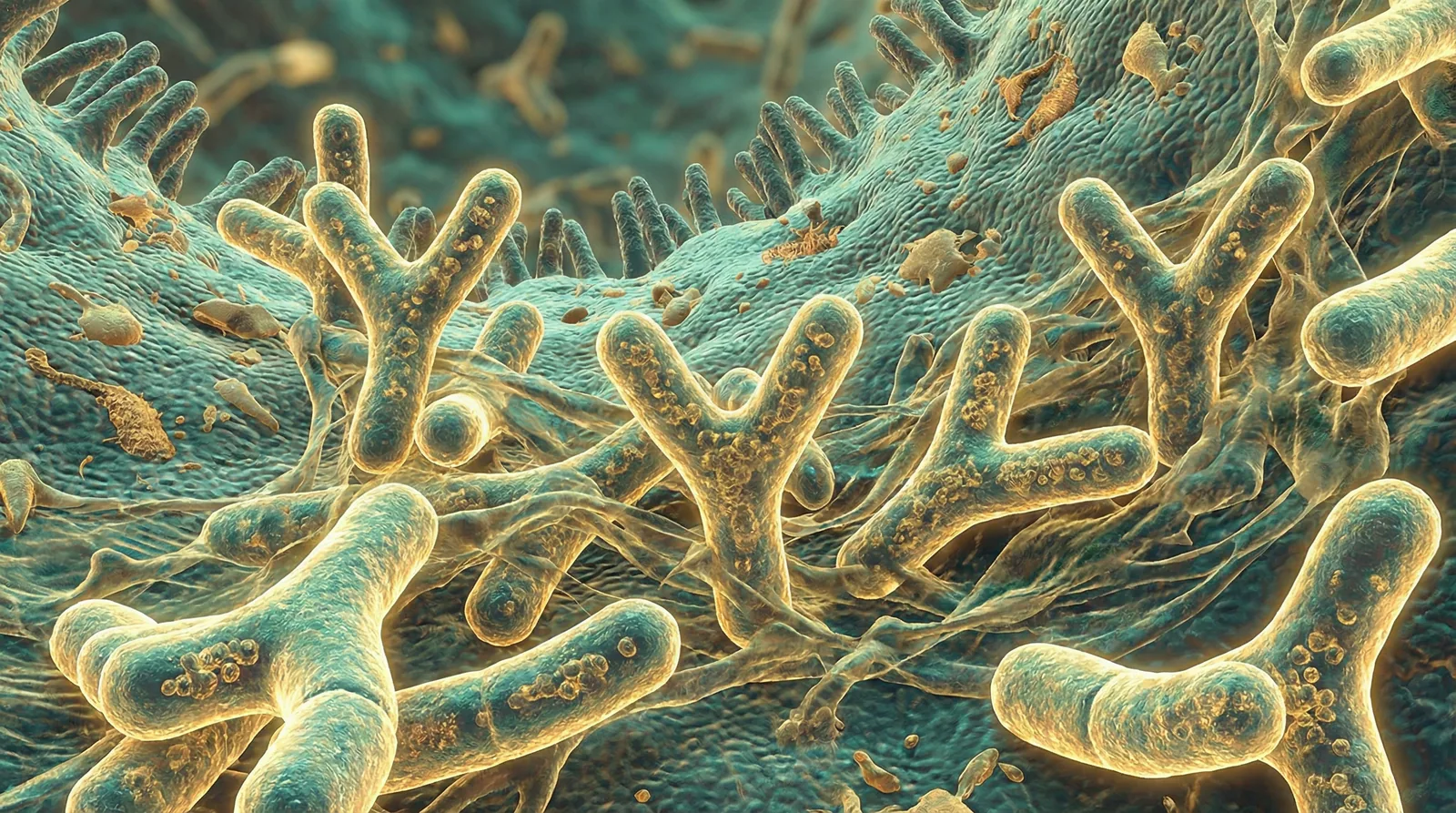
B. adolescentis becomes the most abundant Bifidobacterium species by age 15, peaking at approximately 5% relative abundance around age 40[2]. Unlike other bifidobacteria that colonize breast-fed infants, B. adolescentis is more prevalent in formula-fed infants and becomes dominant after weaning.
Age-Related Patterns
- Infants: Generally absent in breast-fed; present in formula-fed
- Adults: 60-80% prevalence; cell density 10^9-10^10 cells/g feces
- Elderly: Decreases with age but remains elevated in centenarians
- Centenarians: 92% prevalence in semi-supercentenarians (105+) vs 80% in general elderly[3]
Genetic Diversity
Genomic analysis reveals exceptional strain variation with an open pan-genome of 16,696 genes, of which only 412 (2.47%) constitute the core genome[2]. Five major phylogenetic lineages exist with significant regional variation correlating with dietary patterns across Asia, Europe, and North America.
Metabolic Activities
Carbohydrate Utilization
B. adolescentis is specialized for plant-derived glycans rather than host-derived glycans, possessing higher CAZyme gene counts than common probiotic species[1].
Resistant Starch Degradation: B. adolescentis is the primary resistant starch (RS) degrader in the human gut. Strain P2P3 utilizes 63.3% of high-amylose corn starch granules through three cell-surface α-amylases with carbohydrate-binding modules (CBM25/26/74)[4]. This capability is strain-specific—some strains show 0% degradation.
SCFA Production and Cross-Feeding
B. adolescentis produces acetate and lactate in a 3:2 ratio via the bifid shunt pathway[5]. These metabolites support butyrate production through two cross-feeding mechanisms:
- End-product cross-feeding: Lactate converted to butyrate by Eubacterium hallii and Anaerostipes caccae (contributing 44-48% of butyrate carbon at pH 5.7)
- Substrate cross-feeding: Partial starch hydrolysis releases oligosaccharides for Roseburia species
This keystone function positions B. adolescentis as a primary degrader supporting butyrate-producing anaerobes essential for colonic health.
GABA Production
B. adolescentis is the primary GABA producer in the human gut, with the gadB gene present in >90% of strains[6]. High-producing strains achieve >250 mM GABA through glutamate decarboxylation via the GAD system (gadB/gadC).
GABA expression is detected in 15-20% of healthy subjects' gut metagenomes, positioning B. adolescentis as a potential psychobiotic for gut-brain axis modulation. Clinical evidence shows strain SBT2786 improves sleep quality in high-stress individuals (p < 0.05 for PSQI-J, ESS, and mood scores)[7].
Folate Production
B. adolescentis is a folate-prototrophic species capable of de novo vitamin B9 synthesis. Adult-derived strains produce significantly more folate than infant-derived strains[8]:
| Strain Origin | Folate Production |
|---|---|
| Adult-derived | 580-935 μg/g dry matter |
| Infant-derived | 35-200 μg/g dry matter |
The predominantly produced form is 5-methyl-tetrahydrofolate (5-MTHF), the bioactive form. Strain MB 239 shows particularly stable production across pH, carbon sources, and external folate levels.
In fecal cultures, supplementation with B. adolescentis MB 239 increased folate from 28.3 to 52.8 ng/mL, potentially reducing localized colonic folate deficiency and colorectal cancer risk.
Immunomodulatory Effects
Treg Induction and Anti-Inflammatory Activity
B. adolescentis demonstrates potent immunomodulatory effects through regulatory T cell induction[9]:
- Treg/CD4 T cells: Increased from 34.8% to 45.6% (p < 0.05)
- Anti-inflammatory cytokines: Elevated IL-10, IL-4, IL-5
- Pro-inflammatory cytokines: Decreased TNF-α, IL-6, IL-1β, IL-18
The mechanism involves H3K9 histone acetylation at the Il10 promoter via TLR2-ERK/p38 MAPK signaling[10]. Notably, strain IF1-03 induces Tregs while strain IF1-11 induces Th17, demonstrating critical strain-specificity.
Gut Barrier Enhancement
B. adolescentis strengthens intestinal barrier function by:
- Upregulating tight junction proteins (Occludin, ZO-1, Claudin-1)
- Increasing mucin production (Muc2, Muc3)
- Reducing LPS penetration
- Preventing TNF-α-induced barrier disruption
Health and Disease Associations
Inflammatory Bowel Disease
B. adolescentis is significantly reduced in IBD patients. Supplementation with strain ATCC15703 ameliorates chronic colitis in DSS mouse models[9]:
- Reduced diarrhea scores (p < 0.05)
- Lower spleen weight (p < 0.001)
- Increased Th2/CD4 T cells: 4.32% vs 2.28% (p < 0.001)
- Improved Bacteroidetes:Firmicutes ratio: 5 → 17
Irritable Bowel Syndrome
Clinical trial with strain PRL2019 in pediatric IBS demonstrated[11]:
- Complete remission: 52.8% vs 19.4% placebo (p = 0.003)
- IBS-SSS improvement: p = 0.001
- Stool normalization: 25% → 58.3% (p = 0.004)
Colorectal Cancer Protection
B. adolescentis is significantly depleted in CRC patients. Supplementation suppresses tumorigenesis by inducing CD143+ cancer-associated fibroblasts (CAFs) via Wnt/β-catenin/GAS1 signaling[12].
Cell-free supernatants inhibit CRC organoid growth:
- 15.51% reduction in organoid perimeter
- 39.67% reduction in volume (p < 0.0001)
The mechanism involves butyric acid upregulating CYP1A1 and acting as an HDAC inhibitor.
Metabolic Health and Obesity
Resistant starch-induced enrichment of B. adolescentis mediates significant metabolic benefits[13]:
- Weight loss: -2.81 kg (95% CI: -3.55 to -2.07, p < 0.001)
- Insulin sensitivity: Median +1.05 mg/kg/min GIR (p = 0.025)
- Inflammation: Reduced TNFα (p = 0.014) and IL-1β (p = 0.046)
For Type 2 Diabetes, B. adolescentis strains are more effective than B. bifidum, significantly decreasing glucose AUC and improving HOMA-IR[14].
Longevity Association
Higher B. adolescentis abundance correlates with healthy aging and longevity. Centenarian populations consistently show maintained or elevated levels compared to general elderly populations[3], suggesting it as a biological marker for healthy aging.
Probiotic Potential
Clinical Applications
| Condition | Strain | Dose | Duration | Outcome |
|---|---|---|---|---|
| Pediatric IBS | PRL2019 | 20×10^9 CFU/day | 12 weeks | 52.8% complete remission |
| Sleep/Stress | SBT2786 | >1.0×10^11 cells/day | 4 weeks | Improved sleep, mood |
| Obesity | RS-enriched | 40g RS2/day | 8 weeks | -2.81 kg weight loss |
Prebiotic Synergies
B. adolescentis demonstrates strong synergy with prebiotics, particularly resistant starch type 2 from high-amylose maize, which specifically enriches this species and mediates metabolic benefits[13].
Other supportive prebiotics include:
- Fructo-oligosaccharides (FOS)
- Galacto-oligosaccharides (GOS)
- Inulin
- Arabinoxylan oligosaccharides
Strain-Specific Considerations
Metabolic capabilities vary dramatically between strains[2]:
| Trait | Prevalence | Range |
|---|---|---|
| Folate production | 100% | 23-281 ng/mL |
| Lactose metabolism | 100% | 2-232 Miller units β-gal |
| GABA production | 80% | 0.3-14.4 mM |
| Resistant starch utilization | 66% | 26-74% |
| Fecal gas reduction | 100% | 25-79% (mean 62%) |
This strain diversity necessitates careful strain selection for specific therapeutic applications.
B. adolescentis Within the Bifidobacterium Genus
Bifidobacterium adolescentis belongs to the Bifidobacterium genus, one of the most important groups of beneficial bacteria in the human gut microbiome. Understanding its relationship to other Bifidobacterium species helps clarify its unique role.
The Bifidobacterium Family
The Bifidobacterium genus contains over 80 recognized species, with several playing key roles in human health at different life stages:
- B. longum (view profile/): The most broadly distributed species across the lifespan; specializes in immune modulation and gut-brain axis effects. While B. longum includes infant-associated subspecies (B. longum subsp. infantis), B. adolescentis is strictly an adult-type species
- B. bifidum (view profile/): Specializes in host-derived glycan degradation (mucins, HMOs); more focused on immune function than metabolic versatility
- B. breve: Primarily an infant-associated species that declines after weaning, as B. adolescentis rises to dominance
- B. animalis subsp. lactis: Common in commercial probiotics (e.g., BB-12); well-studied but lacks the metabolic versatility of B. adolescentis
What Distinguishes B. adolescentis
Compared to other Bifidobacterium species, B. adolescentis is uniquely characterized by:
- Plant glycan specialization: While B. bifidum degrades host mucins and B. longum subsp. infantis targets HMOs, B. adolescentis is the primary plant-derived carbohydrate specialist
- Resistant starch degradation: A capability rare among other Bifidobacterium species
- GABA production: The highest GABA-producing capacity of any Bifidobacterium species
- Folate output: Among the highest folate producers in the genus
- Adult dominance: Becomes the most abundant Bifidobacterium in adults by age 15
Bifidobacterium as Probiotic Supplements
The Bifidobacterium genus is one of the most widely used groups in probiotic supplements, and B. adolescentis is emerging as a particularly promising species for adult probiotic applications.
Current Probiotic Landscape
Most commercial probiotic supplements contain B. animalis subsp. lactis or B. longum rather than B. adolescentis. However, clinical evidence is increasingly supporting B. adolescentis-specific strains:
| Strain | Application | Key Evidence |
|---|---|---|
| PRL2019 | Pediatric IBS | 53% complete remission vs 19% placebo in RCT |
| iVS-1 | Lactose intolerance | 71% pain reduction, 88% diarrhea reduction |
| SBT2786 | Sleep/stress | Improved sleep quality and mood in high-stress adults |
Selecting a Bifidobacterium Probiotic
When considering Bifidobacterium probiotic supplements:
- Strain matters: Effects are highly strain-specific within B. adolescentis (e.g., IF1-03 induces anti-inflammatory Tregs while IF1-11 induces pro-inflammatory Th17)
- Dose considerations: Clinical trials have used doses ranging from 1x10^9 to 2x10^10 CFU/day
- Synbiotic approach: Pairing B. adolescentis with resistant starch may enhance colonization and metabolic benefits
- Multi-species formulations: Combining B. adolescentis with complementary species like B. longum may provide broader benefits
For a comprehensive overview of probiotic bacteria and their applications, see our guide to probiotics.
Conclusion
Bifidobacterium adolescentis represents a metabolically versatile keystone species of the adult gut microbiome with exceptional probiotic potential. Its unique capabilities in resistant starch degradation, folate and GABA production, and cross-feeding relationships position it as central to gut ecosystem function. Clinical evidence supports its use for IBS, metabolic disorders, and potentially colorectal cancer prevention. The strong association with healthy aging and longevity further highlights its importance in maintaining lifelong gut health.