

Legionella pneumophila
Key Characteristics
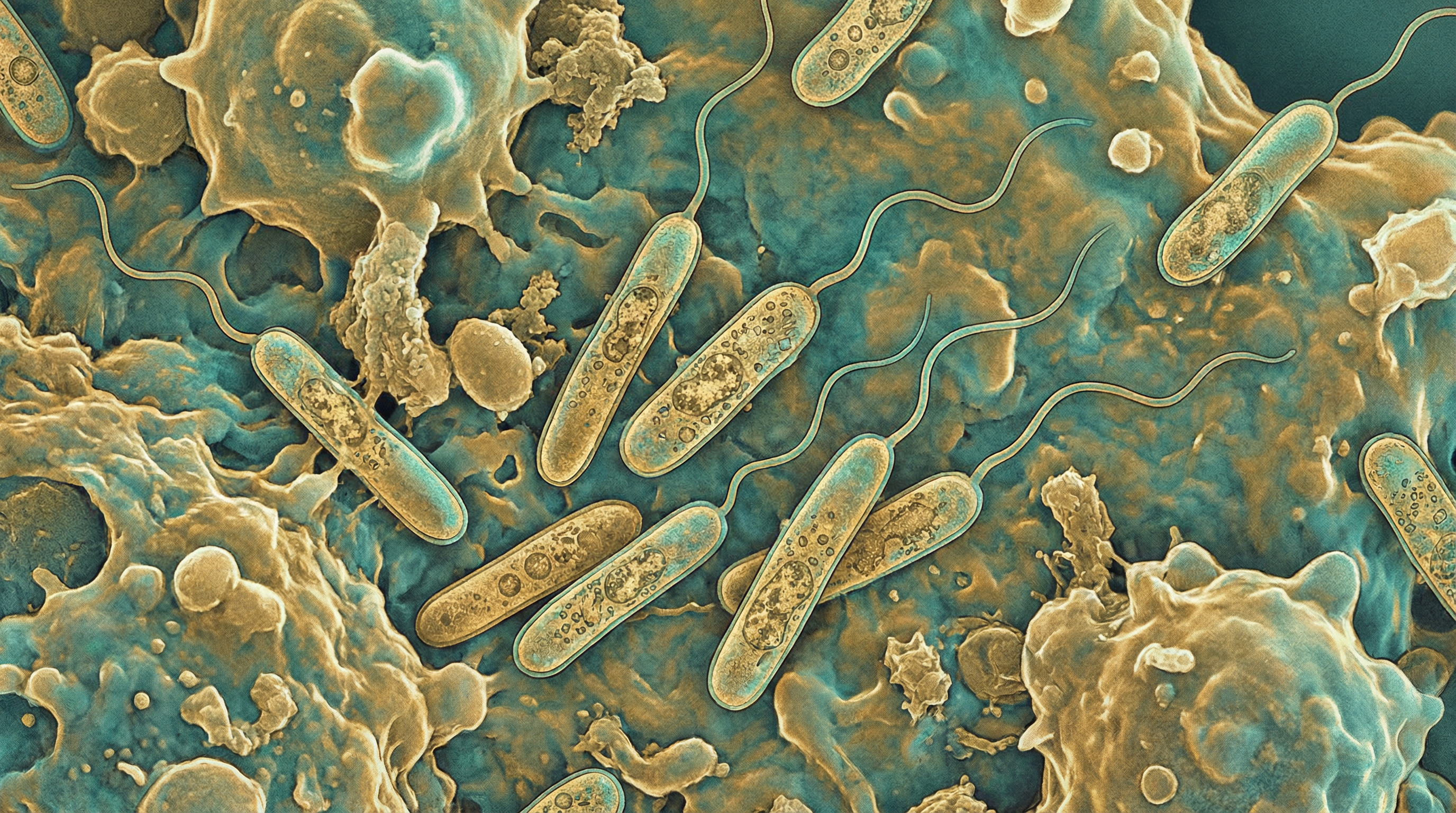
Legionella pneumophila is a Gram-negative, aerobic, rod-shaped bacterium belonging to the family Legionellaceae within the phylum Proteobacteria. It is the primary causative agent of Legionnaires' disease, a severe form of pneumonia. L. pneumophila possesses several distinctive characteristics:
- Rod-shaped (bacillus) morphology, approximately 0.3-0.9 μm in width and 2-20 μm in length
- Fastidious growth requirements, requiring specialized media supplemented with L-cysteine and iron salts
- Aerobic metabolism with optimal growth at temperatures between 35-37°C
- Motile with one or more polar or lateral flagella
- Non-spore forming and non-encapsulated
- Weakly catalase-positive and oxidase-positive
- Contains unique branched-chain fatty acids in its cell wall
- Exhibits pleomorphism, with filamentous forms observed under certain conditions
- Possesses a complex life cycle with distinct morphological and physiological forms
- Genome size of approximately 3.3-3.5 Mb with a G+C content of 38-39%
- Contains a large repertoire of eukaryotic-like proteins acquired through horizontal gene transfer
- Harbors a sophisticated type IV secretion system (Dot/Icm) essential for virulence
- Exhibits natural competence for DNA uptake under specific conditions
- Displays phase variation between replicative and transmissive forms
L. pneumophila is ubiquitous in freshwater environments, where it primarily exists as an intracellular parasite of free-living protozoa, particularly amoebae. The genus Legionella comprises over 60 species, with L. pneumophila being the most clinically relevant, responsible for approximately 90% of Legionnaires' disease cases. Among the 15 serogroups of L. pneumophila, serogroup 1 is the most common cause of human infection.
Role in Human Microbiome
L. pneumophila is not considered a normal component of the human microbiome. It is an environmental bacterium that opportunistically infects humans through inhalation of contaminated aerosols. Unlike many respiratory pathogens, L. pneumophila does not colonize the human respiratory tract under normal conditions and is not transmitted from person to person.
The relationship between L. pneumophila and the human microbiome can be characterized as follows:
Transient colonization: L. pneumophila only transiently colonizes the human respiratory tract during infection. It does not establish long-term colonization or become part of the normal respiratory microbiota.
Interaction with resident respiratory microbiota:
- The resident respiratory microbiota may provide colonization resistance against L. pneumophila
- Disruption of the normal respiratory microbiota (e.g., by antibiotics or underlying conditions) may increase susceptibility to L. pneumophila infection
- L. pneumophila infection can temporarily alter the composition of the respiratory microbiota due to inflammation and immune responses
Environmental microbiome interactions:
- L. pneumophila's primary ecological niche is within environmental biofilms and as an intracellular parasite of free-living amoebae
- It participates in complex microbial communities within water systems, where interactions with other microorganisms influence its survival, growth, and virulence
- Some environmental bacteria can inhibit L. pneumophila growth through production of antimicrobial compounds or competition for resources
- Others may enhance L. pneumophila persistence by providing nutrients or protection within biofilms
Amoeba-microbiome relationship:
- L. pneumophila's natural hosts (amoebae) harbor their own microbiome, which can influence L. pneumophila replication
- Amoebae can serve as "melting pots" for horizontal gene transfer between L. pneumophila and other intracellular bacteria
- Co-infection of amoebae with L. pneumophila and other bacteria can lead to exchange of genetic material and potentially increased virulence
Accidental pathogen concept:
- L. pneumophila evolved as an intracellular parasite of protozoa, not as a human pathogen
- Its ability to infect human cells is considered a consequence of the similarities between amoebae and human macrophages
- The virulence factors that allow L. pneumophila to survive and replicate within human cells evolved for interaction with protozoan hosts
While not a component of the normal human microbiome, understanding L. pneumophila's ecological relationships in environmental microbial communities is crucial for developing strategies to prevent human exposure and infection.
Health Implications
L. pneumophila is responsible for two distinct clinical syndromes: Legionnaires' disease and Pontiac fever. The health implications of L. pneumophila infection include:
Legionnaires' disease (Legionellosis):
- Severe form of pneumonia with an incubation period of 2-10 days
- Initial symptoms include fever, malaise, myalgia, headache, and anorexia
- Progresses to productive cough, chest pain, dyspnea, and respiratory distress
- Extrapulmonary manifestations may include gastrointestinal symptoms (diarrhea, nausea, vomiting), neurological symptoms (confusion, delirium), and renal dysfunction
- Mortality rate ranges from 5-30%, with higher rates in immunocompromised patients
- Requires antibiotic treatment, typically with macrolides or fluoroquinolones
- May lead to long-term sequelae including persistent fatigue, neurologic symptoms, and reduced lung function
Pontiac fever:
- Milder, self-limiting, flu-like illness without pneumonia
- Incubation period of 24-48 hours
- Symptoms include fever, headache, myalgia, and malaise
- Resolves spontaneously within 2-5 days without specific treatment
- No reported fatalities
- Thought to represent an inflammatory or hypersensitivity response to L. pneumophila rather than active infection
Risk factors for infection:
- Advanced age (>50 years)
- Male gender
- Smoking
- Chronic lung disease
- Immunocompromised status (e.g., transplant recipients, patients on corticosteroids)
- Underlying conditions such as diabetes, renal failure, or malignancy
- Recent travel with exposure to hotel water systems
- Exposure to contaminated water sources (cooling towers, hot tubs, decorative fountains)
Epidemiological impact:
- Estimated 8,000-18,000 hospitalizations for Legionnaires' disease annually in the United States
- Likely underdiagnosed and underreported globally
- Occurs both as sporadic cases and in outbreaks
- Seasonal pattern with more cases in summer and early fall
- Increasing incidence over the past two decades
- Economic burden from healthcare costs, outbreak investigations, and litigation
Public health significance:
- Preventable disease through proper design, maintenance, and disinfection of water systems
- Reportable disease in most countries
- Outbreaks often associated with hotels, hospitals, cruise ships, and cooling towers
- Emerging concern in healthcare facilities, particularly for immunocompromised patients
- No person-to-person transmission, limiting epidemic potential
The health impact of L. pneumophila extends beyond individual patients to include substantial public health resources devoted to surveillance, outbreak investigation, and implementation of preventive measures for water systems in buildings and facilities.
Metabolic Activities
L. pneumophila exhibits a complex and adaptable metabolism that reflects its dual lifestyle as an environmental organism and intracellular pathogen. Key aspects of its metabolism include:
Carbon metabolism:
- Primarily uses amino acids as carbon and energy sources
- Preferentially catabolizes serine, threonine, and glutamate
- Possesses complete Embden-Meyerhof-Parnas (EMP) pathway, Entner-Doudoroff (ED) pathway, and pentose phosphate pathway
- Utilizes the ED pathway as the main route for glucose metabolism
- Cannot use carbohydrates as sole carbon sources due to limited uptake mechanisms
- Stores carbon as poly-3-hydroxybutyrate (PHB) during nutrient limitation
- Exhibits biphasic metabolism corresponding to replicative and transmissive phases
Amino acid metabolism:
- Auxotrophic for several amino acids, including cysteine, arginine, isoleucine, leucine, threonine, valine, and methionine
- Possesses numerous proteases and aminopeptidases to acquire amino acids from host proteins
- Manipulates host cell metabolism to increase amino acid availability
- Employs the AnkB effector protein to trigger host proteasomal degradation, generating amino acids
- Upregulates amino acid transporters in the Legionella-containing vacuole (LCV) membrane
Energy generation:
- Strictly aerobic with a complete respiratory chain
- Uses oxygen as the terminal electron acceptor
- Generates ATP primarily through oxidative phosphorylation
- Cannot perform anaerobic respiration or fermentation
- Requires iron for numerous metabolic enzymes and respiratory chain components
Lipid metabolism:
- Synthesizes unique branched-chain fatty acids
- Produces phospholipases that target host cell membranes
- Manipulates host lipid metabolism to acquire lipids for bacterial membrane formation
- Redirects host cell phospholipid biosynthesis to the LCV
Nucleotide metabolism:
- Can synthesize purines and pyrimidines de novo
- Also capable of salvaging nucleotides from the host
- Secretes effector proteins that modulate host nucleotide metabolism
Metabolic adaptation during intracellular growth:
- Shifts metabolism between replicative and transmissive phases
- Replicative phase: high metabolic activity, amino acid catabolism, and protein synthesis
- Transmissive phase: reduced metabolism, accumulation of storage compounds, and increased stress resistance
- Senses amino acid availability as a trigger for phase transition
- Coordinates metabolism with virulence through global regulatory systems
Metabolic interactions with host cells:
- Exploits host metabolic resources without causing immediate cell death
- Redirects host vesicular trafficking to intercept nutrient-rich vesicles
- Manipulates host mitochondrial dynamics and function
- Modulates host cell amino acid transporters to increase nutrient availability
- Uses effector proteins to reprogram host metabolism in favor of bacterial replication
Unique metabolic features:
- Requires unusually high iron concentrations for optimal growth
- Absolute requirement for L-cysteine, which cannot be substituted by other sulfur sources
- Stringent response links metabolic state to virulence gene expression
- Metabolic dormancy during the mature intracellular form (MIF) and viable but non-culturable (VBNC) states
The metabolic versatility of L. pneumophila is essential for its survival in diverse environmental niches and its successful adaptation to intracellular growth within both protozoan and human hosts.
Clinical Relevance
L. pneumophila remains a significant pathogen of clinical importance for several reasons:
Diagnosis:
- Challenges in diagnosis:
- Clinical presentation may mimic other types of pneumonia
- Standard respiratory cultures often fail to detect Legionella
- Requires specialized media (buffered charcoal yeast extract with L-cysteine) for culture
- Slow growth (3-5 days) limits utility of culture for rapid diagnosis
- Diagnostic methods:
- Urinary antigen test: Rapid and specific for L. pneumophila serogroup 1, but misses other serogroups and species
- PCR: Increasing use for detection in respiratory specimens, high sensitivity and specificity
- Direct fluorescent antibody (DFA) staining: Allows rapid detection but lower sensitivity
- Serology: Requires paired acute and convalescent samples, limiting clinical utility
- Culture: Gold standard but technically demanding and slow
- Challenges in diagnosis:
Treatment:
- Antibiotic therapy:
- Macrolides (azithromycin) are first-line therapy
- Fluoroquinolones (levofloxacin, moxifloxacin) are effective alternatives
- Tetracyclines and trimethoprim-sulfamethoxazole as second-line options
- Combination therapy may be considered for severe cases
- Beta-lactams ineffective due to poor penetration into macrophages
- Treatment duration:
- Typically 7-14 days for mild to moderate disease
- Extended to 21 days for severe disease, immunocompromised patients
- Supportive care:
- Respiratory support ranging from oxygen supplementation to mechanical ventilation
- Management of complications including respiratory failure, shock, and multi-organ dysfunction
- Longer hospital stays compared to other community-acquired pneumonias
- Antibiotic therapy:
Prevention and control:
- Environmental control measures:
- Water system design to minimize stagnation and biofilm formation
- Maintenance of hot water temperatures above 60°C and cold water below 20°C
- Regular cleaning and disinfection of cooling towers, hot tubs, and decorative fountains
- Hyperchlorination, copper-silver ionization, or UV light treatment for high-risk settings
- Hospital infection control:
- Enhanced surveillance in healthcare facilities
- Water testing and monitoring programs
- Point-of-use filters for high-risk patient areas
- Proactive facility water management plans
- Environmental control measures:
Epidemiological significance:
- Surveillance:
- Reportable disease in most countries
- Active surveillance systems in many developed nations
- Molecular typing methods (sequence-based typing, whole genome sequencing) for outbreak investigation
- Outbreak patterns:
- Community outbreaks often linked to cooling towers
- Travel-associated cases frequently connected to hotel water systems
- Healthcare-associated cases particularly concerning due to vulnerable population
- Seasonal pattern with peaks in late summer and early fall
- Surveillance:
Emerging issues:
- Increasing incidence:
- Rising reported cases in many countries
- Unclear if due to improved detection or true increase
- Aging infrastructure and water systems may contribute
- Climate change implications:
- Warmer temperatures may favor Legionella growth in water systems
- Extreme weather events can disrupt water treatment
- Antimicrobial resistance:
- Currently uncommon but occasional reports of fluoroquinolone resistance
- Potential for development of resistance with increased antibiotic use
- Increasing incidence:
**Special p (Content truncated due to size limit. Use line ranges to read in chunks)