

Gut Health and Acne
Gut dysbiosis is linked to acne through inflammation, intestinal permeability and androgen signaling. What the evidence shows and what to change first.
Does Gut Health Affect Acne?
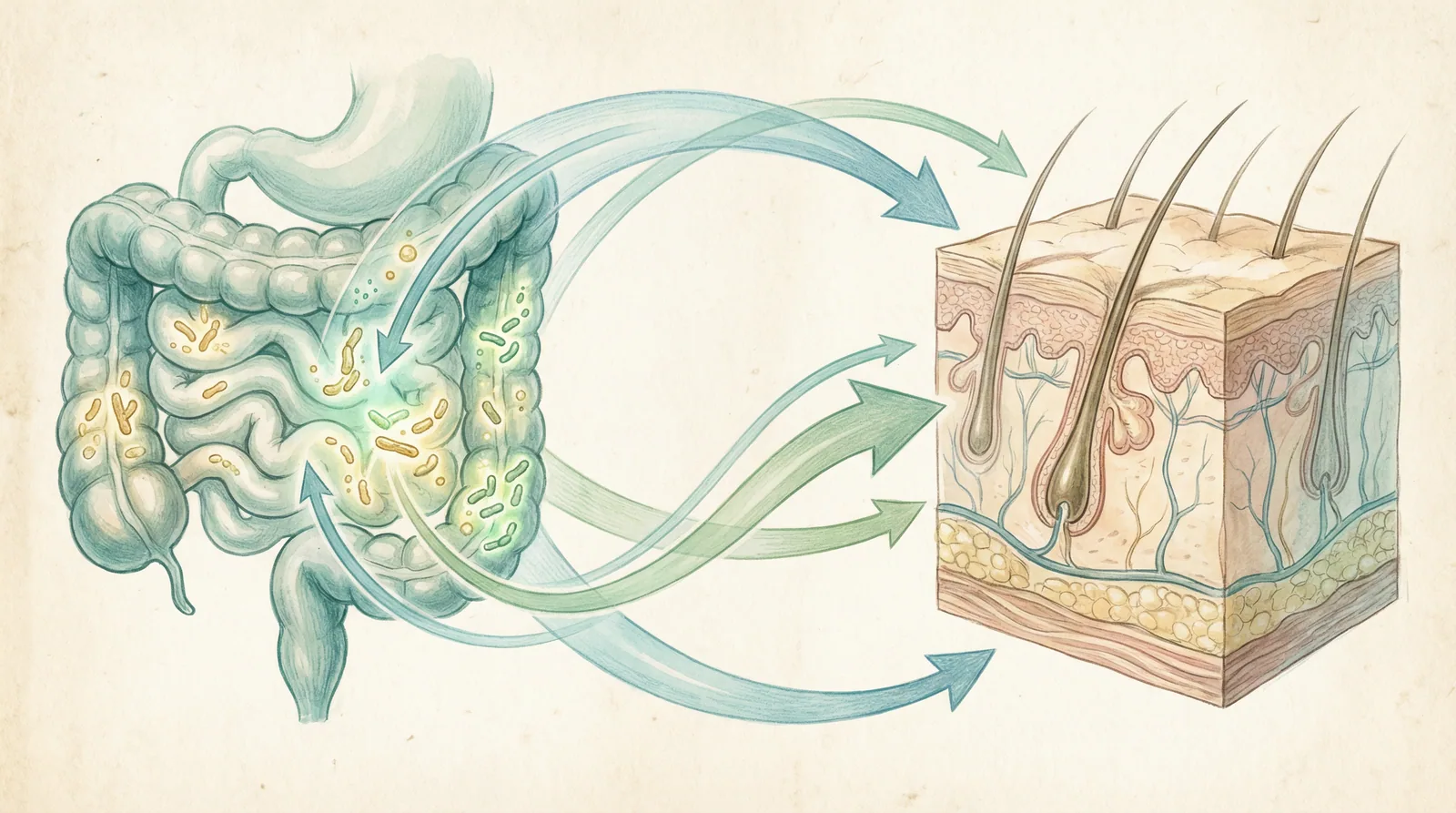
Yes, in part. Research links gut dysbiosis to acne, though the relationship is associative rather than proven causal. People with acne show reduced gut microbial diversity and fewer short-chain fatty acid producing bacteria than matched controls.[1] Three mechanisms are implicated: systemic inflammation, intestinal permeability, and microbial influence on insulin and androgen signaling.[2]
What that does not mean is that acne is a gut disease. Acne vulgaris is an inflammatory condition of the pilosebaceous unit, and sebum production, follicular keratinization, Cutibacterium acnes activity and genetics all remain central to it.[3] The gut appears to be a modifier — one that is easier to change than the others, and one that conventional acne care rarely addresses.
How Gut Dysbiosis Influences Acne
The gut-skin axis is a bidirectional communication system in which intestinal microbial composition influences distant skin inflammation.[2] Four routes have been described.
Systemic inflammation
Dysbiosis can shift the balance of pro- and anti-inflammatory signaling. In a case-control study comparing 43 treatment-naive patients with acne against 43 matched controls, gut samples from the acne group showed depletion of Lachnospiraceae and Ruminococcaceae, two families that produce short-chain fatty acids with anti-inflammatory and barrier-supporting effects.[1]
Intestinal permeability
When barrier integrity is reduced, bacterial products can reach systemic circulation and provoke an immune response. Predictive functional analysis of acne patients' gut microbiomes found enrichment of lipopolysaccharide biosynthesis pathways, which is consistent with — but not proof of — greater endotoxin exposure.[1]
Insulin and androgen signaling
This is the most mechanistically specific link. Insulin and IGF-1 drive sebum production and follicular hyperkeratinization, and gut microbes participate in both glycemic regulation and androgen metabolism. In a randomized trial, 12 weeks of a Lactobacillus rhamnosus SP1 supplement reduced skin IGF-1 expression by 32% and increased FOXO1 expression by 65%, moving both markers toward the pattern seen in unaffected skin.[4]
Nutrient status
Dysbiosis can impair absorption of nutrients relevant to skin repair and inflammation control, including zinc, vitamin A and omega-3 fatty acids.[5]
How to Tell if Your Acne Might Be Gut-Related
No pattern here is diagnostic, and no validated test identifies gut-driven acne. These are features that make a gut contribution more plausible, and reasons to raise it with a clinician — not criteria to self-diagnose from.
- Digestive symptoms alongside the breakouts. Bloating, irregular bowel habit, abdominal pain and constipation have long been described alongside acne, often at a level people do not think of as a gut problem.[5]
- Adult-onset or persistent acne. Acne that begins or continues well past the teenage years is less readily explained by pubertal hormone shifts alone.
- Onset or worsening after antibiotics. Antibiotic courses used for acne measurably alter the gut microbiome, with reductions in Bifidobacterium and Akkermansia species reported after treatment.[6]
- Partial or poor response to topical therapy alone. This is non-specific, but it is often what prompts people to look upstream.
- Location is not a reliable signal. Despite what face-mapping charts claim, there is no evidence that chin, jawline or back acne indicates a specific organ. Back and chest involvement reflects sebaceous gland density, not gut anatomy.
Gut-Related vs. Hormonal Acne
These are not two separate diseases competing for the same person. Androgen and insulin signaling is the shared pathway: gut microbes participate in androgen metabolism, and the one trial that examined skin gene expression found a probiotic shifted IGF-1 and FOXO1, both of which sit upstream of androgen receptor activity in sebaceous glands.[4] The table below describes patterns clinicians commonly use to weight one contribution over the other. They overlap heavily and none is confirmatory.
| Feature | More suggestive of a gut contribution | More suggestive of a hormonal driver |
|---|---|---|
| Timing | No relation to the menstrual cycle; may follow antibiotics, a GI illness, or a period of sustained stress | Predictable premenstrual flares; often changes with hormonal contraception |
| Distribution | Variable; face, chest and back may be involved together | Often concentrated on the lower face, jawline and neck |
| Accompanying symptoms | Bloating, irregular bowel habit, reflux, food intolerance | Irregular or absent periods, excess hair growth, scalp hair thinning |
| Useful next step | Dietary and microbiome-directed changes, alongside standard dermatologic care | Assessment for PCOS or other endocrine causes |
If the hormonal picture predominates, the PCOS gut microbiome protocol covers the androgen-microbiome overlap in more depth. Neither route replaces dermatologic assessment.
Acne, IBS, SIBO, and Leaky Gut
These three come up constantly in searches about gut health and acne, and the evidence behind each differs sharply.
Leaky gut. Increased intestinal permeability is a proposed mechanism, not an established cause. It is biologically plausible, is supported indirectly by the enrichment of lipopolysaccharide pathways found in acne patients' gut microbiomes, and remains difficult to measure reliably outside research settings.[1][2] Background on the barrier itself is covered in our guide to probiotics for leaky gut.
SIBO. The strongest evidence in this space concerns rosacea, not acne. In a controlled study, small intestinal bacterial overgrowth was found in 52 of 113 rosacea patients compared with 3 of 60 controls, and eradicating it produced skin improvement.[7] No equivalent controlled trial exists in acne vulgaris. Anyone extending that finding to acne is extrapolating; the SIBO overview and the SIBO and IMO protocol cover what is actually established.
IBS. There is no established causal relationship between IBS and acne. Both are common, so co-occurrence is expected by chance alone. What the two share is a plausible dependence on gut microbial composition, which is why the same dietary levers appear in both contexts.
Key Microorganisms in Acne
Both gut and skin microbiomes are involved, and the skin side is more about strain identity than bacterial load.[1]
Gut microbiome
- Depleted in acne: short-chain fatty acid producers within Lachnospiraceae and Ruminococcaceae, and Bifidobacterium in several cohorts.[1][6]
- Relatively increased: Proteobacteria, a phylum containing many lipopolysaccharide-bearing organisms.[6]
Skin microbiome
- Cutibacterium acnes (formerly Propionibacterium acnes): abundant on healthy skin as well as acne-affected skin. Severity tracks with phylotype and metabolic output rather than total load.[3]
- Staphylococcus epidermidis: may restrain C. acnes growth and inflammation.
- Malassezia species: these commensal fungi contribute to inflammatory folliculitis in some people.
What to Change First
Ordered by how well the change is supported, not by how much attention it gets. None of this replaces treatment prescribed by a dermatologist, and moderate to severe or scarring acne warrants medical care regardless of diet.
1. Lower the glycemic load of your diet
This has the best trial evidence of anything on this page. In a 12-week randomized controlled trial in 43 males aged 15 to 25, total lesion counts fell by 23.5 on a low-glycemic-load diet versus 12.0 on the control diet.[8] Practically, that means displacing refined flour products, sugary drinks, sweetened breakfast cereals and confectionery, rather than eliminating carbohydrate. Legumes, intact whole grains, and whole fruit are the usual replacements, and they also feed the fiber-fermenting bacteria depleted in acne.
2. Run a time-limited dairy trial
A meta-analysis of 78,529 people aged 7 to 30 found an odds ratio of 1.25 for acne with any dairy intake, rising to 1.32 for low-fat or skim milk.[9] But the same research group's Mendelian randomization study of 20,416 Danish adults found no genetic evidence that milk intake causes adult acne.[10] Read together, that is a real association with unproven causality — which is exactly the situation a personal trial suits. Thirty days off dairy, then reintroduce and observe, gives you an answer for you specifically without a permanent restriction. Replace, don't just remove, so calcium and protein intake hold.
3. Add fermented foods and fiber
No trial has tested fermented foods as an acne treatment, so the rationale is mechanistic rather than proven: the SCFA producers depleted in acne cohorts depend on fermentable fiber.[1] Prebiotic foods such as onions, leeks, garlic, oats, legumes and slightly under-ripe bananas are the practical route. Increase gradually if bloating is already a problem.
4. Consider a strain-specific probiotic
Strain matters more than genus or CFU count here, because the evidence attaches to specific isolates rather than to "probiotics" as a category. The trials are summarized below.
5. Address stress
Psychological stress alters gut microbial composition and intestinal permeability, forming the gut-brain-skin axis described decades before the microbiome was sequenced.[5] This is the least measurable item on the list and one of the more consistently reported.

Probiotic Strains With Human Trial Data in Acne
| Strain | Dose used in trial | Duration | What the trial found |
|---|---|---|---|
| Lacticaseibacillus rhamnosus SP1 (LSP1) | 3 × 10⁹ CFU/day, liquid | 12 weeks | Skin IGF-1 expression fell 32% and FOXO1 rose 65% versus no change on placebo; participants were more likely to be rated improved by a physician, though with a very wide confidence interval in only 20 people[4] |
| Lacticaseibacillus rhamnosus CECT 30031 with Arthrospira platensis | One capsule daily | 12 weeks | Non-inflammatory lesions fell 18.6 versus 10.5 on placebo (p = 0.03); the difference in total lesions (27.9 vs 18.3) did not reach significance, and inflammatory lesions did not differ[11] |
| Lactiplantibacillus plantarum CJLP55 | 1 × 10¹⁰ CFU/day | 12 weeks | Reduced lesion counts and sebum triglycerides with increased skin hydration versus placebo, in 28 adults aged 19 to 39[12] |
| L. acidophilus, L. delbrueckii subsp. bulgaricus and B. bifidum blend | Twice daily, with standard topical therapy | 12 weeks | Given with minocycline, produced a greater lesion-count reduction at 8 and 12 weeks than either the probiotic or the antibiotic alone; open-label, 45 participants[13] |
The honest caveat. Each of these trials is small, and pooling them does not preserve the effect. A 2026 GRADE systematic review and meta-analysis of randomized Lactobacillus trials found no statistically significant reduction in inflammatory lesions, non-inflammatory lesions or total lesion counts against placebo or benzoyl peroxide.[14] Individual strain results are promising and the category-level evidence is not yet convincing. Our guide to choosing microbiome supplements covers how to read strain designations on a label.
How Long Does It Take?
Almost every trial in this area runs to a 12-week endpoint, which is a reasonable expectation to set. Nothing here works in a fortnight.
| Timepoint | What the trials show |
|---|---|
| 4 weeks | Lesion counts had already fallen significantly in all arms of the probiotic-plus-minocycline trial, including the probiotic-only arm[13] |
| 8 weeks | The combined probiotic and antibiotic arm separated from either treatment alone[13] |
| 12 weeks | The standard endpoint for diet and probiotic trials in acne, and the point at which the low-glycemic-load diet trial reported its results[8][4] |
| Beyond 12 weeks | The gap between probiotic and placebo groups was still widening at week 12 in one trial, whose authors concluded longer treatment may be needed to detect an effect on inflammatory lesions[11] |
More general guidance on how long probiotics take to work applies here too.
How Strong Is the Evidence?
| Approach | Evidence level | What the strongest studies show |
|---|---|---|
| Low-glycemic-load diet | Moderate | A 12-week RCT found roughly double the lesion reduction of a control diet[8] |
| Reducing dairy | Mixed | Consistent observational association (OR 1.25) but no genetic support for causality[9][10] |
| Oral probiotics | Preliminary | Individual RCTs report benefits; a pooled meta-analysis of Lactobacillus trials does not[11][14] |
| Topical probiotics and postbiotics | Preliminary | Small trials report reduced inflammatory lesions and improved barrier function, plausibly via immune regulation at the skin surface; trials are short and comparators vary[6][15] |
| Prebiotics and fermented foods | Preliminary | No acne-specific trial; rationale rests on restoring depleted SCFA producers[1] |
| Stress reduction | Preliminary | Mechanistically well described in the gut-brain-skin literature, hard to trial[5] |
Gut Testing for Acne
No microbiome test can diagnose gut-driven acne or predict who will respond to a dietary change. The research linking gut composition to acne is based on group-level differences between cohorts, and those differences are not large or consistent enough to interpret in one person. Consumer stool tests can be useful for tracking diversity and SCFA producers over time, but a "dysbiosis score" is not a clinical finding. Our guide to microbiome testing explains what these panels can and cannot tell you. Persistent digestive symptoms warrant a clinician's assessment rather than a direct-to-consumer panel.
The Gut-Brain-Skin Axis
The connection extends beyond the gut and skin to include the nervous system. Psychological stress can alter gut microbiome composition, increase intestinal permeability, and amplify inflammatory signaling — a loop first proposed by dermatologists in the 1930s and revisited with modern methods.[5] It is one reason stress management belongs in a comprehensive acne plan rather than being treated as an afterthought, and it is a mechanism the gut restoration protocol is built around.
What's Next in Microbiome-Based Acne Research
Research is converging on strain-level and personalized approaches rather than broad probiotic categories.[3] Directions under active investigation include strain-specific formulations targeting the imbalances documented in acne cohorts, precision prebiotics designed to feed depleted taxa, bacteriophage therapy aimed at problematic C. acnes phylotypes while sparing beneficial ones, and postbiotics that deliver bacterial metabolites without live organisms. Mendelian randomization work has begun to test which of these associations are causal, identifying Bifidobacterium among the genera with a possible causal relationship to acne mediated through fatty acid metabolism.[16]
Key Takeaways
- Gut dysbiosis is consistently associated with acne, but causality is not established.[1][2]
- Three mechanisms carry the link: systemic inflammation, intestinal permeability, and microbial influence on insulin and androgen signaling.[4]
- The best-supported change is lowering dietary glycemic load; a dairy reduction trial is a reasonable second step given a real association with unproven causality.[8][9]
- Four probiotic strains have human trial data in acne, but a pooled meta-analysis of Lactobacillus trials found no significant effect — strain-level results should not be read as category-level proof.[14]
- Expect a 12-week horizon, not a two-week one.[11]
- Gut-related and hormonal acne are overlapping rather than mutually exclusive; androgen signaling is the shared pathway.
This page is a research summary and does not constitute medical advice. Acne that is painful, nodular, scarring, or not improving should be assessed by a dermatologist or other qualified clinician. Do not stop or change prescribed treatment, and discuss supplements with a clinician if you are pregnant, immunocompromised, or taking other medication.
Common Symptoms
Microbiome Imbalances
Research has identified the following microbiome patterns commonly associated with this condition:
- Gut dysbiosis
- Increased intestinal permeability
- Elevated Cutibacterium acnes
- Reduced skin microbiome diversity
Research Summary
Observational studies consistently find that people with acne have a different gut microbiome from matched controls, including reduced diversity and fewer short-chain fatty acid producers. Randomized trials support a low-glycemic-load diet, and individual probiotic trials report improvements in lesion counts and skin insulin signaling, though a pooled meta-analysis of Lactobacillus trials did not find a statistically significant benefit. The relationship remains associative rather than proven causal.
Beneficial Microbes for This Condition
Research has identified these microorganisms as potentially beneficial for managing this condition. Click through to learn about specific strains and the clinical evidence behind them.
Frequently Asked Questions
Can an unhealthy gut cause acne?
The evidence links gut dysbiosis to acne but does not prove it causes acne. People with acne repeatedly show reduced gut microbial diversity and fewer short-chain fatty acid producing bacteria than matched controls, and three plausible mechanisms exist: systemic inflammation, intestinal permeability, and microbial influence on insulin and androgen signaling. Most of this research is observational, so the direction of the relationship is not settled.
How do you know if your gut health is causing acne?
There is no validated test that identifies gut-driven acne, and no pattern is diagnostic. Features that make a gut contribution more plausible include concurrent digestive symptoms such as bloating or irregular bowel habit, adult-onset or persistent acne, onset or worsening after a course of antibiotics, and limited response to topical treatment alone. A dermatologist should still assess the acne itself.
How can I improve my gut health for acne?
The change with the strongest trial evidence is lowering the glycemic load of the diet: a 12-week randomized trial found roughly twice the reduction in lesion counts on a low-glycemic-load diet compared with a control diet. Beyond that, a time-limited dairy reduction trial, regular fiber and fermented foods, and stress management are reasonable steps. Discuss any change with a clinician.
Is hormonal acne related to gut health?
The two overlap rather than compete. Gut microbes participate in the metabolism of androgens and in insulin and IGF-1 signaling, which sit upstream of sebum production. One randomized trial found that a Lactobacillus rhamnosus SP1 supplement changed skin expression of IGF-1 and FOXO1, genes tied to androgen receptor activation. Hormonal acne is not simply a gut problem, but the pathways intersect.
Can IBS or SIBO cause acne?
No controlled study has established that IBS or SIBO causes acne. The clearest data in this area concerns rosacea, not acne: one study found small intestinal bacterial overgrowth in 52 of 113 rosacea patients versus 3 of 60 controls, and skin improved after eradication. Whether the same applies to acne has not been tested, so treat any claimed link as unproven.
Can leaky gut cause acne?
Increased intestinal permeability is one of the proposed mechanisms connecting the gut to acne, not a demonstrated cause of it. Analysis of gut microbiome data from acne patients has found enrichment of lipopolysaccharide synthesis pathways, which is consistent with greater endotoxin exposure but does not prove it. Intestinal permeability is also difficult to measure reliably outside research settings.
Which probiotic strains have evidence for acne?
Four have human trial data in acne: Lacticaseibacillus rhamnosus SP1, Lacticaseibacillus rhamnosus CECT 30031 combined with Arthrospira platensis, Lactiplantibacillus plantarum CJLP55, and a Lactobacillus acidophilus, Lactobacillus delbrueckii subsp. bulgaricus and Bifidobacterium bifidum blend used alongside minocycline. Trials are small, and a pooled meta-analysis of Lactobacillus trials found no statistically significant effect on lesion counts.
How long does it take for gut changes to improve acne?
Trials in this area almost all measure outcomes at 12 weeks. Lesion counts began falling by four weeks in one probiotic trial, and differences between treatment and control groups usually widened between eight and twelve weeks. One trial's authors noted the gap was still widening at 12 weeks, suggesting longer courses may be needed. Expect months rather than weeks.
Does dairy cause acne?
Dairy is associated with acne but causation is unsettled. A meta-analysis of 78,529 people aged 7 to 30 found an odds ratio of 1.25 for acne with any dairy intake, and 1.32 for low-fat or skim milk. However, a Mendelian randomization study of 20,416 Danish adults found no genetic evidence that milk intake causes adult acne.
References
- Deng Y, Wang H, Zhou J, Mou Y, Wang G, Xiong X.. Patients with acne vulgaris have a distinct gut microbiota in comparison with healthy controls. Acta Dermato-Venereologica. 2018;98(8):783-790. doi:10.2340/00015555-2968 ↩
- Salem I, Ramser A, Isber N, Tober A.. The gut microbiome as a major regulator of the gut-skin axis. Frontiers in Microbiology. 2018;9:1459. doi:10.3389/fmicb.2018.01459 ↩
- Podwojniak A, Tan IJ, Sauer J, et al.. Acne and the cutaneous microbiome: A systematic review of mechanisms and implications for treatments. Journal of the European Academy of Dermatology and Venereology. 2025;39(4):793-805. doi:10.1111/jdv.20332 ↩
- Fabbrocini G, Bertona M, Picazo Ó, Pareja-Galeano H, Monfrecola G, Emanuele E.. Supplementation with Lactobacillus rhamnosus SP1 normalises skin expression of genes implicated in insulin signalling and improves adult acne. Beneficial Microbes. 2016;7(5):625-630. doi:10.3920/BM2016.0089 ↩
- Bowe WP, Logan AC.. Acne vulgaris, probiotics and the gut-brain-skin axis - back to the future?. Gut Pathogens. 2011;3(1):1. doi:10.1186/1757-4749-3-1 ↩
- Sánchez-Pellicer P, Navarro-Moratalla L, Núñez-Delegido E, et al.. Acne, microbiome, and probiotics: the gut-skin axis. Microorganisms. 2022;10(7):1303. doi:10.3390/microorganisms10071303 ↩
- Parodi A, Paolino S, Greco A, et al.. Small intestinal bacterial overgrowth in rosacea: clinical effectiveness of its eradication. Clinical Gastroenterology and Hepatology. 2008;6(7):759-764. doi:10.1016/j.cgh.2008.02.054 ↩
- Smith RN, Mann NJ, Braue A, Mäkeläinen H, Varigos GA.. A low-glycemic-load diet improves symptoms in acne vulgaris patients: a randomized controlled trial. American Journal of Clinical Nutrition. 2007;86(1):107-115. doi:10.1093/ajcn/86.1.107 ↩
- Juhl CR, Bergholdt HKM, Miller IM, Jemec GBE, Kanters JK, Ellervik C.. Dairy intake and acne vulgaris: a systematic review and meta-analysis of 78,529 children, adolescents, and young adults. Nutrients. 2018;10(8):1049. doi:10.3390/nu10081049 ↩
- Juhl CR, Bergholdt HKM, Miller IM, Jemec GBE, Kanters JK, Ellervik C.. Lactase persistence, milk intake, and adult acne: a Mendelian randomization study of 20,416 Danish adults. Nutrients. 2018;10(8):1041. doi:10.3390/nu10081041 ↩
- Eguren C, Navarro-Blasco A, Corral-Forteza M, et al.. A randomized clinical trial to evaluate the efficacy of an oral probiotic in acne vulgaris. Acta Dermato-Venereologica. 2024;104:adv33206. doi:10.2340/actadv.v104.33206 ↩
- Kim MJ, Kim KP, Choi E, et al.. Effects of Lactobacillus plantarum CJLP55 on clinical improvement, skin condition and urine bacterial extracellular vesicles in patients with acne vulgaris: a randomized, double-blind, placebo-controlled study. Nutrients. 2021;13(4):1368. doi:10.3390/nu13041368 ↩
- Jung GW, Tse JE, Guiha I, Rao J.. Prospective, randomized, open-label trial comparing the safety, efficacy, and tolerability of an acne treatment regimen with and without a probiotic supplement and minocycline in subjects with mild to moderate acne. Journal of Cutaneous Medicine and Surgery. 2013;17(2):114-122. doi:10.2310/7750.2012.12026 ↩
- Abedin ZU, Shah A, Mazhar S, et al.. Lactobacillus-based microbiome therapy for acne vulgaris: a GRADE systematic review and meta-analysis of randomized controlled trials. Journal of Cosmetic Dermatology. 2026;25(3):e70792. doi:10.1111/jocd.70792 ↩
- Kober MM, Bowe WP.. The effect of probiotics on immune regulation, acne, and photoaging. International Journal of Women's Dermatology. 2015;1(2):85-89. doi:10.1016/j.ijwd.2015.02.001 ↩
- He X, Zhang Z, Jiang H, et al.. Causal association of gut microbes and blood metabolites with acne identified through systematic mendelian randomization. Scientific Reports. 2024;14:26816. doi:10.1038/s41598-024-78603-z ↩