

Overview
Lactobacillus acidophilus (commonly abbreviated as L. acidophilus or simply "acidophilus") is a Gram-positive, rod-shaped, non-spore-forming, homofermentative bacterium that naturally colonizes the human gastrointestinal and urogenital tracts. It is widely regarded as the most-studied member of the Lactobacillus family and one of the most extensively researched probiotic bacteria overall, with decades of clinical trials spanning digestive health, immune support, allergy management, and metabolic function.[1]
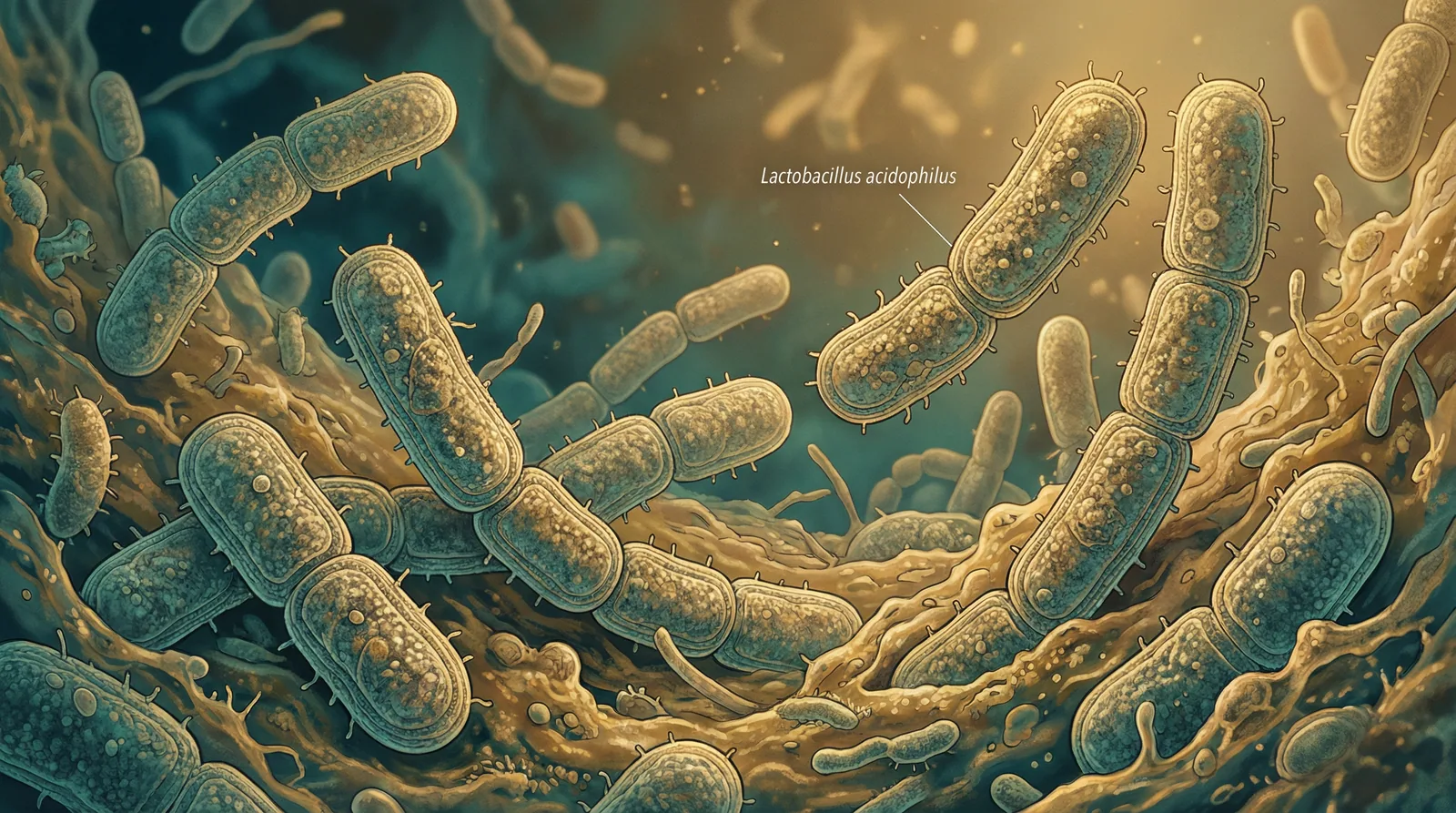
As a lactobacillus probiotic, L. acidophilus produces lactic acid, which helps maintain an acidic environment in the gut and vagina, inhibiting the growth of harmful bacteria. It also produces natural antibiotics called bacteriocins that can directly kill pathogenic microorganisms. The NCFM strain of L. acidophilus was the first of its species to have its complete genome sequenced, enabling researchers to identify the precise molecular mechanisms behind its probiotic effects — including the first demonstration that a probiotic can modulate opioid receptors in the human gut.[2]
Intestinal Barrier Protection
Tight Junction Enhancement
Recent research has identified strain-specific mechanisms by which L. acidophilus protects intestinal barrier function. The LA1 strain uniquely enhances tight junction (TJ) integrity through a TLR-2 and PI3K-dependent pathway that inhibits NF-κB activation.[1] Pre-treatment with LA1 prevents TNF-α-induced increases in intestinal permeability by blocking the activation of myosin light chain kinase (MLCK), a key effector of TJ disruption in inflammatory bowel disease.
Importantly, LA1 demonstrates a novel cell-type-specific regulatory effect: while it activates NF-κB p50/p65 in immune cells through a TLR-2- and MyD88-dependent mechanism, it paradoxically inhibits NF-κB activation in intestinal epithelial cells through a TLR-2-dependent but MyD88-independent pathway.[1] This dual regulatory capacity positions intestinal epithelial TLR-2 receptors as evolutionarily advantageous sensors that enhance barrier function in response to commensal bacteria rather than triggering inflammation.
Antimicrobial Peptide Induction
L. acidophilus strains stimulate the expression of multiple antimicrobial peptides that strengthen mucosal defense:
- β-defensin 2 (hBD-2): Induces dose-dependent expression and secretion via NF-κB and AP-1 pathways[3]
- Angiogenin-4: Enhanced expression through IL-17-dependent mechanisms[4]
- Reg3g and Reg3b: Promoted via IL-17-dependent innate defense responses[4]
- Defa4 (α-defensin 4): Upregulated independently of IL-17 signaling[4]
Immune Modulation
Strain-Specific Immunoregulatory Properties
The NCK2025 strain, engineered to be deficient in lipoteichoic acid (LTA), exhibits profound immunoregulatory effects through enhanced IL-10 production and reduced IL-12/TNF-α secretion by dendritic cells.[5] This LTA-deficient strain:
- Induces CD4+FoxP3+ regulatory T cells (Tregs)
- Down-regulates costimulatory molecules (CD40, CD86) on dendritic cells
- Prevents and treats DSS-induced colitis with up to 90% reduction in histological scores
- Shifts immune responses toward regulatory phenotypes
IL-17 and IL-22 Pathway Activation
The BIO5768 strain demonstrates unique capacity to trigger IL-17-dependent innate defense responses independently of NOD2 signaling, making it potentially valuable for Crohn's disease patients with NOD2 mutations.[4] This strain:
- Enhances maturation of bone marrow-derived dendritic cells (BMDCs)
- Supports IL-17 secretion by CD4+ T cells
- Activates type 3 innate lymphoid cells (ILC3) to produce IL-22
- Promotes antimicrobial peptide secretion by intestinal epithelial cells
Pathogen Inhibition
E. coli O157:H7 Suppression
The La-5 strain secretes quorum-quenching molecules that interfere with E. coli O157:H7 cell-to-cell signaling, resulting in remarkable protective effects:[6]
- 76% reduction in EHEC adherence to epithelial cells
- 100% survival in mouse models versus 40% control
- 10,000-fold reduction in fecal shedding
- Inhibition of attaching and effacing lesion formation
These secreted molecules are heat-stable, pH-resistant (pH 2.0-10.0), and likely consist of short peptide chains that block EHEC virulence gene expression.
H. pylori Eradication Enhancement
Inactivated L. acidophilus LB strain significantly improves Helicobacter pylori eradication when combined with standard triple therapy.[7] In a randomized controlled trial of 120 patients:
- Eradication rates increased from 70-72% to 87-88% (p<0.05)
- Mechanism involves inhibition of H. pylori attachment to gastric epithelium
- Effect persists even with lyophilized and inactivated bacterial preparations
Metabolic Health Benefits
Obesity Prevention Through Akkermansia Enhancement
The LA5 strain exhibits anti-obesity properties through promotion of Akkermansia muciniphila, a beneficial mucin-degrading bacterium.[8] LA5 administration in high-fat diet mice demonstrated:
2,000-fold increase in colonic A. muciniphila abundance
- Mechanism: fecal pH acidification from pH >6.5 to optimal 6.5 for Akkermansia growth
- Reduced body weight, visceral fat mass, and liver steatohepatitis
- Improved lipid profiles (triglycerides, total cholesterol, LDL, HDL)
- Strengthened gut barrier integrity and reduced endotoxemia
Bile Salt Metabolism
L. acidophilus NCFM encodes two bile salt hydrolase (BSH) genes (bshA and bshB) that deconjugate bile salts, contributing to:[9]
- Cholesterol-lowering effects through bile acid metabolism
- Enhanced colonization and survival in the gastrointestinal tract
- Reduced serum cholesterol and liver triglycerides in animal models
- Modulation of host metabolic signaling through altered bile acid profiles
The BSH repertoire reflects evolutionary adaptation to vertebrate-associated niches, with 93.75% of L. acidophilus strains encoding BSH proteins.
Clinical Applications
Inflammatory Bowel Disease
L. acidophilus strains demonstrate protective effects against experimental colitis through multiple mechanisms:
TNBS-Induced Colitis:
- Significant reduction in macroscopic Wallace scores[4]
- Decreased histological Ameho scores
- Down-regulation of pro-inflammatory cytokines (TNF-α, IL-6, CXCL2)
Infectious Colitis (Citrobacter rodentium):
- Improved colon length and reduced inflammation[4]
- Attenuation of pro-inflammatory gene expression (IL-1β, IL-6, TNF-α)
- Enhanced antimicrobial peptide production
Optimal Candidates for Supplementation
Based on clinical and mechanistic evidence, L. acidophilus supplementation may particularly benefit:
- Individuals with compromised intestinal barrier function ("leaky gut")
- Patients with IBS or mild inflammatory bowel conditions
- Those with lactose intolerance
- Women with recurrent vaginal infections
- Individuals on H. pylori eradication therapy
- Crohn's disease patients with NOD2 mutations (strain BIO5768)
Mechanisms of Action Summary
L. acidophilus exerts beneficial effects through:
- Direct pathogen antagonism: Lactic acid production, bacteriocin secretion, competitive exclusion
- Barrier enhancement: TLR-2/PI3K-mediated tight junction strengthening, mucin production stimulation
- Immune modulation: DC maturation, Treg induction, balanced Th1/Th17 responses
- Metabolic regulation: BSH activity, promotion of beneficial Akkermansia, SCFA modulation
- Anti-inflammatory molecule production: 50-100 kDa peptides that reduce cytokine responses
Dietary Sources and Supplementation
Natural sources of L. acidophilus include:
- Yogurt and fermented dairy products
- Kefir
- Sauerkraut and fermented vegetables
- Miso and tempeh
Supplementation considerations:
- Typical probiotic doses: 10⁸-10⁹ CFU/day
- Strain-specific effects: LA1, LA5, NCFM, BIO5768 strains show distinct properties
- Delivery matrix matters: capsules may differ from yogurt delivery
- Both live and heat-inactivated preparations can be effective
L. Acidophilus as a Probiotic Supplement
Lactobacillus acidophilus is one of the most widely available probiotic supplements worldwide, found in single-strain capsules, multi-strain formulas, and fortified foods. When choosing an acidophilus probiotic supplement, strain selection is critical — the name "L. acidophilus" alone is not sufficient, as different strains have different clinical evidence profiles.
Which L. Acidophilus Strain to Choose
- NCFM: The best choice for bloating, visceral pain, immune support in children, and insulin sensitivity. This is the most genomically characterized lactobacillus probiotic strain, with evidence from multiple randomized controlled trials.[10][11][12]
- La-5: Typically used in combination with Bifidobacterium BB-12, with evidence for antibiotic-associated diarrhea, IBS symptom relief, and cholesterol management in type 2 diabetes.[13]
- L-92: A heat-killed paraprobiotic specifically studied for atopic dermatitis and allergic rhinitis, with a unique immune-rebalancing mechanism.[14]
Dosing Guidelines
Research suggests effective doses of L. acidophilus vary by strain and condition:
- NCFM: 1-20 billion CFU per day (immune support in children used lower doses; bloating trials used higher doses combined with Bi-07)
- La-5: Typically 1-10 billion CFU per day, almost always combined with BB-12
- L-92: 20 mg per day of heat-killed preparation (not measured in CFU)
What to Look For in a Supplement
When selecting an acidophilus supplement, consider these evidence-based criteria:
- Strain designation: Products should specify the exact strain (e.g., "NCFM" or "La-5"), not just "L. acidophilus"
- CFU guarantee through expiration: The live bacteria count at manufacturing is less meaningful than what survives to expiration
- Third-party testing: Independent verification of contents and potency
- Storage requirements: Some acidophilus strains require refrigeration; others are shelf-stable
- Complementary strains: Research suggests L. acidophilus often performs best in combination with Bifidobacterium species
For broader context on how L. acidophilus fits into the probiotic landscape, see our guide on probiotics and beneficial bacteria. To understand how acidophilus supports digestive health goals, explore our digestive health section.
Interactions with Other Gut Bacteria
L. acidophilus exhibits important ecological relationships with other members of the gut microbiome:
- Cross-feeding with Akkermansia muciniphila: The La-5 strain has been shown to increase A. muciniphila abundance by over 2,000-fold in animal models, likely through fecal pH acidification that creates favorable growth conditions.[8]
- Synergy with Bifidobacterium species: Multiple clinical trials demonstrate enhanced effects when L. acidophilus strains are combined with Bifidobacterium BB-12 or Bi-07, suggesting complementary mechanisms of action.
- Competitive exclusion of pathogens: L. acidophilus directly antagonizes harmful organisms including E. coli O157:H7 and H. pylori through antimicrobial compound secretion and competitive adhesion.[6]
- Synergy with Lactobacillus rhamnosus: Both species are commonly combined in multi-strain formulas, where they may target different aspects of gut health — L. rhamnosus GG excels at diarrhea prevention while L. acidophilus NCFM targets bloating and pain signaling.