

Debaryomyces hansenii
Overview
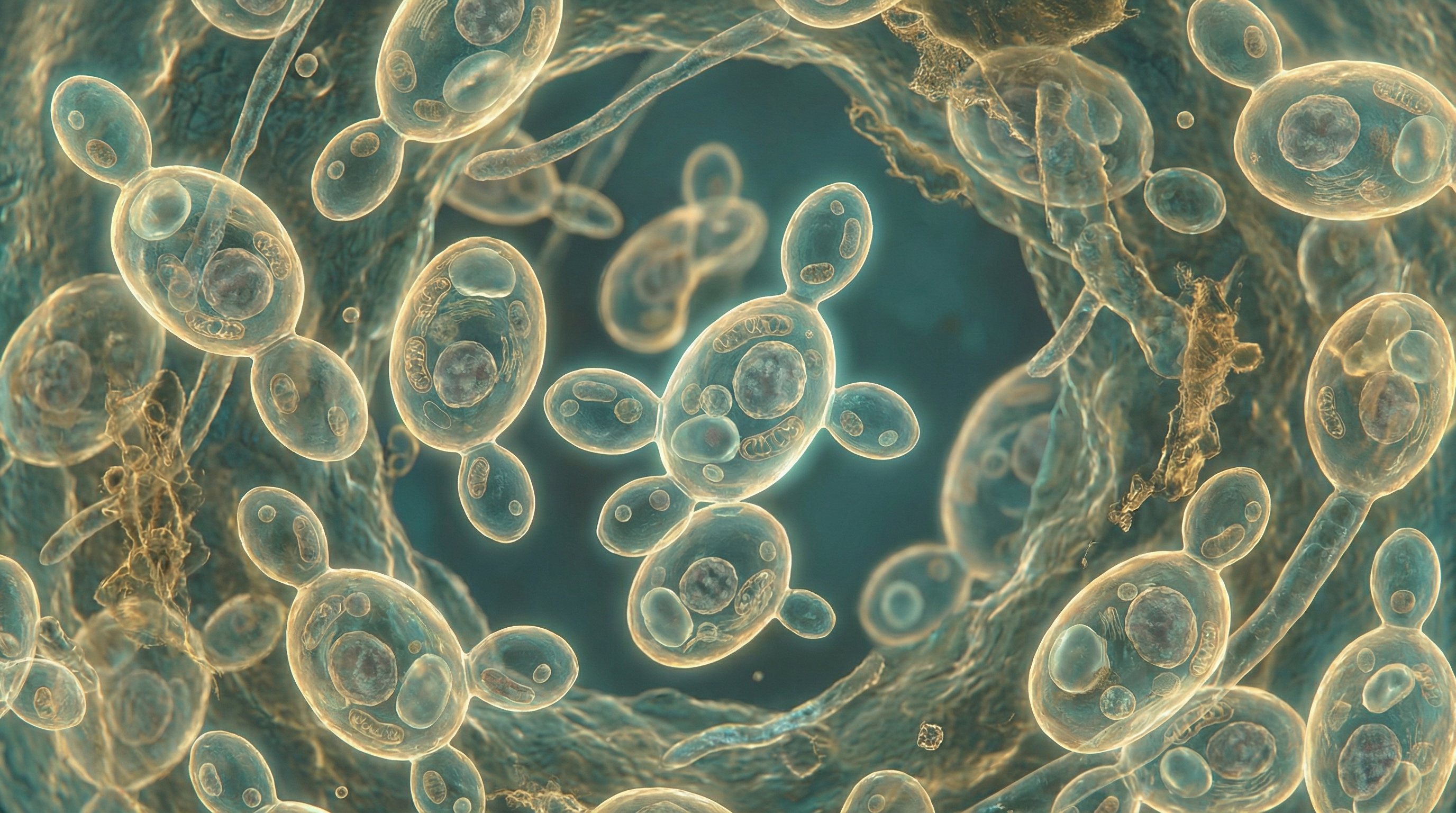
Debaryomyces hansenii is a species of yeast that has emerged as a significant component of the human mycobiome (fungal microbiome) with complex and sometimes contradictory roles in human health. This salt-tolerant fungus is widely distributed in natural environments and is commonly used in the food industry for surface ripening of cheese and meat products. In recent years, D. hansenii has gained attention for its presence in the human gut microbiome and its potential involvement in various health conditions.
Research has revealed a dual nature of D. hansenii in human health: on one hand, it has been found to be enriched in inflamed intestinal tissues of Crohn's disease patients and can impair wound healing in experimental models; on the other hand, it has shown potential beneficial effects in treating antibiotic-associated diarrhea by helping maintain a healthy intestinal microbiota structure. This dichotomy highlights the complex relationship between fungi and human health, where the same organism can be beneficial or detrimental depending on the context, host factors, and microbial community dynamics.
As part of the human gut mycobiome, D. hansenii interacts with the bacterial microbiota, the host immune system, and other components of the gut ecosystem, contributing to the intricate balance that influences health and disease states. Understanding these interactions is crucial for developing targeted approaches to manipulate the gut microbiome for therapeutic purposes.
Characteristics
Debaryomyces hansenii possesses several distinctive characteristics that contribute to its ecological versatility and potential impact on human health:
Morphology: D. hansenii cells are typically oval to ellipsoidal in shape, reproducing by multilateral budding. The colonies appear white to cream-colored on standard growth media.
Salt Tolerance: One of the most notable features of D. hansenii is its exceptional halotolerance (salt tolerance), allowing it to grow in environments with high salt concentrations (up to 24% NaCl). This characteristic makes it well-adapted to food preservation environments and potentially to certain niches within the human body.
Metabolic Capabilities: D. hansenii can utilize various carbon sources and has been shown to produce extracellular enzymes, including proteases and lipases, which may contribute to its ability to colonize and interact with host tissues.
Killer Toxin Production: Some strains of D. hansenii produce killer toxins that are effective against pathogenic yeasts, particularly Candida species, suggesting potential antimicrobial properties that could influence microbial community dynamics in the gut.
Biofilm Formation: D. hansenii has the ability to form biofilms, which may enhance its persistence in the gut environment and resistance to host defense mechanisms and antimicrobial agents.
Genetic Adaptability: The genome of D. hansenii exhibits considerable plasticity, allowing it to adapt to various environmental conditions and potentially to different niches within the human host.
Role in Human Microbiome
The role of D. hansenii in the human microbiome is complex and context-dependent:
Presence in Inflamed Tissues: Research has shown that D. hansenii preferentially localizes to and is abundant within incompletely healed intestinal wounds of mice and inflamed mucosal tissues of Crohn's disease patients. This suggests a potential role in chronic inflammation and impaired tissue repair.
Interaction with Gut Microbiota: D. hansenii can influence the composition and structure of the intestinal bacterial microbiota. Studies in mice with antibiotic-associated diarrhea have shown that D. hansenii treatment can help maintain a healthy mucosal microbiota structure similar to that of normal mice.
Modulation of Immune Responses: D. hansenii has been found to interact with the host immune system, particularly through the induction of a type I interferon-CCL5 axis in macrophages, which may contribute to its effects on wound healing and inflammation.
Colonization Dynamics: While D. hansenii is often considered a transient member of the gut microbiome, its enrichment in specific contexts (such as inflammatory bowel disease) suggests that it may establish more persistent colonization under certain conditions.
Ecological Niche: D. hansenii may occupy specific niches within the gut ecosystem, particularly in the mucosa, where it can interact with host cells and other microorganisms.
Health Implications
The health implications of D. hansenii in the human gut are multifaceted and sometimes contradictory:
Potential Negative Effects
Inflammatory Bowel Disease: D. hansenii has been found to be enriched in inflamed intestinal tissues of Crohn's disease patients, suggesting a potential role in the pathogenesis or perpetuation of this condition.
Impaired Wound Healing: Research in mouse models has demonstrated that D. hansenii can impair mucosal healing through the myeloid cell-specific type I interferon-CCL5 axis. When introduced into injured conventionally raised or gnotobiotic mice, D. hansenii cultures from injured mice and inflamed Crohn's disease tissues impaired colonic healing.
Chronic Inflammation: The presence of D. hansenii in wounds and inflamed tissues may contribute to persistent inflammation, a hallmark of inflammatory bowel diseases including Crohn's disease and ulcerative colitis.
Potential Beneficial Effects
Treatment of Antibiotic-Associated Diarrhea: Studies in mice have shown that D. hansenii treatment can help maintain the structure of the mucosal microbiota in comparison with normal mice and inhibit the proliferation of opportunistic bacteria following antibiotic-induced dysbiosis.
Antimicrobial Properties: Some strains of D. hansenii produce killer toxins that are effective against pathogenic yeasts, particularly Candida species, suggesting a potential role in protecting against fungal pathogens in the gut.
Modulation of Gut Microbiota: D. hansenii treatment has been shown to inhibit the increase in Proteobacteria (often associated with dysbiosis) in mice with antibiotic-associated diarrhea, suggesting a potential role in maintaining a healthy bacterial community structure.
Metabolic Activities
The metabolic activities of D. hansenii in the human gut include:
Carbohydrate Metabolism: D. hansenii can utilize various carbon sources, including sugars present in the gut environment, which may influence its ability to colonize and persist in this ecosystem.
Protein Degradation: Through its proteolytic enzymes, D. hansenii may contribute to protein degradation in the gut, potentially affecting nutrient availability and host-microbe interactions.
Lipid Metabolism: D. hansenii produces lipases that can break down lipids, which may influence lipid metabolism in the gut and potentially affect host physiology.
Secondary Metabolite Production: D. hansenii produces various secondary metabolites, including killer toxins, that may influence the gut microbial community and host responses.
Adaptation to Gut Conditions: D. hansenii's metabolic flexibility allows it to adapt to the varying conditions in the gut, including changes in pH, oxygen availability, and nutrient composition.
Clinical Relevance
The clinical relevance of D. hansenii is emerging in several areas:
Inflammatory Bowel Disease: The enrichment of D. hansenii in inflamed tissues of Crohn's disease patients suggests that it may be a potential biomarker or therapeutic target for this condition. Understanding its role in disease pathogenesis could lead to novel approaches for diagnosis and treatment.
Wound Healing: The finding that D. hansenii impairs mucosal healing suggests that targeting this fungus could potentially enhance tissue repair in conditions characterized by impaired wound healing, such as inflammatory bowel disease.
Antibiotic-Associated Diarrhea: The potential beneficial effects of D. hansenii in treating antibiotic-associated diarrhea suggest that it could be developed as a probiotic or therapeutic agent for this common condition.
Microbial Community Modulation: D. hansenii's ability to influence the gut microbial community structure suggests that it could be used as a tool for modulating the microbiome in various health conditions.
Food Safety and Biotechnology: As a common food-associated yeast, understanding the potential health impacts of D. hansenii is important for food safety and for developing novel biotechnological applications.
Interactions with Other Microorganisms
D. hansenii engages in complex interactions with other members of the gut microbiome:
Competition with Pathogenic Fungi: Through the production of killer toxins, D. hansenii may compete with and inhibit the growth of pathogenic fungi, particularly Candida species, in the gut environment.
Modulation of Bacterial Communities: D. hansenii treatment has been shown to influence the composition of bacterial communities in the gut, particularly by inhibiting the proliferation of opportunistic bacteria such as Proteobacteria.
Cross-Kingdom Signaling: D. hansenii may engage in cross-kingdom signaling with bacteria and other microorganisms in the gut, influencing their behavior and gene expression.
Biofilm Interactions: Within biofilms, D. hansenii may interact with various microbial species, potentially enhancing their collective resistance to host defenses and antimicrobial agents.
Ecological Succession: D. hansenii may play a role in ecological succession within the gut microbiome, particularly following perturbations such as antibiotic treatment.
Research Significance
D. hansenii holds significant importance in microbiome research for several reasons:
Dual Role in Health and Disease: The seemingly contradictory roles of D. hansenii in health and disease highlight the complex and context-dependent nature of host-microbe interactions, challenging simplistic views of microorganisms as either "good" or "bad."
Mycobiome Understanding: Research on D. hansenii contributes to our growing understanding of the human mycobiome and its role in health and disease, an area that has been relatively understudied compared to the bacterial microbiome.
Therapeutic Potential: The potential beneficial effects of D. hansenii in treating antibiotic-associated diarrhea suggest that it could be developed as a novel probiotic or therapeutic agent.
Disease Mechanisms: Studying the role of D. hansenii in inflammatory bowel disease and wound healing provides insights into the mechanisms underlying these conditions and potential approaches for intervention.
Ecological Interactions: Research on D. hansenii's interactions with other microorganisms in the gut contributes to our understanding of the complex ecological dynamics within the microbiome.
Despite its potential significance in human health, many aspects of D. hansenii's biology and its interactions with the host and other microorganisms remain to be fully elucidated. Continued research on this fascinating yeast promises to yield valuable insights into the complex ecosystem of the human gut and its implications for health and disease.