

Overview
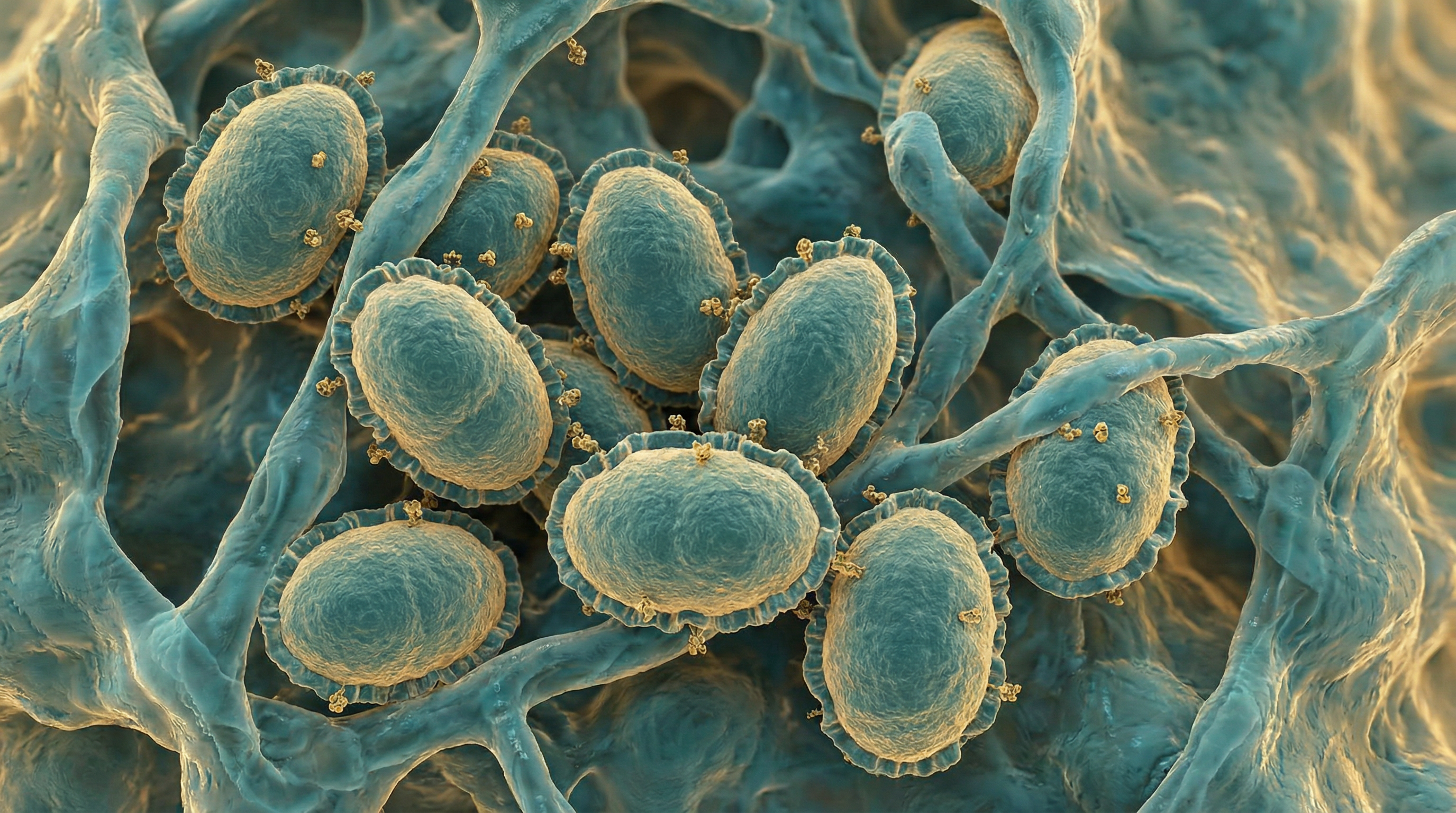
Akkermansia muciniphila is a Gram-negative, oval-shaped, anaerobic bacterium belonging to the Verrucomicrobia phylum. It is the sole representative of this phylum consistently found in mammalian gastrointestinal samples and has emerged as one of the most promising next-generation beneficial microbes for metabolic health.[1]
Key Characteristics
A. muciniphila is a mucin-degrading specialist that colonizes the intestinal mucosa, comprising approximately 1-4% of the gut microbial community in healthy adults. The bacterium possesses a unique metabolism centered around the degradation of mucin, the main glycoprotein of the intestinal mucus layer. Its genome encodes several mucolytic enzymes including glycosyl hydrolases, proteases, sulfatases, and sialidases that enable it to utilize mucin as a source of carbon, nitrogen, and energy.[2]
Clinical Evidence
Human Clinical Trials
A landmark 2019 proof-of-concept study demonstrated that supplementation with pasteurized A. muciniphila in overweight and obese insulin-resistant volunteers resulted in significant metabolic improvements:[2]
- Insulin sensitivity: +28.62% improvement
- Insulinemia: -34.08% reduction
- Total cholesterol: -8.68% reduction
- Body weight: -2.27 kg decrease
- Fat mass: -1.37 kg decrease
Importantly, a 2025 phase 2 randomized controlled trial revealed that supplementation efficacy depends critically on baseline intestinal A. muciniphila levels. Participants with low baseline levels showed significant reductions in body weight, BMI, total fat mass, visceral fat mass, and HbA1c, while those with high baseline levels showed no significant clinical improvements.[1]
Mechanisms of Action
Gut Barrier Enhancement
A. muciniphila strengthens intestinal barrier function through multiple mechanisms:[3]
- Mucus layer restoration: Restored intestinal mucus layer thickness that becomes significantly thinned during obesity
- Tight junction upregulation: Increases expression of tight junction proteins (ZO-1, occludin, claudin-3)
- Goblet cell stimulation: Enhances goblet cell count and mucus secretion via NLRP6 inflammasome and autophagy pathways
Metabolic Regulation
The bacterium improves metabolic health through several pathways:[5]
- GLP-1 secretion: Secretes P9 protein that directly stimulates GLP-1 release from intestinal L-cells
- SCFA production: Produces acetate and propionate from mucin fermentation
- Endocannabinoid modulation: Activates PPAR receptors and downregulates CB1 receptors
- Thermogenesis: Promotes thermogenic activation of brown adipose tissue
Immune Modulation
A 2022 study in Nature identified that a specific phospholipid (diacyl phosphatidylethanolamine) in the A. muciniphila cell membrane mediates homeostatic immune responses through non-canonical TLR2-TLR1 signaling, helping to reset cellular activation thresholds and suppress inflammatory responses.[4]
Key Bioactive Components
Proteins
- Amuc_1100: A 30 kDa outer membrane pili-like protein that remains stable after pasteurization, strongly activates TLR2, and improves gut barrier function while inducing anti-inflammatory IL-10 production
- P9 protein: A secreted protein that binds to ICAM-1/ICAM-2 receptors and stimulates GLP-1 secretion for improved glucose homeostasis
Metabolites
- Short-chain fatty acids (SCFAs): Primarily acetate and propionate that support other beneficial bacteria and provide energy for colonocytes
- Extracellular vesicles (AmEVs): Membrane-derived vesicles that activate AMPK signaling and upregulate tight junction proteins
Ecological Role
A. muciniphila plays a crucial role in the gut ecosystem through cross-feeding relationships. By degrading mucin into acetate and propionate, it provides substrates for butyrate-producing bacteria like Clostridia species. This mucin degradation also prompts the host to produce more mucus, maintaining healthy mucus layer dynamics.[5]
Safety Profile
Comprehensive toxicological evaluation has established the safety of pasteurized A. muciniphila:[6]
- NOAEL: Established at 1500 mg/kg body weight/day (highest dose tested)
- Genotoxicity: In vitro tests (Ames and micronucleus) were negative
- Human tolerance: Daily supplementation well tolerated with adverse event rates comparable to placebo
- Regulatory status: Recognized by European Food Safety Authority (EFSA) as 'novel food' safe for human administration
Populations Requiring Caution
- Active inflammatory bowel disease (IBD) patients
- Individuals with colitis-associated colorectal cancer
- Patients with Parkinson's disease or multiple sclerosis (already high abundance)
- Those with PCOS or endometriosis (higher IBD risk)
Clinical Applications
Optimal Candidates
- Individuals with low baseline A. muciniphila levels
- Overweight or obese individuals with metabolic syndrome
- Type 2 diabetes patients with insulin resistance
- Individuals with compromised gut barrier function
Dosing
- Typical dose: 1×10¹⁰ colony forming units (CFU) per day
- Treatment duration: Typically 12 weeks in clinical trials
- Preferred form: Pasteurized bacteria often preferred due to stability and safety profile
References
Zhang Y, Liu R, Chen Y, et al. Akkermansia muciniphila supplementation in patients with overweight/obese type 2 diabetes: Efficacy depends on its baseline levels in the gut. Cell Metabolism. 2025;37(3):592-605.e6. doi:10.1016/j.cmet.2024.12.010
Depommier C, Everard A, Druart C, et al. Supplementation with Akkermansia muciniphila in overweight and obese human volunteers: a proof-of-concept exploratory study. Nature Medicine. 2019;25(7):1096-1103. doi:10.1038/s41591-019-0495-2
Everard A, Belzer C, Geurts L, et al. Cross-talk between Akkermansia muciniphila and intestinal epithelium controls diet-induced obesity. Proceedings of the National Academy of Sciences. 2013;110(22):9066-9071. doi:10.1073/pnas.1219451110
Bae M, Cassilly CD, Liu X, et al. Akkermansia muciniphila phospholipid induces homeostatic immune responses. Nature. 2022;608(7921):168-173. doi:10.1038/s41586-022-04985-7
Mo C, Lou X, Xue J, et al. The influence of Akkermansia muciniphila on intestinal barrier function. Gut Pathogens. 2024;16:41. doi:10.1186/s13099-024-00635-7
Druart C, Plovier H, Van Hul M, et al. Toxicological safety evaluation of pasteurized Akkermansia muciniphila. Journal of Applied Toxicology. 2021;41(2):276-290. doi:10.1002/jat.4044
Ottman N, Reunanen J, Meijerink M, et al. Pili-like proteins of Akkermansia muciniphila modulate host immune responses and gut barrier function. PLoS ONE. 2017;12(3):e0173004. doi:10.1371/journal.pone.0173004
Zheng M, Han R, Yuan Y, et al. The role of Akkermansia muciniphila in inflammatory bowel disease: Current knowledge and perspectives. Frontiers in Immunology. 2023;13:1089600. doi:10.3389/fimmu.2022.1089600