

Overview
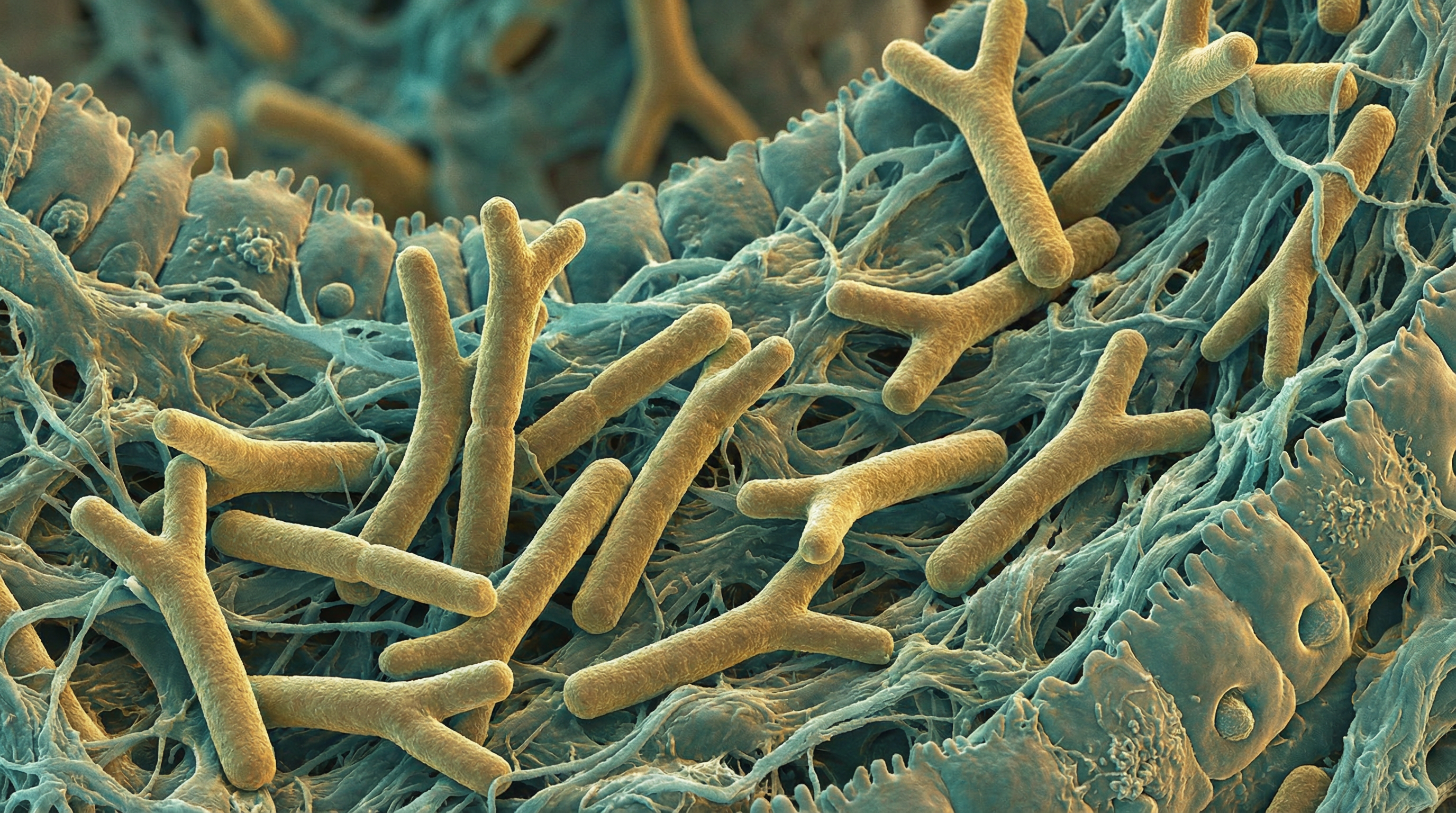
Bifidobacterium longum is a Gram-positive, anaerobic, rod-shaped bacterium and one of the most extensively researched probiotic species. It is among the first colonizers of the infant gut and remains a key beneficial bacterium throughout the lifespan, with documented effects on digestive health, immune function, mental wellbeing, and metabolic health.[1]
Key Strains and Their Applications
BB536
One of the most extensively studied strains, effective for constipation, ulcerative colitis, allergies, and metabolic health.[4]
NCC3001
Psychobiotic strain with documented effects on depression, stress, and the gut-brain axis.[1]
35624 (B. infantis 35624)
Strain with potent immunomodulatory properties, particularly effective for IBS through normalization of IL-10/IL-12 cytokine ratio.[2]
1714
Translational psychobiotic for stress reduction, cognitive enhancement, and sleep quality improvement.[3]
EVC001
Infant-specialized strain that metabolizes human milk oligosaccharides (HMOs) and prevents necrotizing enterocolitis (NEC).
Mechanisms of Action
Immunomodulation
- Upregulation of regulatory T cells (Tregs) expressing Foxp3
- Normalization of IL-10/IL-12 cytokine ratio (anti-inflammatory to pro-inflammatory)
- Reduction of pro-inflammatory cytokines (TNF-α, IL-1β, IL-6, IL-8, IL-17)
- Modulation of Th1/Th2 and Th17/Treg balance
Gut Barrier Enhancement
- Upregulation of tight junction proteins (ZO-1, occludin, claudin-1)
- Reduction of intestinal permeability
- Activation of TLR2 and NOD2 pathways
- Maintenance of mucus layer integrity
Metabolite Production
- Short-chain fatty acids: Acetate, lactate, and cross-feeding support for butyrate production
- Tryptophan metabolites: Indole-3-lactic acid (ILA), indole-3-carbaldehyde (I3C)
- Biotin synthesis: Produces biotin and pimelate through microbial crosstalk
Gut-Brain Axis Modulation[3]
- Regulation of hypothalamic-pituitary-adrenal (HPA) axis
- Reduction of serum corticosterone and ACTH levels
- Increased Brain-Derived Neurotrophic Factor (BDNF) expression
- Modulation of brain wave activity (theta and alpha bands)
Clinical Evidence
Irritable Bowel Syndrome (IBS)
The strain B. infantis 35624 demonstrated significant reduction in all cardinal IBS symptoms including abdominal pain, bloating, and bowel movement difficulty. The mechanism involves normalization of the IL-10/IL-12 cytokine ratio.[2]
Depression and Anxiety
A landmark 2017 study in Gastroenterology showed that B. longum NCC3001 reduced depression scores in IBS patients with comorbid anxiety/depression. fMRI revealed reduced limbic reactivity to negative emotional stimuli in the amygdala and frontolimbic regions.[1]
Stress Response
B. longum 1714 attenuated cortisol output and subjective anxiety in response to acute stress, while improving hippocampus-dependent visuospatial memory and enhancing frontal midline EEG mobility.[3]
Chronic Constipation
BB536 significantly improved bowel movement frequency and reduced failure of evacuation in elderly individuals with chronic constipation. Mechanisms include SCFA production (acetic and butyric acid) and suppression of microinflammation.[4]
Atopic Dermatitis
B. longum CCFM1029 alleviates atopic dermatitis through conversion of tryptophan to indole-3-carbaldehyde (I3C), activating the aryl hydrocarbon receptor (AhR) signaling pathway and suppressing Th2-type immune responses.[5]
Infant Health
A meta-analysis of 15 RCTs (3,152 infants) found B. longum supplementation significantly reduces risk of necrotizing enterocolitis (RR=0.539). The strain metabolizes HMOs to produce lactic and acetic acids, lowering intestinal pH to inhibit pathogens.[6]
Safety Profile
B. longum has an excellent safety record across all age groups:
- Regulatory status: GRAS (Generally Recognized As Safe) by FDA; QPS (Qualified Presumption of Safety) in Europe
- Adverse events: Rare and typically mild (transient GI symptoms in <5% of users)
- Special populations: Safe in infants, elderly, pregnant women, and immunocompromised individuals
- No antibiotic resistance transfer in safety-tested strains
Dosing Guidelines
| Application | Typical Dose | Duration |
|---|---|---|
| IBS | 1×10⁹ to 1×10¹⁰ CFU daily | 4-8 weeks |
| Constipation | 5×10⁹ to 5×10¹⁰ CFU daily | 4 weeks |
| Stress/Anxiety | 1×10⁹ to 1×10¹⁰ CFU daily | 4-8 weeks |
| Atopic dermatitis | 1×10⁹ CFU daily | 8-12 weeks |
| Ulcerative colitis | 2-3×10¹¹ CFU daily | 8 weeks |
| Infant NEC prevention | 1×10⁷ to 8×10⁹ CFU daily | Variable |
References
Pinto-Sanchez MI, Hall GB, Ghajar K, et al. Probiotic Bifidobacterium longum NCC3001 Reduces Depression Scores and Alters Brain Activity: A Pilot Study in Patients With Irritable Bowel Syndrome. Gastroenterology. 2017;153(2):448-459.e8. doi:10.1053/j.gastro.2017.05.003
O'Mahony L, McCarthy J, Kelly P, et al. Lactobacillus and Bifidobacterium in irritable bowel syndrome: symptom responses and relationship to cytokine profiles. Gastroenterology. 2005;128(3):541-551. doi:10.1053/j.gastro.2004.12.037
Allen AP, Hutch W, Borre YE, et al. Bifidobacterium longum 1714 as a translational psychobiotic: modulation of stress, electrophysiology and neurocognition in healthy volunteers. Translational Psychiatry. 2016;6(11):e939. doi:10.1038/tp.2016.191
Takeda T, Asaoka D, Nojiri S, et al. Usefulness of Bifidobacterium longum BB536 in Elderly Individuals With Chronic Constipation: A Randomized Controlled Trial. The American Journal of Gastroenterology. 2023;118(3):561-568. doi:10.14309/ajg.0000000000002028
Fang Z, Pan T, Li L, et al. Bifidobacterium longum mediated tryptophan metabolism to improve atopic dermatitis via the gut-skin axis. Gut Microbes. 2022;14(1):2044723. doi:10.1080/19490976.2022.2044723
Guo H, Fan M, Hou T, et al. Efficacy and Safety of Bifidobacterium longum Supplementation in Infants: A Meta-Analysis of Randomized Controlled Trials. Foods. 2023;12(24):4451. doi:10.3390/foods12244451
Patterson E, Tan HTT, Groeger D, et al. Bifidobacterium longum 1714 improves sleep quality and aspects of well-being in healthy adults. Scientific Reports. 2024;14:3725. doi:10.1038/s41598-024-53810-w
Sabaté JM, Iglicki F. Effect of Bifidobacterium longum 35624 on disease severity and quality of life in patients with irritable bowel syndrome. World Journal of Gastroenterology. 2022;28(7):732-744. doi:10.3748/wjg.v28.i7.732