

Bifidobacterium bifidum
Overview
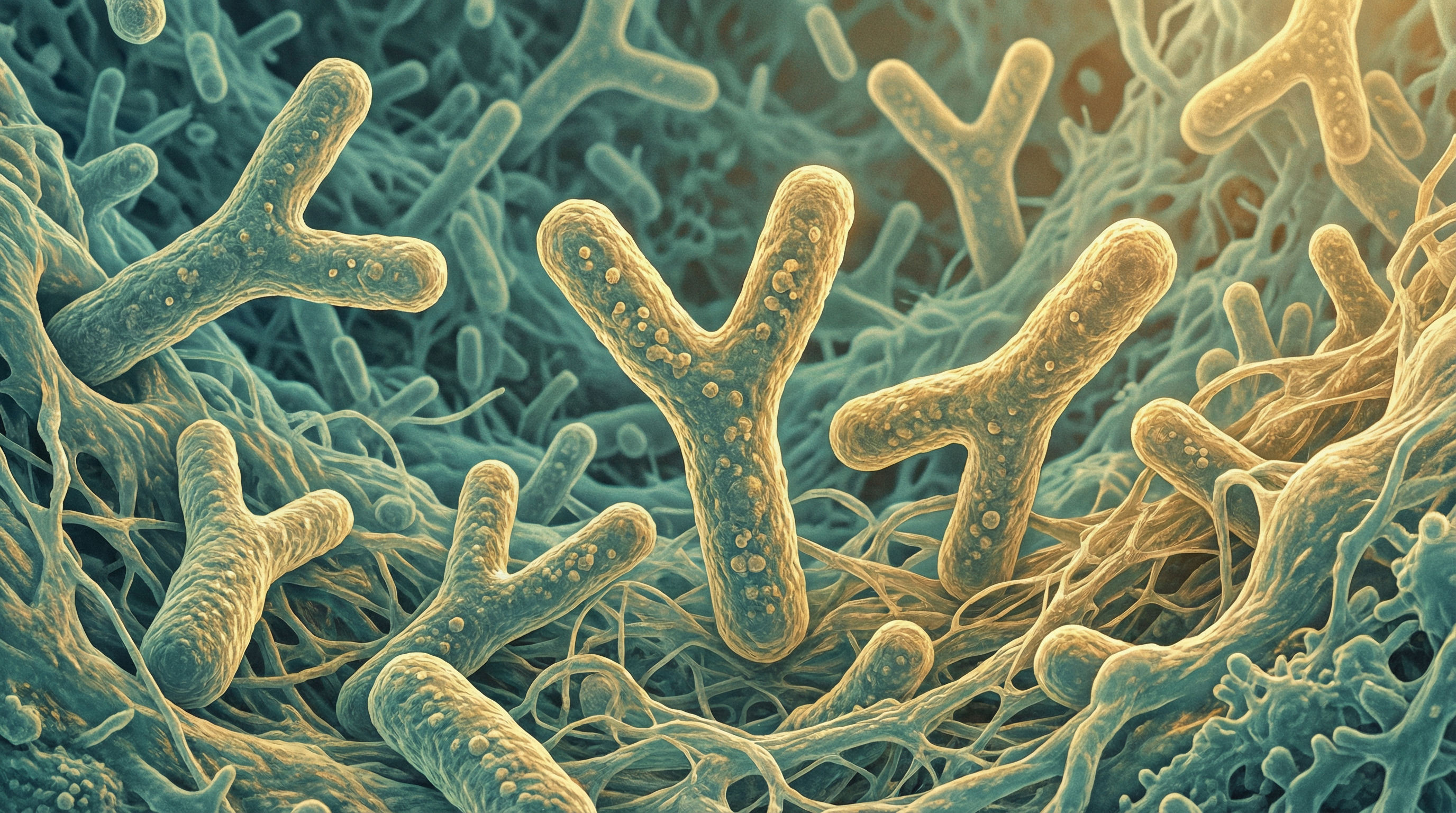
Bifidobacterium bifidum is one of the most important probiotic bacteria in human health, serving as a keystone species in the infant gut microbiome. Unlike most bifidobacteria that process glycans intracellularly, B. bifidum employs a unique extracellular degradation strategy for human milk oligosaccharides (HMOs) and mucin glycans—a feature that enables it to share nutrients with other beneficial bacteria in an "altruistic" cross-feeding network.
B. bifidum is among the first microbes to colonize the infant gut, with prevalence peaking at approximately 60% at 6 months in breastfed infants before declining to about 20% after 3 years and ~5% in the elderly.
Key Characteristics
- Genome: 2.21 Mbp, 62.66% GC content, with ~12% of genes dedicated to carbohydrate transport and metabolism
- Prevalence: 28.3% across age groups (excluding centenarians), highest in infancy
- Primary metabolites: Acetate, lactate, formate via the fructose-6-phosphate phosphoketolase pathway (bifid shunt)
- Unique feature: Extracellular glycan degradation enabling cross-feeding with other gut microbes
Human Milk Oligosaccharide (HMO) Metabolism
B. bifidum possesses a sophisticated enzymatic machinery for degrading HMOs, the third most abundant component of human milk (≥4 g/L).
Key HMO-Degrading Enzymes
| Enzyme | Gene | Family | Function |
|---|---|---|---|
| Lacto-N-biosidase | LnbB | GH20 | Liberates lacto-N-biose I from type 1 HMOs (Km=68 μM, kcat=89 s⁻¹) |
| 1,2-α-L-fucosidase | AfcA | GH95 | Removes terminal fucose from 2'FL-type HMOs |
| 1,3/4-α-L-fucosidase | AfcB | GH29 | Removes fucose from other linkages |
| β-1,4-galactosidase III | BbgIII | GH2 | Cleaves type 2 chains |
| β-N-acetylglucosaminidase | BbhI | GH20 | Removes GlcNAc residues |
| Sialidases | SiaBb1/2 | GH33 | Removes terminal sialic acid |
Lacto-N-Biosidase: A Critical Enzyme
LnbB is a 120 kDa enzyme with a complex multi-domain structure:
- N-terminal signal peptide (secretion)
- GH20 catalytic domain
- Carbohydrate-binding module 32 (CBM32) for polymer binding
- Bacterial immunoglobulin-like domain
- C-terminal membrane anchor
This enzyme liberates lacto-N-biose I (type 1 chain) from HMOs extracellularly, making these sugars available to other bacteria.
Mucin Degradation
B. bifidum is one of the few bifidobacteria capable of degrading host-derived mucin glycans:
Mucin-Specific Enzymes
| Enzyme | Gene | Target |
|---|---|---|
| Endo-α-N-acetylgalactosaminidase | EngBF (GH101) | Core 1 O-glycans |
| α-GlcNAcase | GH129 | Tn antigen |
| α-Galactosidase | GH110 | Blood group B antigen |
| Sulfoglycosidase | BbhII (GH20) | Sulfated glycans |
Transcriptomic studies show 56 genes with >5-fold increased expression when grown on mucin versus lactose, indicating sophisticated adaptation to host-derived glycans.
Bifunctional Sialidase (SiaBb2)
Remarkably, B. bifidum's sialidase serves dual functions:
- Enzymatic: Cleaves α2,6-linked sialic acid from glycans
- Adhesive: Binds directly to mucosal surfaces (independent of enzymatic activity)
- Blood group binding: Recognizes blood type A antigen
This bifunctionality enhances both nutrient acquisition and colonization.
Cross-Feeding: The Keystone Species Role
B. bifidum's extracellular degradation strategy enables a remarkable "altruistic" cross-feeding network:
Cross-Feeding Evidence
| Model | Effect | Quantification |
|---|---|---|
| In vitro with B. breve | Growth stimulation | 100-fold increase (2 log units) |
| In vivo (germ-free mice) | B. breve colonization | 10⁵ → 10⁸ CFU/g feces |
| Human fecal cultures (child) | Other Bifidobacterium spp. | 60-990 fold increase |
| Human fecal cultures (infant) | Other Bifidobacterium spp. | 1,700-10,000 fold increase |
Shared Metabolites
B. bifidum releases the following compounds into the environment:
- Monosaccharides: Fucose, galactose, glucose, N-acetylglucosamine, sialic acid
- Disaccharides: Lacto-N-biose (LNB), galacto-N-biose (GNB), lactose
- SCFAs: Acetate, lactate
These substrates feed bacteria that cannot degrade complex glycans themselves, including:
- B. breve
- B. longum
- Faecalibacterium prausnitzii (acetate → butyrate conversion)
- Roseburia intestinalis
- Eubacterium rectale
Immunomodulatory Effects
Treg Cell Induction via Cell Surface Polysaccharides
A landmark Science Immunology study identified B. bifidum's cell surface β-glucan/galactan (CSGG) polysaccharides as potent inducers of regulatory T cells:
- Mechanism: CSGG → TLR2 on dendritic cells → Foxp3+ Treg differentiation
- TCR diversity: pTregs display diverse specificity toward dietary and microbial antigens
- Clinical relevance: IBD patients have lower B. bifidum levels than healthy controls
- Therapeutic potential: CSGG demonstrated stable capacity to suppress experimental colitis
Cytokine Modulation
B. bifidum strains exhibit strain-specific immunomodulatory profiles:
Anti-inflammatory:
- IL-10: Generally upregulated
- TGF-β: Induced for Treg differentiation
Pro-inflammatory regulation:
- TNF-α: Generally downregulated systemically
- IL-12: Strain-dependent responses
- IL-17: Specific strains induce Th17 cells for mucosal defense
Gut Barrier Enhancement
B. bifidum strengthens intestinal barrier function through multiple mechanisms:
- Tight junctions: Maintains occludin, claudin-1, ZO-1 expression
- Mucin production: Upregulates MUC2, MUC3, MUC4
- TEER: Significantly increases transepithelial electrical resistance (p<0.0001)
- Brush border: Preserves villin-1 expression and SGLT-1 for water absorption
Clinical Applications
Rotavirus Gastroenteritis
Strain G9-1 demonstrates significant protective effects:
| Treatment | Diarrhea Incidence | p-value |
|---|---|---|
| Prophylactic (3 dpi) | 74.2% → 34.8% | <0.01 |
| Therapeutic (3 dpi) | 90.5% → 60.5% | <0.05 |
| Viral titer reduction | 9.5 → 1.7 PFU/mg (median) | <0.001 |
Mechanisms include induction of mucosal protective factors (MUC2-4, TGF-β1, TFF3) and maintenance of tight junction proteins.
Antibiotic-Associated Diarrhea Prevention
A JAMA Pediatrics RCT (n=313 children) of multispecies probiotic including B. bifidum W23:
| Outcome | Probiotic | Placebo | RR (95% CI) | p-value |
|---|---|---|---|---|
| Overall diarrhea | 20.9% | 32.3% | 0.65 (0.44-0.94) | 0.02 |
| IV rehydration needed | 0% | 3.2% | - | 0.03 |
| Rotaviral diarrhea | Reduced | - | - | 0.01 |
Constipation
Strain G9-1 in 31 patients with chronic constipation:
| Outcome | Baseline | 8 Weeks | p-value |
|---|---|---|---|
| JPAC-QOL score | 1.73 ± 0.54 | 0.97 ± 0.65 | <0.01 |
| Bowel movements (days/period) | 10.2 ± 3.42 | 11.3 ± 2.77 | <0.01 |
| Straining score | 3.25 ± 0.79 | 2.8 ± 0.9 | 0.03 |
| Bristol stool scale (hard subset) | 2.59 ± 0.83 | 3.27 ± 0.82 | 0.03 |
Microbiome changes: Increased Chao1 diversity, increased butyrate-producing bacteria (Sarcina genus), enhanced propanoate (p=0.007) and butanoate (p=0.013) metabolism.
Helicobacter pylori Inhibition
Strain CECT 7366 demonstrates potent anti-H. pylori activity:
| Model | Result |
|---|---|
| In vitro growth inhibition | 81.94% (supernatant); 94.77% (purified fractions) |
| In vivo ulcers (day 21) | 0 ulcers/stomach vs 0.60 in placebo |
| Peyer's patches involvement | 40% vs 90% in vehicle group |
| Active compounds | Proteinaceous peptides <5,000 Da, cationic nature |
IBS and Crohn's Disease
Strain G9-1 in quiescent Crohn's disease with IBS-D symptoms (n=11):
- IBDQ score: 169 → 180 (p=0.007)
- Anxiety: 7 → 4 (p=0.03)
- Serum MCP-1: 7.47 → 4.46 pg/mL (p=0.048)
- Bacteroides abundance significantly increased (p=0.049)
Safety Profile
Regulatory Status
| Strain | Regulatory Status | Approved Use |
|---|---|---|
| BGN4 | FDA GRAS (GRN 814, 2019) | Infant formula up to 10⁸ CFU/serving |
| NITE BP-31 | FDA GRAS (GRN 1090, 2023) | Infant formula 2.28×10⁶ CFU/mL reconstituted |
| Species | EFSA QPS | Qualified Presumption of Safety in Europe |
Safety Characteristics
- Hemolytic activity: None
- Secondary bile acids: No production
- D-lactic acid: No production
- Biogenic amines: Low production
- Antibiotic resistance: Aminoglycoside resistance is structural (lack of transport), not transferable
Clinical Trial Safety
Multiple clinical trials demonstrate excellent safety:
- No severe adverse effects during pregnancy/breastfeeding supplementation
- No significant changes in stool consistency or evacuation frequency in healthy adults
- Safety profiles comparable to placebo across all age groups
Unique Safety Feature
A 2025 study found B. bifidum shows the lowest antibiotic resistance levels among bifidobacteria, with high HMO consumption capacity inversely correlated with resistance genes (p=0.003).
Ecological Significance
B. bifidum serves as a keystone species in the infant gut ecosystem:
- Pioneer colonizer: Among first bacteria to establish in breastfed infant gut
- Nutrient provider: Extracellular glycan degradation feeds entire bifidobacterial community
- Butyrate enabler: Acetate production supports butyrate-producing bacteria
- Pathogen exclusion: Competitive inhibition and immune activation
- Barrier maintenance: Sustains mucus layer and tight junction integrity
Summary
Bifidobacterium bifidum represents a uniquely important probiotic species with:
- Specialized enzymatic machinery for HMO and mucin degradation
- Altruistic cross-feeding behavior supporting entire gut microbial communities
- Potent immunomodulatory effects via TLR2-dependent Treg induction
- Strong clinical evidence for diarrhea prevention, constipation relief, and gut health
- Excellent safety profile with FDA GRAS and EFSA QPS status
Its role as a keystone species in early life makes B. bifidum particularly important for infant microbiome development and long-term health programming.