

Neisseria lactamica
Overview
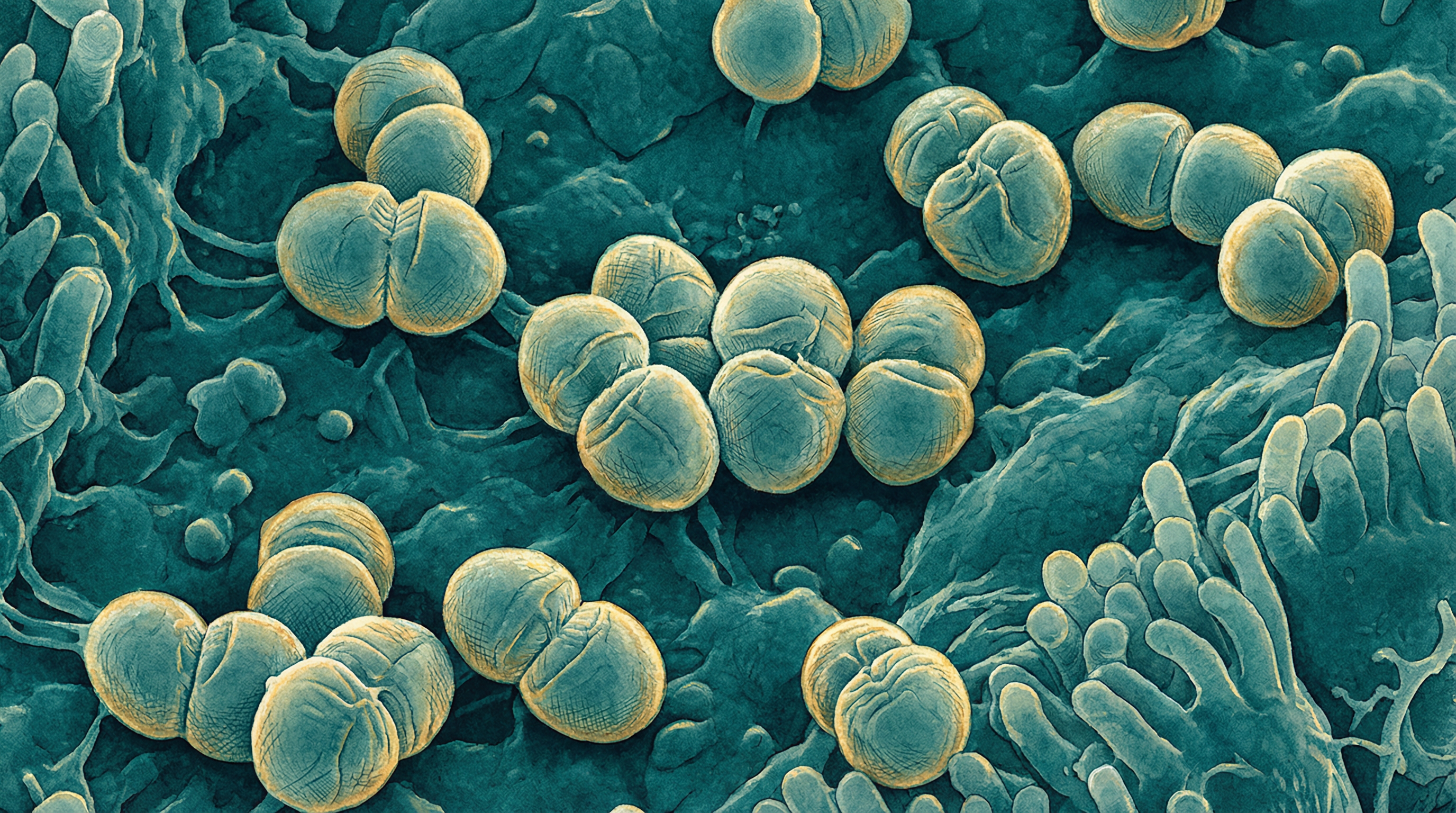
Neisseria lactamica is a non-pathogenic commensal bacterium of the human nasopharynx that shares remarkable genomic similarity with Neisseria meningitidis while lacking the key virulence factors that enable invasive disease[1]. This close relationship makes it an ideal candidate for inducing natural cross-reactive immunity against meningococcal disease, and recent clinical trials have established it as a promising live vaccine vector platform.
Characteristics
N. lactamica shares 78% of its chromosome (1.7 Mb) with pathogenic Neisseria species as part of the core neisserial genome:
Genomic Features (Reference strain Y92-1009)
- Genome size: 2,146,723 bp
- GC content: 52.3%
- Coding density: 85.3%
- Protein-coding genes: 1,980
- Prophage: One intact 49.8 kb prophage with 81 proteins
Key Differences from Pathogens
| Feature | N. lactamica | N. meningitidis |
|---|---|---|
| Capsule | Absent | Present (serogroups A, B, C, etc.) |
| IgA protease (iga) | Absent | Present |
| PilC1 adhesin | Absent | Present |
| Cell invasion | Does not invade | Invades epithelial cells |
| Disease potential | Extremely rare | Causes meningitis, septicemia |
Of 127 virulence-associated genes, 85 are present in N. lactamica, but the 6 pathogen-specific genes (iga, dca, virG, NMB1880, NMB1882, NMB1646) are absent, explaining its commensalism[2].
Protective Immunity Against N. meningitidis
Natural N. lactamica colonization induces cross-reactive immunity against meningococcal disease through multiple mechanisms[3]:
Immune Mechanisms
Serum Bactericidal Activity (SBA)
- Strain Y92-1009 induced SBA titers up to 8,192 against serogroup A, 4,096 against serogroup B, and 256 against serogroup C
- Antibody- and complement-mediated bacteriolysis provides functional protection
- 71.4% of participants with non-protective baseline SBA achieved protective titers (≥4) following colonization
Cross-reactive Antibodies
- IgG antibodies recognize multiple N. meningitidis surface antigens across serogroups
- Mucosal IgA provides first-line defense at the colonization site
- Responses are not specific to a particular meningococcal serogroup
Memory B Cell Induction
- N. lactamica-specific IgG memory B cells increase 16-fold (from 0.0024% to 0.0384%)
- Cross-reactive N. meningitidis-specific memory B cells in 53% of colonized participants
- Memory persists for at least 90 days, suggesting long-lived protection
Opsonophagocytic Activity
- Antisera promote uptake of N. meningitidis by HL-60 phagocytes
- Activity comparable to homologous meningococcal immunization
Epidemiological Evidence
Natural N. lactamica carriage correlates inversely with N. meningitidis colonization and invasive meningococcal disease:
- N. lactamica carriage is 6 times higher in children up to 5 years than N. meningitidis carriage
- This high carriage coincides with the period of lowest meningococcal disease risk after maternal antibody waning
Controlled Human Infection Studies
Multiple phase I/II trials demonstrate safe and reproducible colonization with robust immunological responses[4].
Key Clinical Trials
| Study | Year | N | Colonization | Key Finding |
|---|---|---|---|---|
| Evans et al. | 2011 | 41 | 63.4% | 85% remained colonized at 12 weeks; 100% safety |
| Deasy et al. | 2015 | 310 | 33.6% | Reduced N. meningitidis from 24.2% to 14.7% (P=0.006) |
| Dale et al. | 2022 | 31 | 85% | Cross-reactive B-cell responses; seroconversion at 14 days |
| Laver et al. | 2021 | - | 100% | GM-Nlac expressing NadA; 71.4% protective SBA |
| Theodosiou et al. | 2025 | 21 | 71% | Safe in pregnancy; no infant transmission |
Cumulative Safety Data
- Total inoculations: Over 400 in adults
- Serious adverse events: Zero attributable to N. lactamica
- Transmissibility: No transmission to household contacts documented
- Antibiotic susceptibility: Remains susceptible (Ciprofloxacin MIC <0.03 mg/L)
Live Vaccine Vector Platform
Genetically modified N. lactamica (GM-Nlac) expressing heterologous antigens represents a breakthrough in vaccine delivery[5].
GM-Nlac Expressing NadA (First-in-Human Trial)
Design: Chromosomally-transformed N. lactamica expressing Neisseria adhesin A (NadA)
Results:
- 100% of colonized participants carried bacteria asymptomatically for ≥28 days
- 86% still carrying at 90 days
- 50% showed ≥2-fold rise in anti-NadA IgG
- Generated NadA-specific IgG- and IgA-secreting plasma cells within 14 days
- Memory B cells detectable in peripheral blood for at least 90 days
Safety:
- No serious adverse events
- No transmission to bedroom-sharers during 90-day period
- Not detected in exhaled breath or on surgical facemasks
- Maintained antibiotic susceptibility throughout
Platform Advantages
- Acts as both antigen presentation platform and adjuvant
- Induces systemic and mucosal immunity simultaneously
- Sustained antigen release during colonization
- Low-cost "immunobiotic" approach
- Non-invasive nasal administration
- Potential for broad herd protection
Microbiome Competition
N. lactamica excludes N. meningitidis through multiple competitive mechanisms[6]:
Exclusion Mechanisms
Niche Occupation and Displacement
- Physical displacement of existing N. meningitidis colonization
- Prevention of new meningococcal acquisition for ≥16-26 weeks
- More potent than ACWY glycoconjugate vaccination
Resource Competition
- Competition for essential nutrients in the nasopharyngeal niche
- Microevolution during colonization suggests adaptation to nutrient limitation
- Outcompetes N. meningitidis for limited resources
Immune-Mediated Exclusion
- Cross-reactive antibodies and memory B cells provide ongoing protection
- Effect persists beyond direct bacterial competition
Differential Host Response
- N. lactamica upregulates proinflammatory genes (TNF-α, IL1A, IL8) alerting host defense
- N. meningitidis suppresses these same pathways
- 58% of activated genes respond only to live bacteria
Age-Related Colonization Patterns
N. lactamica colonization follows a distinct age-dependent pattern inversely correlated with meningococcal disease risk[7]:
| Age Group | N. lactamica Carriage | N. meningitidis Carriage | Clinical Significance |
|---|---|---|---|
| 1-2 years | Peak >40% | <5% | Highest natural protection |
| 2-5 years | 6x higher than N.m. | Low | Transition period |
| Adolescents | 1.8-3% | Peak 10-40% | Highest meningococcal transmission |
| Adults | <5% | Variable | Rare natural colonization |
Transmission Dynamics
- Horizontal transmission: Primary route; adult carriage 41% when living with children <5 years vs 0% without
- Vertical transmission: No sustained mother-to-infant transmission despite 71% maternal colonization
- Experimental colonization: Adults can be successfully colonized (63-85% rate) despite low natural carriage
Immunological Mechanisms
Antibody Responses
IgG (Systemic)
- Median memory B cells increase 16-fold (0.0024% → 0.0384%, P<0.0001)
- 47% show cross-reactive N. meningitidis-specific IgG plasma blasts
- Persistence for at least 90 days post-colonization
IgA (Mucosal)
- Generated within 14 days of colonization
- Median IgA plasma blasts increase from 0 to 5 per 10⁵ PBMCs (P<0.0001)
- 65% show cross-reactive N. meningitidis-specific IgA responses
- Both serum and salivary IgA detected
Colonization Duration Dependency
Seroconversion requires sustained colonization:
- Significant immune responses at 14 days but not 4 days
- Duration critical for vaccine efficacy
- Implications for dosing strategies
Maternal Immunity
- Total IgG concentration up to 1.5 times higher in cord blood than maternal blood
- Maternal IgG half-life approximately 30 days in infants
- Natural infant colonization associated with 4-fold increase in anti-N. meningitidis IgG
Clinical Applications and Future Directions
Current Research Priorities
- Phase III efficacy trials for meningococcal disease prevention
- GM-Nlac expressing multiple antigens for broader coverage
- Optimization of colonization rates in diverse populations
- Long-term durability of immunity studies
- Infant colonization strategies to maximize natural protection
Potential Applications
- Live attenuated vaccine against meningococcal disease
- Vaccine vector platform for other respiratory pathogens
- Probiotic bacterial medicine for outbreak control
- Immunobiotic for inducing herd immunity in high-risk populations
- Clinical trials ongoing in the African meningitis belt (Mali)