

Treponema denticola
Key Characteristics
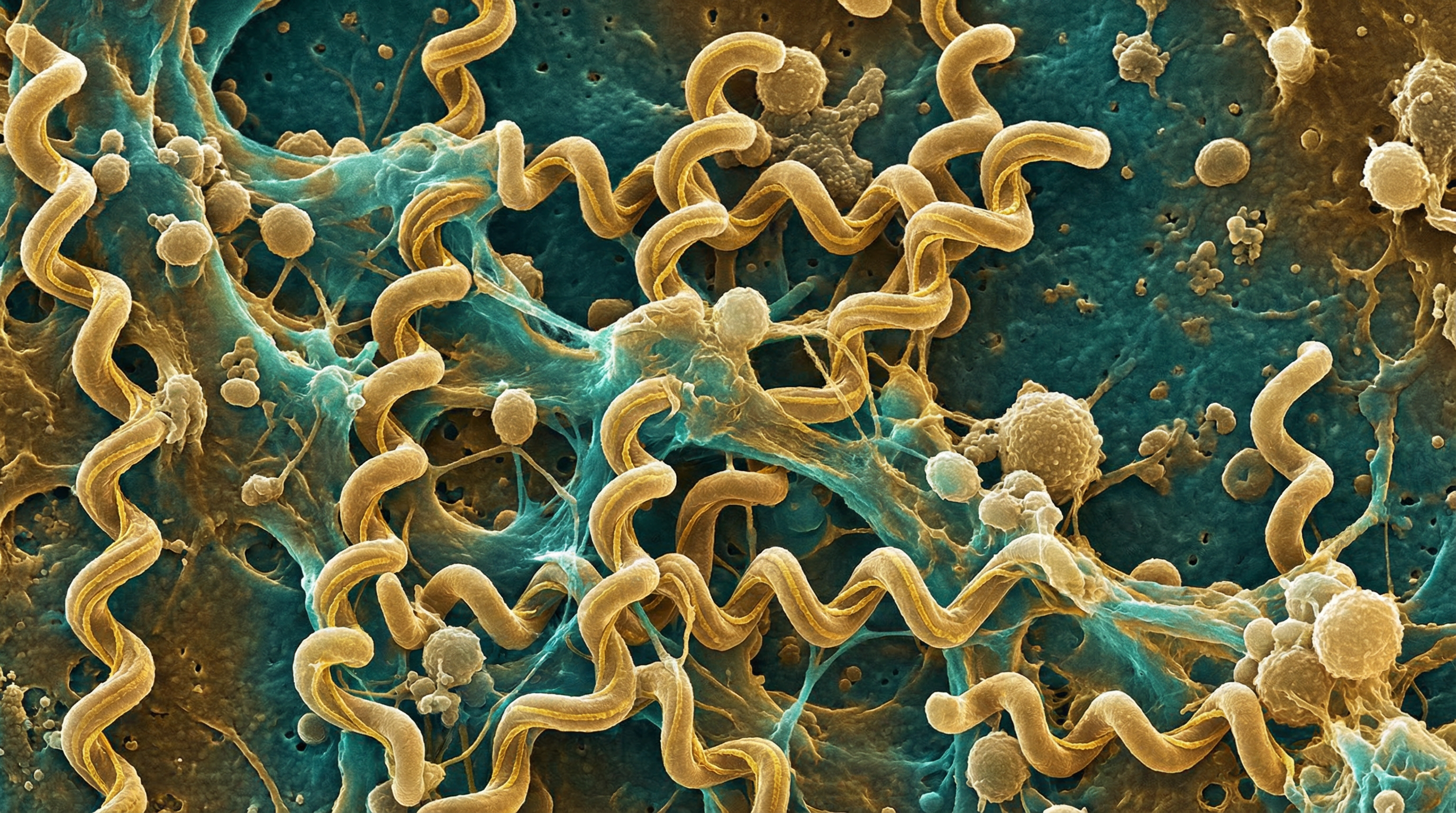
Treponema denticola is a Gram-negative, obligate anaerobic, motile, helical-shaped spirochete bacterium. It belongs to the Spirochaetes phylum and is characterized by its distinctive spiral morphology and unique flagellar arrangement. The bacterium possesses periplasmic flagella (endoflagella) that are enclosed within the periplasmic space between the cell membrane and outer sheath, giving it a corkscrew-like motility that enables it to move efficiently through viscous environments.
T. denticola has a complex outer membrane structure containing lipoproteins, peptidoglycans, and various surface proteins that contribute to its virulence. Its genome encodes numerous enzymes and proteins that facilitate host tissue invasion, immune evasion, and nutrient acquisition.
Role in Human Microbiome
T. denticola is primarily found in the human oral cavity, specifically in:
Dental plaque: It is a key component of mature dental biofilms, particularly in subgingival plaque.
Periodontal pockets: It thrives in the anaerobic environment of deep periodontal pockets, where it is found in significantly higher numbers in individuals with periodontal disease compared to healthy individuals.
Oral microbiome ecology: It is considered a late colonizer in dental biofilm formation, appearing after initial colonization by aerobic and facultative anaerobic species.
T. denticola is part of the "red complex" of periodontal pathogens, along with Porphyromonas gingivalis and Tannerella forsythia. This bacterial consortium is strongly associated with severe forms of periodontal disease and tissue destruction.
Health Implications
Pathogenic Potential
T. denticola is implicated in several oral and potentially systemic conditions:
Periodontal diseases: It is strongly associated with various forms of periodontal disease, including:
- Early-onset periodontitis
- Necrotizing ulcerative gingivitis
- Acute pericoronitis
- Chronic periodontitis
Tissue destruction: It contributes to periodontal tissue destruction through:
- Direct cytotoxic effects on host cells
- Induction of inflammatory responses
- Degradation of extracellular matrix components
- Disruption of host cell adhesion
Systemic disease connections with substantial recent evidence:
Alzheimer's Disease:
- T. denticola directly induces tau hyperphosphorylation at Ser396, Thr181, and Thr231 via GSK3β activation (Journal of Dental Research, 2022)
- Colonizes brain tissues in mouse models after oral infection
- Activates neuroinflammation in hippocampus; induces Aβ1-40 and Aβ1-42 accumulation
- Can reach CNS via trigeminal nerve, bypassing BBB
- AD clinical trials (2022) with gingipain inhibitors support oral-brain connection
Cardiovascular Disease:
- T. denticola DNA and virulence genes detected in atherosclerotic plaques
- Activates endothelial cells, inducing IL-8 and MCP-1 for monocyte chemotaxis
- May initiate/accelerate atherosclerosis development
Colorectal Cancer:
- Td-CTLP detected in colon adenocarcinoma tissue
- Low antibody levels to T. denticola associated with increased colon and bladder cancer risk
- Activates MMPs and fragments TIMPs promoting tumor progression
Virulence Mechanisms
T. denticola possesses sophisticated virulence factors regulated by the AtcSR two-component system:
Dentilisin Protease Complex
Dentilisin (CTLP/Td-CTLP) is the major virulence factor:
- Structure: Outer membrane-associated complex of acylated PrtP protease with lipoproteins PrcA and PrcB, encoded by the prcB-prcA-prtP operon
- Substrates: Degrades transferrin, fibrinogen, fibronectin, laminin, and gelatin
- MMP activation: Activates proMMP-8 and proMMP-9; fragments TIMP-1, TIMP-2, and C1q
- Cancer connection: Td-CTLP detected in colon adenocarcinoma; enhances MMP-8-mediated degradation of type I and II collagens
- Regulation: AtcSR deletion significantly reduces dentilisin activity and protease gene transcription
Major Surface Protein (Msp)
- Function: Disrupts epithelial barrier function and cell adhesion; forms pores in epithelial cells
- Motility regulation: Affects outer sheath stiffness and crawling velocity
- Immune effects: Contributes to cytotoxicity and tissue invasion
Outer Membrane Vesicles (OMVs)
Recent research (2025) highlights OMVs as key virulence delivery systems:
- Cargo: Enriched with dentilisin, PrtP, PrcA, PcrB, lipooligosaccharides
- Inflammatory response: Induce IL-6, IL-8, MCP-1, PGE2, NO in gingival fibroblasts
- Biofilm contribution: Involved in interspecies communication and robust biofilm development
- Matrix degradation: Weaken connective tissue architecture
Motility and Tissue Penetration
- Periplasmic flagella: Essential for synergistic biofilm formation; motility mutants show 5-fold reduction in dual-species biofilm
- Two-phase motility: Swims in liquid, crawls on surfaces via adhesive outer sheath components
- AtcS regulation: Deletion reduces flaB2 and flaB3 expression and plaque diameter
- Neural pathways: Can migrate along peripheral nerves/lymphatic vessels to CNS, bypassing BBB at trigeminal level
Immune Evasion
- Cytokine manipulation: Degrades cytokines and chemokines, impairing neutrophil recruitment
- Cell inhibition: Inhibits proliferation of fibroblasts and endothelial cells; prevents lymphocyte activation and neutrophil degranulation
- Complement resistance: Manipulates host cell signaling and suppresses immune responses
Metabolic Activities
T. denticola exhibits several key metabolic activities:
Amino acid fermentation: It primarily ferments amino acids as energy sources, particularly:
- Glutamate
- Aspartate
- Serine
- Alanine
Peptide utilization: It can degrade host-derived peptides for nutrition using its various proteases.
Glycine metabolism: It possesses a glycine reductase system that allows it to use glycine as an energy source.
Volatile sulfur compound production: It can produce volatile sulfur compounds (VSCs) such as hydrogen sulfide (H₂S) and methyl mercaptan (CH₃SH), which contribute to oral malodor.
Limited carbohydrate utilization: Unlike many oral bacteria, it has limited ability to metabolize carbohydrates.
Clinical Relevance
T. denticola has significant clinical relevance demonstrated in recent studies (2020-2025):
Diagnostic and Prognostic Value
- Disease correlation: Levels correlate significantly with pocket depth, clinical attachment loss, and overall periodontal severity
- Predictive marker: Progression of chronic periodontitis can be predicted by T. denticola levels in subgingival plaque
- Treatment outcome: Residual T. denticola infection predicts poor periodontal treatment outcomes (aOR 1.49; p=0.002)
Clinical Trial Evidence (2025)
Recent retrospective trial (259 patients) on antibiotic therapy:
- Antibiotic benefit: Higher T. denticola reduction with systemic antibiotics (metronidazole or amoxicillin + metronidazole)
- Linear regression: Δ T. denticola: β: -0.25(-0.47; 0.003), p=0.034 comparing no antibiotics vs metronidazole
- No synergy: No difference found between amoxicillin + metronidazole vs metronidazole alone
Therapeutic Targets
Dentilisin as primary target:
- Critical for organism survival and pathogenesis
- Understanding assembly and activation mechanisms may enable new therapeutics
AtcSR two-component system:
- Master regulator with LytTR DNA-binding domain (unique to spirochetes)
- Deletion affects 449 genes and abolishes bone resorption in murine model
Novel antimicrobials under investigation:
- Amixicile: Specific anti-spirochete activity
- Curcumin: Significant inhibition of Red Complex bacteria
- Oxantel: Disrupts polymicrobial biofilm development
Vaccine Development
- Technical challenges have limited T. denticola-specific vaccine development
- OMV-based periodontal vaccines under investigation
- Antisera against outer sheath proteins show varied results
- Investment in T. denticola research identified as cost-effective approach for policymakers
Neurological Implications
Periodontal treatment may serve as intervention for cognitive decline prevention, given T. denticola's demonstrated ability to induce AD-like pathology in brain tissue.
Interaction with Other Microorganisms
T. denticola interacts extensively with other oral microorganisms:
Red complex consortium: It forms a pathogenic consortium with P. gingivalis and T. forsythia, with synergistic interactions that enhance virulence.
Biofilm formation: It contributes to the structural and functional properties of dental biofilms.
Metabolic interactions: It engages in metabolic cross-feeding with other oral bacteria, particularly:
- Utilizing peptides and amino acids released by other proteolytic bacteria
- Providing metabolic end products that can be used by other species
Co-aggregation: It can co-aggregate with various oral bacteria, including:
- Fusobacterium nucleatum
- Porphyromonas gingivalis
- Streptococcus species
Research Significance
T. denticola has significant research importance:
Periodontal disease pathogenesis: It serves as a model organism for understanding the complex host-pathogen interactions in periodontal disease.
Spirochete biology: It provides insights into the unique biological properties of spirochetes.
Oral-systemic connections: It is being investigated for potential roles in systemic diseases, particularly neurodegenerative conditions like Alzheimer's disease.
Biofilm research: It contributes to our understanding of polymicrobial biofilm formation and function.
Therapeutic development: Research on its virulence mechanisms is informing the development of novel therapeutic approaches for periodontal disease.
Recent research has explored the potential pathways by which T. denticola might access the central nervous system, particularly through the trigeminal nerve and locus coeruleus, potentially contributing to neurodegenerative processes. This emerging area of research highlights the potential significance of this oral pathogen beyond the confines of the oral cavity.
References
Sela MN. Role of Treponema denticola in periodontal diseases. Crit Rev Oral Biol Med. 2001;12(5):399-413.
Kwon D, et al. Treponema denticola as a prognostic biomarker for periodontitis in dogs. PLoS ONE. 2022;17(1):e0262859.
Pisani F, et al. The Mechanistic Pathways of Periodontal Pathogens Entering the Brain: The Potential Role of Treponema denticola in Tracing Alzheimer's Disease Pathology. Int J Environ Res Public Health. 2022;19(15):9386.
Baehni PC, et al. Treponema denticola induces actin rearrangement and detachment of human gingival fibroblasts. Infect Immun. 1992;60:3360-3368.
Battikhi T, et al. Treponema denticola outer membrane enhances the phagocytosis of collagen-coated beads by gingival fibroblasts. Infect Immun. 1999;67:1220-1226.
Armitage GC, et al. Relationship between the percentage of subgingival spirochetes and the severity of periodontal diseases. J Periodontol. 1982;53:550-556.
Albandar JM, et al. Putative periodontal pathogens in subgingival plaque of young adults with and without early-onset periodontitis. J Periodontol. 1997;68:973-981.
Riviere GR, et al. Identification of spirochetes related to Treponema pallidum in necrotizing ulcerative gingivitis and chronic periodontitis. N Engl J Med. 1991;325:539-543.