

Treponema pallidum
Key Characteristics
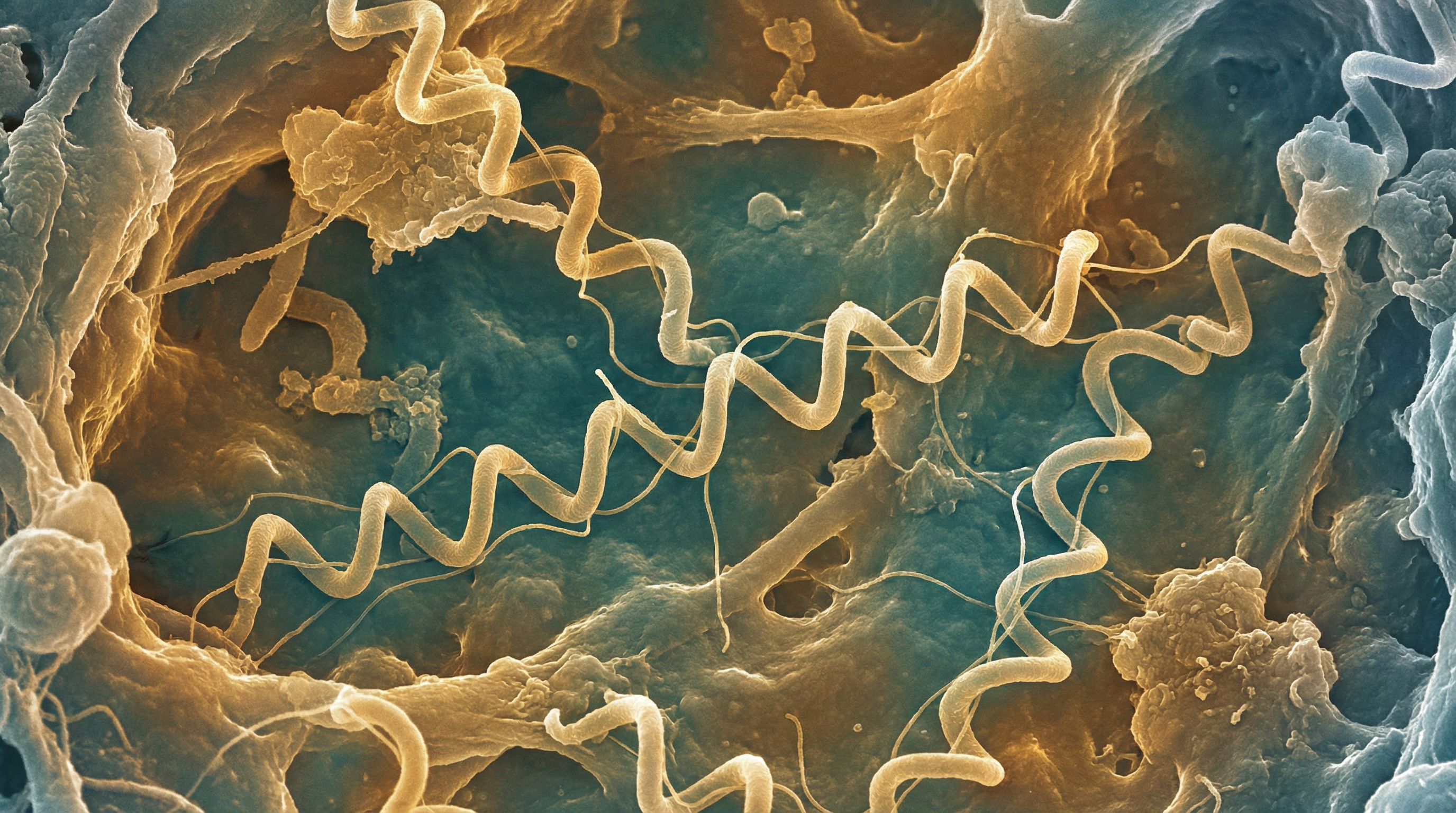
Treponema pallidum is a gram-negative, spiral-shaped bacterium belonging to the phylum Spirochaetes. It is the causative agent of syphilis, a multi-stage sexually transmitted infection. T. pallidum has several distinctive characteristics:
- Helically coiled, corkscrew-shaped morphology (6-15 μm long and 0.1-0.2 μm wide)
- Motile with characteristic rotation about its longitudinal axis and flexing movements
- Extremely thin, making it invisible under conventional light microscopy but visible using dark-field microscopy
- Fastidious organism with narrow optimal ranges of pH (7.2-7.4), redox potential (-230 to -240 mV), and temperature (30-37°C)
- Highly sensitive to environmental conditions, being rapidly inactivated by heat, cold, desiccation, and most disinfectants
- Microaerophilic (requires low oxygen levels)
- Long generation time of approximately 30 hours
- Cannot be cultured in vitro on artificial media, a major obstacle to research
T. pallidum is classified into three subspecies: T. pallidum subsp. pallidum (causing venereal syphilis), T. pallidum subsp. pertenue (causing yaws), and T. pallidum subsp. endemicum (causing endemic syphilis). Among these, T. pallidum subsp. pallidum is considered the most virulent due to its ability to cross blood-brain and maternal-fetal placental barriers.
Role in Human Microbiome
Unlike many other bacteria in the human microbiome, T. pallidum is not considered a normal commensal organism. It functions exclusively as a pathogen in humans, who are its only known natural host. The bacterium primarily affects the genital tract during initial infection but can disseminate throughout the body via the bloodstream.
While nonpathogenic treponemes may be part of the normal flora of the intestinal tract, oral cavity, or genital tract, T. pallidum itself is not part of the normal human microbiome. Its presence always indicates an active infection or disease state.
T. pallidum has evolved specialized mechanisms to survive within the human host, including:
- Ability to adhere to host cells and extracellular matrix as a crucial initial step of infection
- Capacity to penetrate tissues and vascular barriers throughout the body
- Remarkable immune evasion strategies that have earned it the designation "the stealth pathogen"
Health Implications
T. pallidum causes syphilis, a multi-stage infection with diverse clinical manifestations that has earned it the reputation as "the great imitator" due to its ability to mimic many other disorders. The stages of syphilis include:
Primary Syphilis: After an incubation period of 10-90 days, a painless ulcer (chancre) develops at the site of inoculation, accompanied by regional lymphadenopathy.
Secondary Syphilis: Following dissemination, symptoms include skin rashes (particularly on palms and soles), mucocutaneous lesions, generalized lymphadenopathy, and systemic symptoms like fever and malaise.
Latent Syphilis: An asymptomatic period that can last for years, divided into early latency (first 4 years, when relapses may occur) and late latency.
Tertiary Syphilis: Can affect almost any tissue, with manifestations including:
- Cardiovascular syphilis (aortitis, aneurysms)
- Neurosyphilis (meningeal, meningovascular, or parenchymatous forms)
- Gummatous syphilis (destructive granulomatous lesions)
Congenital Syphilis: Occurs when T. pallidum crosses the placenta to infect a fetus, resulting in stillbirth, neonatal death, or various congenital abnormalities.
The health impact of T. pallidum infection is significant, with untreated syphilis potentially leading to severe neurological damage, cardiovascular complications, and death. Additionally, syphilis infection increases the risk of HIV transmission and acquisition.
Metabolic Activities
T. pallidum has limited metabolic capabilities, which contributes to its obligate parasitic lifestyle. Key metabolic features include:
- Extremely small genome with limited metabolic genes
- Lacks genes for the synthesis of fatty acids, nucleotides, enzyme cofactors, and most amino acids
- Relies heavily on the host for nutrients and metabolic precursors
- Possesses transport systems to acquire essential nutrients from the host
- Utilizes carbohydrates as primary energy source through glycolysis
- Has limited tricarboxylic acid (TCA) cycle enzymes
- Lacks electron transport chain components for oxidative phosphorylation
- Generates ATP primarily through substrate-level phosphorylation
- Contains genes for a sodium-proton antiporter (Rnf complex) that may contribute to energy conservation
The bacterium's limited metabolic capabilities explain why it cannot be cultured in vitro and requires close association with host tissues for survival and replication.
Clinical Relevance
T. pallidum remains a significant global health concern. According to WHO estimates, approximately 11 million people worldwide acquire syphilis annually, with mother-to-child transmission occurring in nearly 2 million pregnancies.
Clinical relevance includes:
Diagnosis: Relies on a combination of:
- Direct detection methods (dark-field microscopy, PCR)
- Serological tests (non-treponemal tests like RPR and VDRL; treponemal tests like FTA-ABS and TPPA)
- Clinical manifestations
Treatment: Penicillin remains the treatment of choice for all stages of syphilis. The type, dose, and duration depend on the stage and clinical manifestations:
- Primary, secondary, and early latent: Benzathine penicillin G as a single intramuscular dose
- Late latent or tertiary: Three doses of benzathine penicillin G at weekly intervals
- Neurosyphilis: Intravenous aqueous crystalline penicillin G for 10-14 days
Prevention: Strategies include:
- Safe sex practices and condom use
- Regular screening of high-risk populations
- Partner notification and treatment
- Screening of pregnant women to prevent congenital syphilis
Public Health Significance: Syphilis has seen a resurgence in recent decades, particularly among men who have sex with men and in conjunction with HIV co-infection. The emergence of macrolide-resistant strains has complicated treatment in some regions.
Interaction with Other Microorganisms
T. pallidum's interactions with other microorganisms are not as well-characterized as those of other bacteria due to difficulties in culturing it. However, several important interactions have been documented:
Interaction with the normal microbiota: T. pallidum can disrupt the established microbial community at infection sites, particularly in the genital tract.
Co-infection with HIV: Syphilis and HIV have a synergistic relationship:
- Syphilitic lesions facilitate HIV transmission and acquisition
- HIV infection may alter the clinical course of syphilis and response to treatment
- HIV-infected individuals may have a higher risk of neurological complications
Interaction with host immune cells: T. pallidum interacts with macrophages, dendritic cells, and T cells, but has evolved mechanisms to evade immune clearance:
- Extremely low density of surface-exposed proteins
- Antigenic variation through gene conversion
- Coating itself with host proteins to mask surface antigens
Biofilm associations: Some research suggests T. pallidum may associate with biofilms in certain contexts, though this area requires further investigation.
The bacterium's "stealth pathogen" nature is largely due to its unique outer membrane, which contains very few proteins, making it difficult for the immune system to recognize and target the organism.
Research Significance
T. pallidum has significant research importance for several reasons:
Model for immune evasion: Its remarkable ability to evade host immune responses makes it a valuable model for studying bacterial persistence.
Genomics insights: Comparative genomics of T. pallidum subspecies has provided insights into the evolution of bacterial pathogens and host adaptation.
Challenging research subject: The inability to culture T. pallidum in vitro has necessitated the development of innovative research approaches.
Vaccine development: Despite decades of research, no effective vaccine exists, making this an important area of ongoing investigation.
Diagnostic advances: Research on T. pallidum has led to improved diagnostic methods, including molecular techniques.
Public health significance: The resurgence of syphilis globally highlights the need for continued research on transmission, prevention, and treatment.
Recent research directions include:
- Molecular mechanisms of T. pallidum pathogenesis
- Genetic basis for the differences in invasiveness among treponemal subspecies
- Development of an animal model that better recapitulates human disease
- Novel approaches to culture T. pallidum in vitro
- Strategies for genetic manipulation of the organism
References
Radolf JD, Deka RK, Anand A, Šmajs D, Norgard MV, Yang XF. Treponema pallidum, the syphilis spirochete: making a living as a stealth pathogen. Nat Rev Microbiol. 2016;14(12):744-759.
Peeling RW, Mabey D, Kamb ML, Chen XS, Radolf JD, Benzaken AS. Syphilis. Nat Rev Dis Primers. 2017;3:17073.
Lafond RE, Lukehart SA. Biological basis for syphilis. Clin Microbiol Rev. 2006;19(1):29-49.
Ho EL, Lukehart SA. Syphilis: using modern approaches to understand an old disease. J Clin Invest. 2011;121(12):4584-4592.
Šmajs D, Norris SJ, Weinstock GM. Genetic diversity in Treponema pallidum: implications for pathogenesis, evolution and molecular diagnostics of syphilis and yaws. Infect Genet Evol. 2012;12(2):191-202.