

Pseudomonas aeruginosa
Pseudomonas aeruginosa is a gram-negative opportunistic pathogen and one of the leading causes of healthcare-associated infections worldwide. With a large genome (5.5-7 Mbp, >65% GC content) encoding remarkable metabolic versatility and an arsenal of virulence factors, this bacterium causes severe infections particularly in immunocompromised patients, those with cystic fibrosis, and individuals requiring mechanical ventilation or urinary catheters.[1]
Global Health Burden
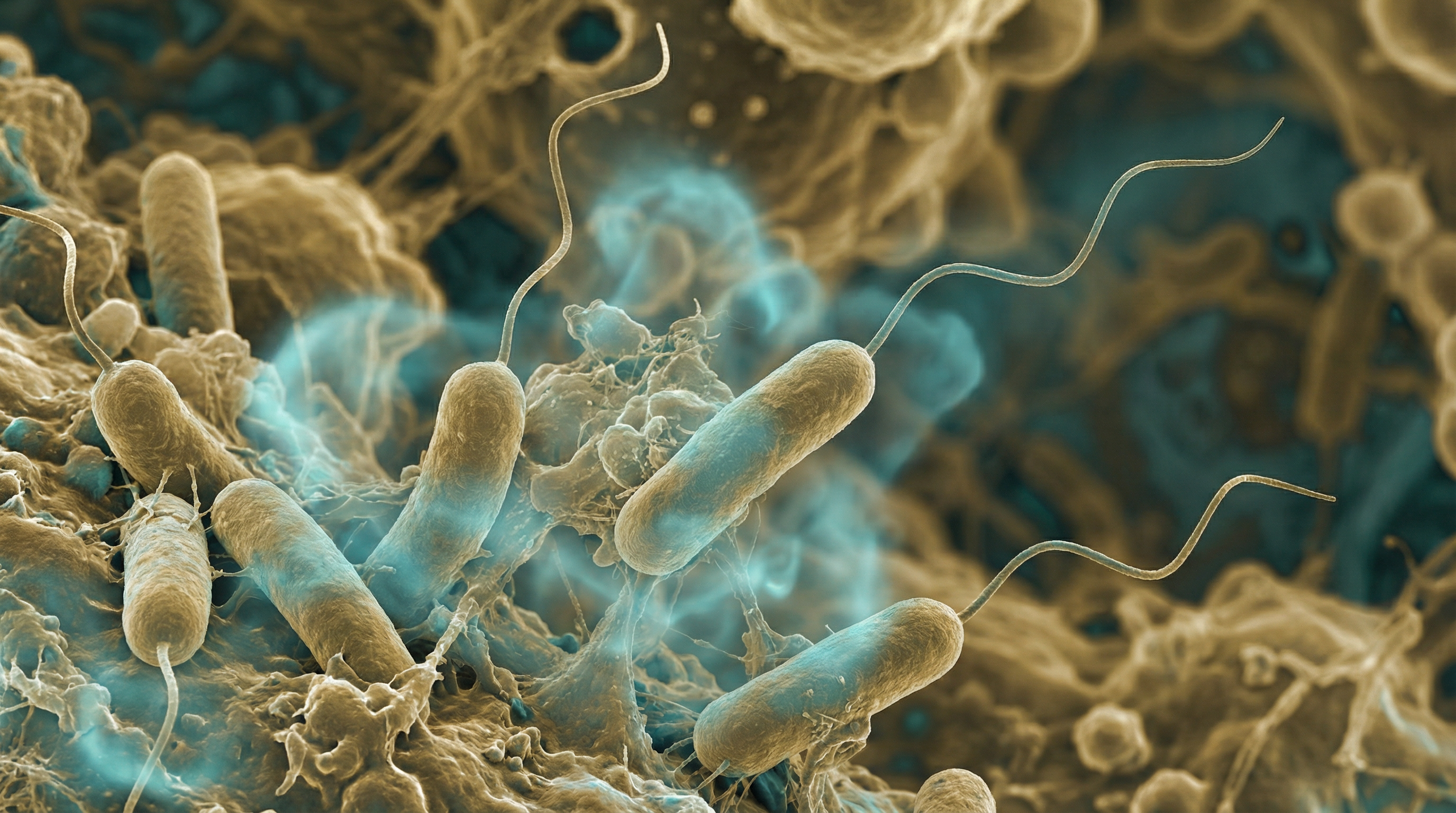
P. aeruginosa represents a critical public health threat:
- 4.95 million deaths associated with antimicrobial-resistant bacteria globally (2019)
- 32,600 MDR cases and 2,700 deaths in the US (2017)
- Healthcare costs of $767 million annually in the US alone
- Accounts for 7.1-9% of hospital-acquired infections in Europe and US
- Up to 23% of ICU-acquired infections[2]
Clinical Significance
Cystic Fibrosis
P. aeruginosa is the foremost cause of respiratory infections and mortality in cystic fibrosis (CF) patients:
- ~30,000 US patients and >70,000 worldwide have CF
- 75% of adult CF patients are colonized with P. aeruginosa
- 30% acquisition within 6 months; 70% by age 3 (by culture); 98% when including serology
- ~70% develop mucoid phenotype with median conversion age of 13 years
- 90% of CF deaths are attributed to pulmonary dysfunction
- Median predicted survival has improved to 65.6 years (2021)[3]
Ventilator-Associated Pneumonia (VAP)
P. aeruginosa is the leading cause of VAP (26% of cases globally):
- 69% mortality (significantly higher than APACHE II predicted 42.6%, p=0.037)
- Attributable mortality: at least 38%
- Initial antibiotic failure: 67%
- Persistent pneumonia: 35%[2]
Bloodstream Infections
P. aeruginosa bacteremia carries high mortality:
- Overall mortality: 34.5-58.8%
- XDR P. aeruginosa mortality: 41.1% vs 25.1% for non-XDR (p=0.03)
- Infection-related mortality: 37.5% (XDR) vs 17.1% (non-XDR, p=0.002)
- 52% of transplant patient BSIs occur within 3 months of transplant
Catheter-Associated UTIs
P. aeruginosa causes >10% of CAUTIs, which account for 30% of all healthcare-associated infections:
- Daily bacteriuria risk: 3-7% with catheterization
- Long-term catheterization: ~100% bacteriuria after 1 month
- Febrile episodes: 56× higher mortality
- Annual US healthcare costs: $340-370 million[4]
Antibiotic Resistance
Multidrug Resistance (MDR)
P. aeruginosa exhibits intrinsic and acquired resistance mechanisms:
- MDR rate: 9-30% depending on geographic area
- ICU resistance rates: Carbapenems 26.3%, Cephalosporins 26.5%, Fluoroquinolones 27.1%
- European resistance (2020): 30.1% resistant to at least one antibiotic; 17.3% to two or more
Extensively Drug-Resistant (XDR)
XDR P. aeruginosa represents an escalating threat:
- XDR prevalence: 3.7-22% of isolates
- XDR mortality: 35.1% among infected patients
- Treatment-specific mortality: Colistin 39.0%, Ceftazidime-avibactam 28.2%, Ceftolozane-tazobactam 18.8%
- Hematologic malignancy patients: 50% mortality[5]
Resistance Mechanisms
P. aeruginosa possesses multiple intrinsic resistance mechanisms:
- Outer membrane permeability: 12-100 fold lower than E. coli
- Efflux pumps: 12 RND-family systems expressed; 4 contribute to clinical resistance (MexAB-OprM, MexXY, MexCD-OprJ, MexEF-OprN)
- Carbapenem resistance: 15.26% prevalence; 100% show OprD mutations
- Carbapenemases detected: GES-5, OXA-101, IMP, VIM
Virulence Factors
Type III Secretion System (T3SS)
The T3SS injects effector proteins directly into host cells:
| Effector | Function | Prevalence | Clinical Impact |
|---|---|---|---|
| ExoU | Cytotoxic phospholipase A2 | 19-28% | 50% ICU isolates; 75% burn ward; RR 3.69 for death |
| ExoS | ADP-ribosyltransferase | 70-100% | Vaccine target |
| ExoT | Bifunctional enzyme | 96-100% | Contributes to invasion |
| ExoY | Adenylate cyclase | 80-100% | Disrupts cell signaling |
ExoU-positive strains show dramatically higher resistance:
- 81.4% fluoroquinolone non-susceptible (p=0.0003)
- 69.8% aminoglycoside non-susceptible (p=0.001)
- 76.7% are MDR/XDR strains[6]
Type VI Secretion System (T6SS)
P. aeruginosa uses three T6SS systems for bacterial competition and virulence:
- H1-T6SS: Exclusively antiprokaryotic; provides 10⁴-fold growth advantage in 48h
- H2-T6SS: Trans-kingdom activity; 67% mouse mortality at 36h (wild-type) vs 20% (mutant)
- H3-T6SS: Targets both prokaryotes and eukaryotes
Biofilm Formation
Biofilm formation is central to P. aeruginosa pathogenesis:
- 10-1,000× more antibiotic resistant than planktonic cells (some cases 10,000×)
- >50% of healthcare-acquired infections involve biofilms
- 20-60% mortality in biofilm-associated infections
- Composition: 97% water, <2% proteins, 1-2% polysaccharides
Quorum sensing systems (Las, Rhl, PQS, IQS) regulate biofilm development, with ~10% of the genome involved in quorum sensing regulation.[7]
Gut Colonization and the Gut-Lung Axis
Intestinal Colonization in ICU Patients
The gut serves as a reservoir for subsequent P. aeruginosa infections:
- 11.6% colonization on ICU admission
- 28.2% of colonized patients develop clinical infection (vs 4.2% of non-colonized)
- Infection risk ratio: 6.74 (95% CI: 4.91-9.25)
- Prior carbapenem use increases XDR risk (OR 4.88)[8]
Gut-to-Lung Translocation
P. aeruginosa can translocate from the intestinal tract to cause respiratory and systemic infections, particularly in critically ill patients. Antibiotic-induced dysbiosis promotes gut colonization by disrupting protective microbiota.
Treatment Options
New Beta-Lactam/Beta-Lactamase Inhibitor Combinations
Modern agents show improved activity against resistant strains:
| Agent | Overall Susceptibility | MDR/XDR Susceptibility | XDR Mortality |
|---|---|---|---|
| Ceftolozane-tazobactam | 97% | 55-96.6% | 18.8% |
| Ceftazidime-avibactam | 92-95% | 66-86.5% | 28.2% |
| Imipenem-relebactam | 91% | 80.5% restoration | - |
Inhaled Antibiotics for CF
Inhaled antibiotics achieve high airway concentrations with minimal systemic toxicity:
- Tobramycin inhalation: >70% eradication rate in new CF infections; 6.7% FEV1 improvement
- Aztreonam lysine (Cayston): Improvements in FEV1, symptom scores, bacterial density
- Levofloxacin inhalation: 79% reduction in need for additional antibiotics
Combination Therapy
Combination therapy shows no significant benefit over monotherapy for susceptible isolates (OR 1.21, p=0.55), though may benefit severe infections with resistant organisms.
Research and Emerging Therapies
Active research areas include:
- Bacteriophage therapy: 10 clinical trials underway/completed
- Vaccines: Flagellin vaccine in Phase III trials; IC43 (OprF/OprI) reached Phase III
- Quorum sensing inhibitors: SsoPox1 lactonase reduced mortality from 75% to 20% in rat models
- Catheter modifications: Liquid-infused silicone shows 99.55% reduction in bacterial colonization